Daijiworld Media Network – Tehran
Tehran, May 21: Iran has reportedly established a complex clearance mechanism for ships passing through the Strait of Hormuz, tightening its control over one of the world’s most crucial maritime oil routes amid rising regional tensions and global energy concerns.
According to a report, vessels crossing the strategic waterway are now subject to extensive scrutiny, security checks and in some cases government-level negotiations with Iranian authorities. The Strait of Hormuz handles nearly one-fifth of the world’s oil supply and remains a critical route for global energy trade.
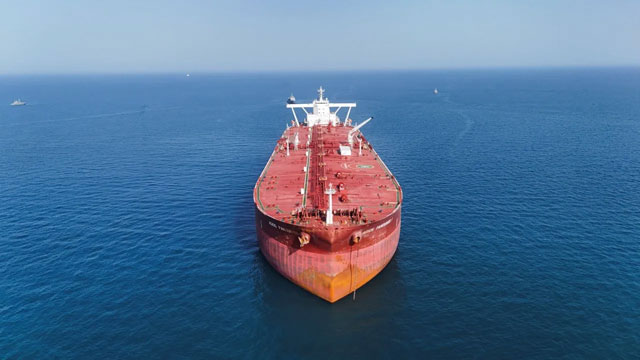
The development comes after escalating tensions in the Gulf region following recent military confrontations involving Iran, Israel and the United States.
One such vessel, the 330-metre-long oil tanker Agios Fanourios I, carrying Iraqi crude oil to Vietnam, reportedly underwent a tense and prolonged passage through the strait after receiving clearance through a direct arrangement between Iraq and Iran.
The vessel had been stranded near Dubai since late April before finally beginning its journey on May 10 along a route designated by Iranian authorities. During the transit, the tanker reportedly navigated between multiple Iranian-controlled checkpoints near islands including Abu Musa, Greater Tunb and Larak.
Sources cited in the report said the ship was briefly stopped near Hormuz Island by speedboats belonging to Iran’s Islamic Revolutionary Guard Corps (IRGC) over suspicions of smuggled cargo. After inspection and several hours of delay, the vessel was allowed to continue its journey.
Shipping and intelligence sources told that Iran has introduced a tiered system prioritising vessels linked to allies such as China and Russia, while other ships may require bilateral government arrangements or additional approvals for passage.
The report further claimed that some ship operators have allegedly been asked to pay security and navigation charges for safe passage, although Iran has not officially confirmed the practice. Under international maritime law, governments cannot charge ships simply for crossing international straits.
The United States has also warned shipping companies against making payments to Iranian entities, citing sanctions and restrictions linked to the Iranian government and the IRGC.
Documents reviewed reportedly showed that ships are required to submit detailed information including cargo value, ownership details, crew nationalities and voyage routes before receiving approval.
Indian shipping authorities are also said to be coordinating closely with Iranian officials for the safe movement of Indian vessels through the region. Reports stated that ships are instructed to follow designated routes strictly and comply with Iranian naval directions during transit.
The worsening situation has significantly disrupted maritime movement in the Gulf. According to maritime intelligence estimates cited in the report, fewer than 60 ships crossed the Strait of Hormuz between April 18 and May 6, compared to the usual daily average of 120 to 140 vessels.
Global shipping operators and sailors have reportedly expressed growing concern over safety risks, including fears of attacks, inspections and sea mines in the conflict-hit waters.
The situation has added further uncertainty to global oil markets and international shipping as tensions continue to rise in the region.