Mangalore IAS - Current Affairs 2026
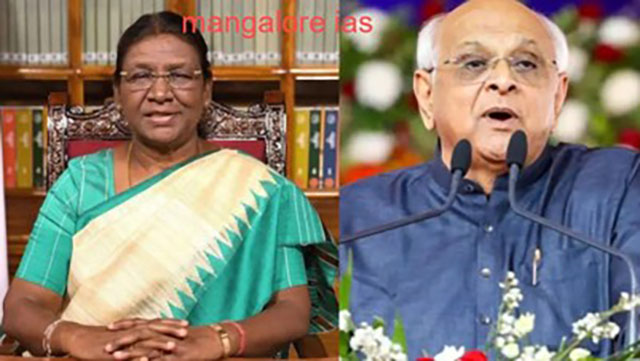
1. Gujarat Uniform Civil Code Bill 2026
President Droupadi Murmu has given her assent to the Gujarat Uniform Civil Code Bill, 2026, making Gujarat the second state in India after Uttarakhand to enact a state-level Uniform Civil Code. The President granted her approval on September 17, 2026, which was officially notified through the Gujarat Government Gazette published on October 1, 2026.
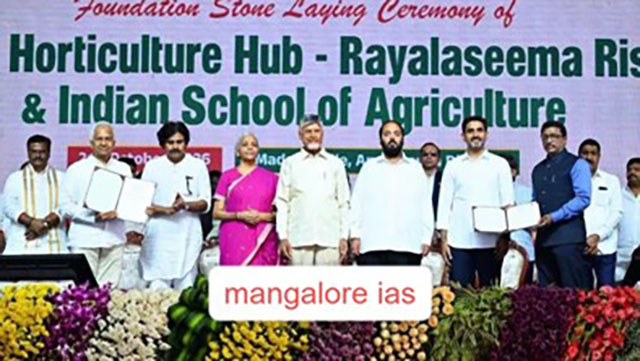
2. Global Horticulture Hub at Madanapalle
Andhra Pradesh has laid the foundation stone for the Global Horticulture Hub worth Rs 1 lakh crore at Madanapalle of Annamayya district on 2 October 2026. The project named Rayalaseema Rising is going to turn the drought-prone area of Rayalaseema into a global hub for the production, processing, and export of fruits and vegetables. It is going to involve three phases of development in 10 districts by developing 201 clusters in 303 mandals and 5,869 villages.
What Is the Global Horticulture Hub?
Global Horticulture Hub is an integrated horticulture development project to develop a full agricultural value chain in Rayalaseema. Cultivation and irrigation, rural connectivity, post-harvest facilities, food processing, marketing, and export all have been integrated within the project.
It is going to involve the project between August 2026 to July 2029 in three phases. Andhra Pradesh government has made a budget provision of Rs 40,352 crore for the project whereas Rs 60,000 crore is likely to be mobilized through private sector participation.
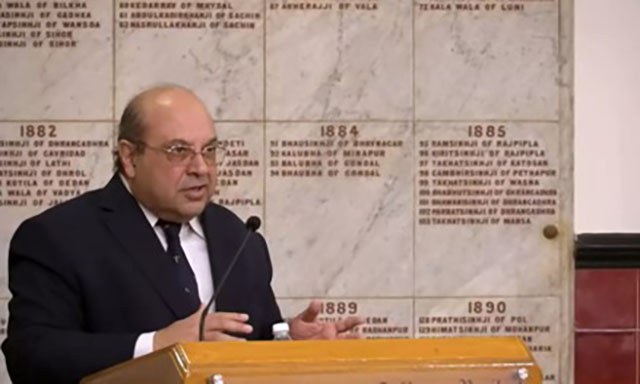
3. Former Supreme Court judge Justice Rohinton Fali Nariman laments that the removal of 90 lakh voters in Bengal did not move the Supreme Court enough to stay the SIR process.
"In West Bengal elections, 90 lakh voters were disenfranchised; that is an astounding figure. 90 lakh voters getting disenfranchised did not somehow move the Supreme Court enough to stay this. Out of those who were disenfranchised, some 22 lakh voters actually filed appeals. The others must be people who don't have the wherewithal for access to justice. And of these 22 lakh voters, some 1 lakh voter appeals were decided 93% in favour of the voters. So, you can imagine this was a completely illegal knocking out of the common man, the citizen of India, in order that a government obtains what it wants.
And in West Bengal, we saw, it ousted the Government of the day and brought in the Government of the Centre . Now, these are very very disturbing things that are happening in our country today."
4. Classical Languages
Classical Languages of India
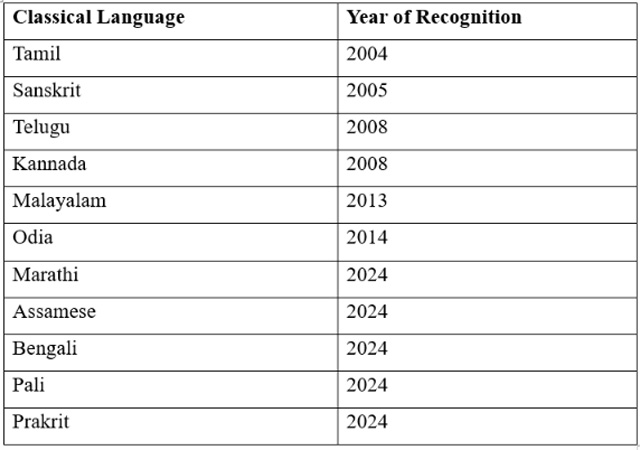
The current development is an addition to the list of Classical Language in India, which was extended in 2024. On 3rd October, 2024, the Union Cabinet granted Classical Language status to Marathi, Pali, Prakrit, Assamese and Bengali, making the total of Classical Languages in India reach 11.
There were six languages which had been granted the status before this development, namely Tamil, Sanskrit, Telugu, Kannada, Malayalam and Odia. Tamil became the first Classical Language of India in 2004.
5. National Household Travel Survey
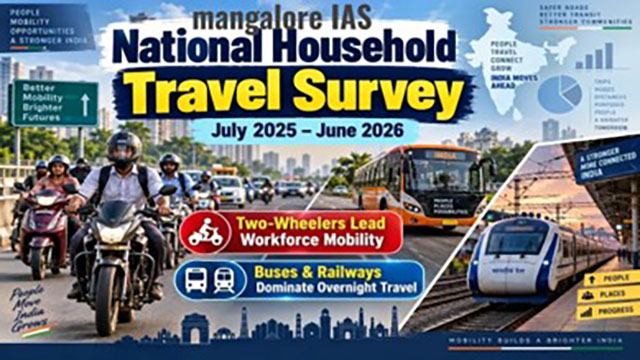
The National Household Travel Survey Factsheet released by the National Statistics Office (NSO) provides the first comprehensive data on daily domestic mobility across rural and urban India.
Overview and Methodology
1. Conduct Period: July 2025 – June 2026 (80th Round of the National Sample Survey).
2. Scope: Covered 14,274 villages and 10,377 urban blocks, surveying 4,92,023 households and 20,34,371 individuals.
3. Trip Definition: Any travel covering a distance of more than 1 km.
Key Findings on Student Commuting
1. Daily Travel: 66.4% of students aged 6 years and above travel over 1 km daily for basic education (65.6% in rural areas, 68.1% in urban areas).
2. Youth Participation: Students aged 15–29 record the highest regular trip participation at 79.1% (rural) and 73.3% (urban).
Modes of Transport:
• Walking: 37.0%
• Buses: 29.5%
• Bicycles: 15.8%
• Auto-rickshaws: 10.5% nationally (14.4% in cities)
Timing & Duration: Average travel time is 23 minutes, with 87.6% arriving within 30 minutes.
Key Findings on Workforce Commuting
Daily Travel: Over half of all workers aged 15 and above travel over 1 km to fixed or non-fixed workplaces (54.5% rural, 64.1% urban).
Modes of Transport:
• Two-wheelers: 42.6% (predominant mode)
• Public Transport: Only 9% of Indians use public transport primarily to get to work.
• Cars: A mere 3%.
Public Transport Surges: While metro, suburban rail, and trams account for 5% of urban commutes nationally, usage surges in Maharashtra (20.7%), West Bengal (16.5%), and Delhi (14.4%).
Commuting Costs: National average monthly expenditure is Rs 785 per worker. Urban workers spend Rs 1,044, which is 71% higher than rural workers at Rs 612.
6. Nobel Prize in Physics 2026
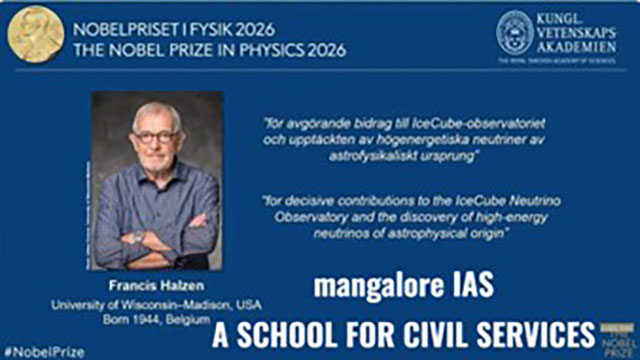
The Royal Swedish Academy of Sciences has awarded the Nobel Prize in Physics 2026 to physicist Francis Halzen for his pioneering work on the IceCube Neutrino Observatory and the discovery of high-energy neutrinos of astrophysical origin.
The prize citation states that Halzen was honoured “for decisive contributions to the IceCube Neutrino Observatory and the discovery of high-energy neutrinos of astrophysical origin.”
His work helped establish an entirely new way of observing the universe by using elusive particles known as neutrinos as cosmic messengers.
What are Neutrinos?
Neutrinos are extremely light, electrically neutral subatomic particles.
They are often called “ghost particles” because they interact only very weakly with matter. Trillions of neutrinos can pass through the human body every second without producing any noticeable effect.
Because they can travel vast cosmic distances without being significantly deflected or absorbed, neutrinos can carry information directly from some of the most energetic and distant regions of the universe.
This makes them valuable tools for studying phenomena that may be difficult to observe using ordinary light or other electromagnetic radiation.
Nobel Prize in Physics
The Nobel Prize in Physics is awarded by the Royal Swedish Academy of Sciences.
It is one of the original Nobel Prize categories established according to the will of Alfred Nobel.
The prize recognises discoveries and achievements that have made major contributions to physics and to humanity’s understanding of the natural world.
7. Nobel Prize in Chemistry 2026
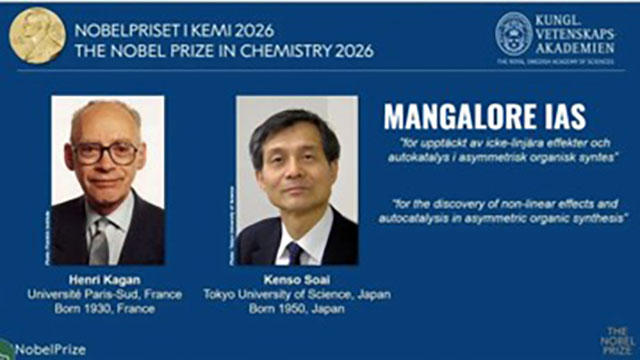
The Nobel Prize in Chemistry 2026 has been awarded jointly to Henri B. Kagan and Kenso Soai for their pioneering contributions to asymmetric organic synthesis.
The Royal Swedish Academy of Sciences honoured the two scientists “for the discovery of non-linear effects and autocatalysis in asymmetric organic synthesis.”
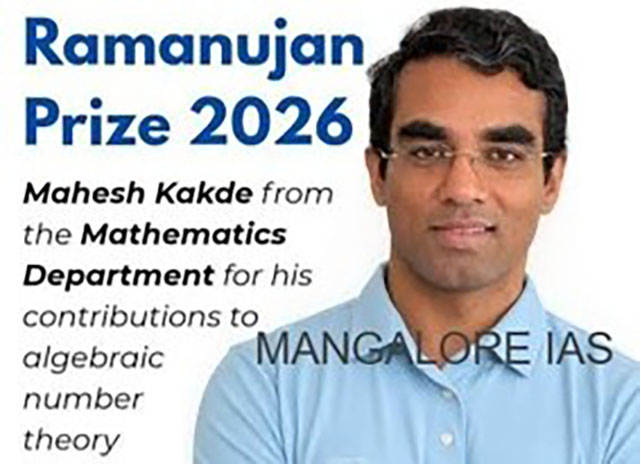
8. Ramanujan Prize for Number Theory
Indian mathematician Mahesh Kakde, a professor at the Indian Institute of Science (IISc), Bengaluru, has been awarded the 2026 Ramanujan Prize for Young Mathematicians from Developing Countries for his outstanding contributions to number theory.
The award recognises Kakde’s important research in algebraic number theory, particularly his work on Iwasawa theory, the Gross-Stark conjecture and the Brumer-Stark conjecture.
The Ramanujan Prize for Young Mathematicians from Developing Countries is awarded to outstanding mathematicians working in developing countries.
It is jointly awarded by:
- International Centre for Theoretical Physics (ICTP)
- International Mathematical Union (IMU)
The award is meant for mathematicians below the age of 45 who have made significant contributions to mathematical research while working in developing countries.
The prize was established in 2005 and carries a cash award of USD 10,000.
- Weekly Wisdom - October 3, 2026
- Weekly Wisdom - September 25, 2026
- Weekly Wisdom - September 18, 2026
- Weekly Wisdom - September 11, 2026
- Weekly Wisdom - September 4, 2026
- Weekly Wisdom - August 28, 2026
- Weekly Wisdom - August 16, 2026
- Weekly Wisdom - August 7, 2026
- Weekly Wisdom - August 1, 2026
- Weekly Wisdom - July 25, 2026
- Weekly Wisdom - July 18, 2026
- Weekly Wisdom - July 11, 2026
- Weekly Wisdom - July 3, 2026
- Weekly Wisdom - June 26, 2026
- Weekly Wisdom - June 19, 2026
- Weekly Wisdom - June 12, 2026
- Weekly Wisdom - June 5, 2026
- Weekly Wisdom - May 29, 2026
- Weekly Wisdom - May 22, 2026
- Weekly Wisdom - May 15, 2026
- Weekly Wisdom - May 8, 2026