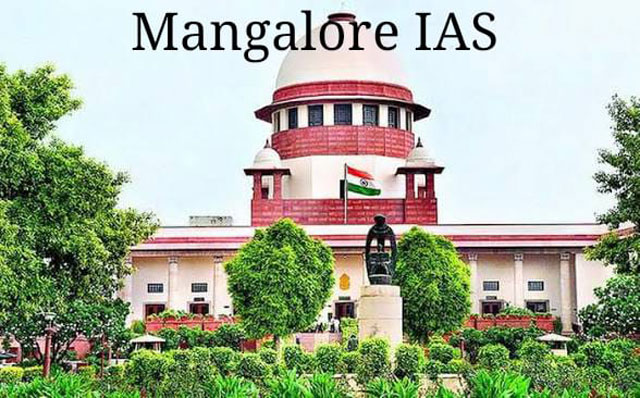
Centre Approves Proposal to Increase Supreme Court Judge Strength to 37
Union Cabinet on 5th May, 2026 approved a proposal to increase the strength of the Supreme Court from 34 to 38 judges. At present, the Supreme Court has an approved strength of 34 judges including the Chief Justice of India (CJI). This new proposal will be introduced in the Parliament through the Supreme Court (Number of Judges) Amendment Bill, 2026. This decision is expected to improve the efficiency of the top court and faster disposal of pending cases.
Supreme Court Amendment Bill 2026 Key Highlights
The Supreme Court (Number of Judges) Amendment Bill, 2026 seeks to amend the existing Supreme Court (Number of Judges) Act, 1956.
Over the years India’s Supreme Court has witnessed the steady rise in the number of pending cases. As the increasing litigation and complex constitutional matters the workload of judges has grown day by day. After the addition of four more judges is expected to strengthen judicial capacity and improve the speed of justice delivery.
The larger bench strength will help in quicker constitution of benches, faster hearings and timely disposal of cases. It will also reduce the work load pressure on existing judges and improve the overall functioning of the judiciary.
Constitutional Provision Behind Supreme Court Strength
Under the Article 124(1) of the Constitution of India have the provision about the composition of the Supreme Court. It states that Supreme Court shall consist of the Chief Justice of India and such number of judges as Parliament may prescribe by the law.
Initially, the Constitution had allowed a maximum of seven judges apart from the Chief Justice. After time by time with the growth of population, legal disputes, and constitutional responsibilities and Parliament has amended the law several times to increase the court’s strength.
How SC Judge Strength Has Increased Over Time?
Earlier, the original Supreme Court (Number of Judges) Act, 1956 fixed the number of judges at 10 excluding the Chief Justice.
In the year 1960 the strength was increased to 13 judges. It was further expanded to 17 in 1977.
Later strength was rose to 25 via 1986 amendment and then 30 through the 2008 amendment. The last major increase came in 2019 when the strength was raised from 30 to 33 judges.
The latest proposal of 2026 will increase the number to 37 marks another important step in judicial reforms.
Q1) Who has the power to increase the number of judges in the Supreme Court of India?
A) President
B) Governor of all states
C) Parliament
D) Prime Minister and Chief minister
E) Law minister
Q1) The recent proposal to increase the sanctioned strength of Supreme Court judges to 37 is a necessary but insufficient step toward addressing the crisis of judicial pendency in India. Critically analyze." (250 words, 15 Marks)
Surya Kant, Chief Justice of India, has announced that Sikkim has become the country’s first fully paperless judiciary. The announcement was made at a national conclave in Gangtok, highlighting India’s push toward digital justice delivery. The transition aims to eliminate physical paperwork.
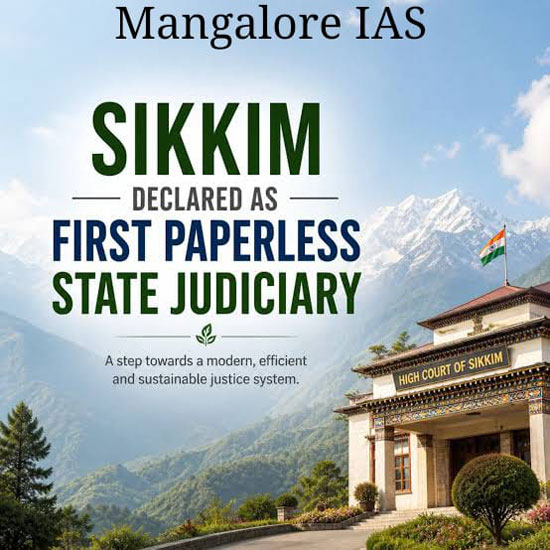
Q2). Which state has recently become the first in India to transition to a fully paperless judiciary?
A) Kerala
B) Sikkim
C) Goa
D) Telangana
Mains Practice Question
Q2) “The declaration of Sikkim as India’s first paperless judiciary marks a transformative shift from traditional physical courts to a digital-first justice system. Discuss the potential benefits and challenges of integrating technology like Artificial Intelligence (AI) and e-filing in the Indian judicial process. (150 words, 10 Marks)”
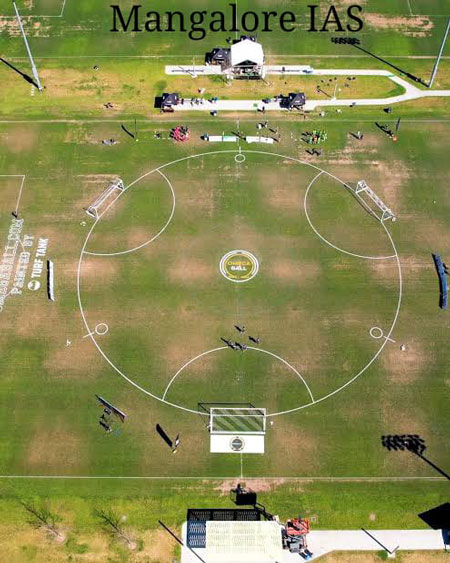
Indian Institute of Technology Madras Introduces ‘OmegaBall’, India’s First Three-Team Football Format.
Key Features of OmegaBall:
Gameplay: Three teams (5 players each: 4 outfield, 1 goalkeeper) play
simultaneously on a circular pitch.
Structure: Each team defends one goal and attacks two, with no offside rule, fostering constant movement.
Match Format: The game consists of three periods of 13 minutes each (39 minutes total).
Tournament: The inaugural tournament was organized by the IIT Madras Institute of Gymkhana and Office of Dean, featuring teams from IIT Madras and other Chennai-based colleges, including Loyola College and Savitha University.
Q3) In the newly introduced OmegaBall format, how many teams play on the field simultaneously?
A) Two teams
B) Three teams
C) Four teams
D) Five teams
Centre notifies new South Coast Railway Zone with HQ at Visakhapatnam
For the India Railway Infrastructure Union Government has officially notified the creation of the new South Coast Railway Zone. It will have headquarters at Visakhapatnam in Andhra Pradesh. This new railway zoe will become operational from June 1,2026. The move is expected to improve the railway administration and strengthen regional connectivity, will enhance the operational efficiency in Andhra Pradesh and surrounding regions. This new zone has been formed through the reorganization of the existing East Coast Railway and South Central Railway under the provisions of the Railways Act, 1989.
The South Coast Railway (SCoR) was carved out from parts of the South Central Railway and East Coast Railway to improve administrative efficiency in Andhra Pradesh. It consists of the Vijayawada, Guntur, Guntakal, and Visakhapatnam divisions.
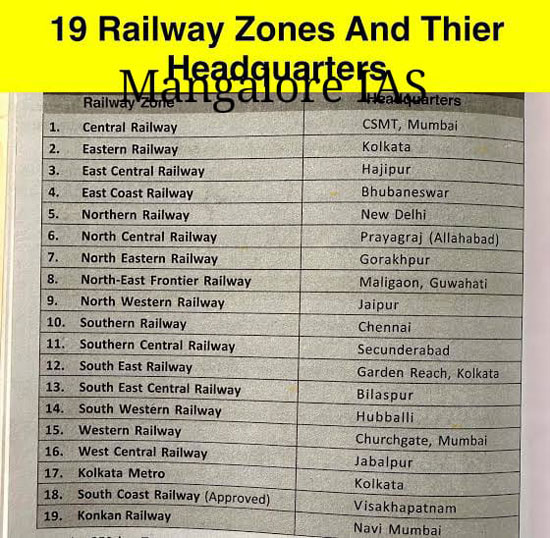
Q4). Which of the following is the newest (19th) operational Railway Zone in India, notified to commence full operations on June 1, 2026?
A. West Coast Railway (WCoR)
B. South Coast Railway (SCoR)
C. Central Coastal Railway (CCoR)
D. Andhra Railway Zone (ARZ)
Mains Practice Question
4Q) “In an era where Indian Railways is moving towards 'corporatization' and 'unified cadres' (IRMS), discuss the relevance of increasing the number of administrative zones." (250 words)
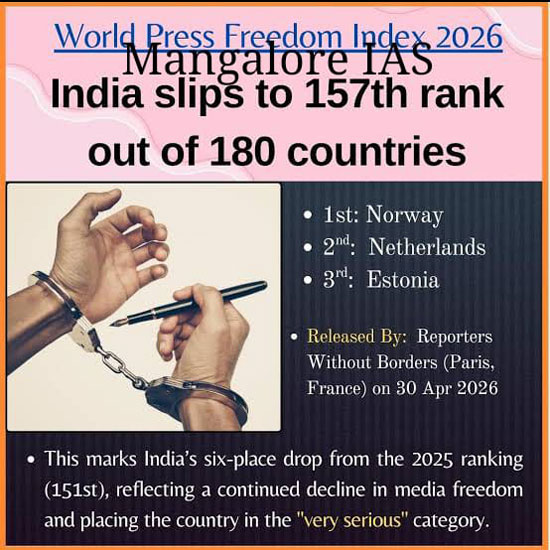
Global Press Freedom Hits Record Low in World Press Freedom Index 2026 Report
India has been ranked at 157th out of 180 countries in the latest World Press Freedom Index 2026. Press freedom has reached its weakest point in decades across the globe, according to the latest annual report by Reporters Without Borders. The group’s World Press Freedom Index, which evaluates 180 countries, recorded its lowest average score in the index’s 25-year history. For the first time ever more than half of the countries assessed fall into the ‘difficult’ or ‘very serious’ category.
The World Press Freedom Index evaluates the all countries based on these five key indicators.
1) Political environment
2)Legal framework
3)Economic conditions
4)Social context
5)Safety of journalists.
5Q) Which organization publishes the annual World Press Freedom Index?
A) Amnesty International
B) Reporters Without Borders (RSF)
C) United Nations (UN)
D) Freedom House
Mains question
“In the context of the 2026 World Press Freedom Index, discuss why a free press is considered the 'fourth pillar' of a democracy." (150 words)
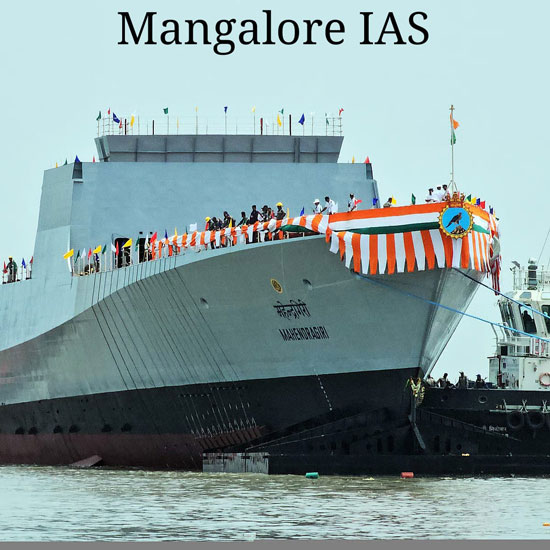
Recently, the INS Mahendragiri was delivered to the Indian Navy at Mazagon Dock Shipbuilders Limited (MDSL) Mumbai.
About INS Mahendragiri
It is the sixth ship of Nilgiri Class (Project 17A).
It was designed by Warship Design Bureau (WDB).
It was built at Mazagon Dock Shipbuilders Limited (MDSL) Mumbai.
Features of INS Mahendragiri
Propulsion: These ships are configured with Combined Diesel or Gas (CODOG) propulsion plants.
Comprising a diesel engine and a gas turbine that drive a Controllable Pitch Propeller (CPP) on each shaft, and state-of-the-art Integrated Platform Management System (IPMS)
Armaments: The potent weapon and sensor suite comprises anti-surface, anti-air, and anti-submarine warfare systems
What are Project 17A frigates?
These are versatile multi-mission platforms designed to address current and emerging challenges in the maritime domain.
The five already delivered to the Navy are INS Nilgiri, INS Himgiri, INS Udaygiri, INS Taragiri and INS Vindhyagiri.
Armaments: P17A ships are fitted with an advanced weapon and sensor suite like MF-STAR active phased array radar, BrahMos supersonic cruise missiles, and Barak-8 long-range surface-to-air missiles, designed for superior anti-air, anti- surface and anti-submarine warfare.
Q6) INS Mahendragiri, recently commissioned into the Indian Navy, is named after a mountain peak located in which state?
A)Maharashtra
B)Andhra Pradesh
C)Odisha
D)Tamil Nadu
Santa marta climate conference
The first International Conference on Transitioning Away from Fossil Fuels (TAFF), held April 24–29, 2026, in Santa Marta, Colombia, co-hosted by Colombia and the Netherlands, brought together 57 nations to develop practical, just, and equitable strategies for phasing out fossil fuels. It established a "coalition of the doers" to create actionable, post-COP28, ground-level policy roadmaps.
Key outcomes from the Santa Marta conference include:
- Focus on Action: Moving from mere ambition to managing the practical decline of fossil fuels, strengthening economic resilience, and diversifying energy systems.
- Thematic Pillars: Discussions centered on three pillars: overcoming dependence on fossil fuels, transforming supply and demand, and strengthening international cooperation and diplomacy.
- Global Participation: Despite the absence of major emitters like China, India, and the US, attendees represented countries accounting for nearly 50% of global GDP.

Q. Consider the following statements regarding the first International Conference on Transitioning Away from Fossil Fuels (TAFF), held in April 2026:
- It was co-hosted by Colombia and the Netherlands in Santa Marta, Colombia.
- The conference concluded with a legally binding international agreement for the immediate phase-out of all fossil fuel subsidies by 2030.
- Major emitters, including the United States, China, and India, were active participants and signatories to the final roadmap.
- The conference outcomes are intended to feed into the COP30 Presidency’s roadmap and the second Global Stocktake under the Paris Agreement.
Which of the statements given above are correct?
A) 1 and 2 only
B) 2 and 3 only
C) 1 and 4 only
D) 1, 3, and 4 only
India new AI tool “abhay”
The Central Bureau of Investigation (CBI) launched "Abhay," an AI-powered chatbot, in April 2026 to combat rising digital arrest scams and fake notice frauds in India. Developed to enhance cyber safety, the tool allows citizens to verify the legitimacy of alleged CBI notices, preventing financial extortion and building public confidence against online scams.
Key Aspects of the Abhay AI Tool:
- Purpose: To tackle the rising menace of "digital arrest" scams and impersonation of law enforcement agencies.
- Launch: Inaugurated by Chief Justice of India (CJI) Surya Kant at the 22nd D.P. Kohli Memorial Lecture, as mentioned in.
- Functionality: Citizens can use the chatbot to instantly verify if a notice, summons, or email purportedly from the CBI is authentic or fraudulent.
- Significance: It serves as a rapid response tool against cybercrimes, designed to prevent criminals from coercing the public with fake legal threats.
- Background: The initiative aims to address a critical gap between increasing cyber offenses and institutional response times.
Q. With reference to the ‘Abhay’ tool, recently seen in the news, consider the following statements:
- It is an AI-powered chatbot launched by the Central Bureau of Investigation (CBI).
- Its primary objective is to help citizens verify the authenticity of official notices and summons to prevent "digital arrest" scams.
- It was developed in collaboration with the International Criminal Police Organization (Interpol) to track cross-border cybercriminals.
Which of the statements given above is/are correct?
A) 1 and 2 only
B) 2 and 3 only
C) 1 and 3 only
D) 1, 2, and 3
Women reservation bill 2026
The Constitution (131st Amendment) Bill, 2026, aimed to implement 33% women's reservation in the Lok Sabha and State Assemblies by increasing the Lok Sabha seats to 850, was defeated in the Lok Sabha on April 17, 2026, failing to reach the required two-thirds majority (298 for, 230 against). The Bill linked this quota to a new delimitation process based on the upcoming census.
Key Proposed Changes
- Seat Expansion: The Bill proposed increasing the number of Lok Sabha seats from 543 to 850 to accommodate the reservation without reducing seats for male representatives.
- Delinking from New Census: The 2023 Act required reservation to wait for the first census after 2026. The 2026 Bill sought to bypass this by using the 2011 Census for immediate delimitation.
- Implementation Goal: The aim was to ensure the 33% quota would be active for the 2029 General Elections, rather than waiting until 2034.
Constitutional amendments in India are formal changes to the constitution (Article 368) aimed at adapting to new circumstances, requiring a special majority in Parliament, though some provisions require ratification by state legislatures. The process balances flexibility and rigidity, with the Supreme Court's "Basic Structure" doctrine prohibiting alterations to the constitution's core principles. [1, 2, 3, 4]
Key Aspects of Indian Constitutional Amendments:
- Procedure (Article 368): Amendments are initiated by Parliament, not state legislatures. A bill must pass each house by a special majority, and in some cases, ratified by half the state legislatures.
- Types of Amendments:
- Simple Majority: Similar to ordinary legislative processes.
- Special Majority: Majority of total membership of each House and a majority of not less than 2/3 of members present and voting.
3. Special Majority + State Ratification: Necessary for changing federal structures (e.g., election of President, Supreme Court/High Courts powers).
Limitations: The Parliament cannot alter the "Basic Structure" of the Constitution, a doctrine established in the 1973 Kesavananda Bharati case.
With reference to the Constitution (131st Amendment) Bill, 2026 and the Nari Shakti Vandan Adhiniyam (2023), consider the following statements:
- With reference to the Constitution (131st Amendment) Bill, 2026 and the Nari Shakti Vandan Adhiniyam (2023), consider the following statements:
- The Nari Shakti Vandan Adhiniyam provides for a 33% reservation for women in the Lok Sabha, State Legislative Assemblies, and the Delhi Legislative Assembly.
- A Constitutional Amendment Bill requires a special majority in both Houses of Parliament and ratification by at least half of the State Legislatures to be enacted.
Which of the statements given above is/are correct?
A) 1 and 2 only
B) 2 only
C) 2 and 3 only
D) 1, 2, and 3
Mains Practice Question
"Explain the key features of the Nari Shakti Vandan Adhiniyam (2023) and discuss its significance for women's empowerment in India." (150 words, 10 Marks)
"The recent legislative attempt to fast-track women's reservation by linking it with immediate delimitation highlights the complex interplay between demographic justice and federal stability in India. Critically analyze." (250 words, 15 Marks)
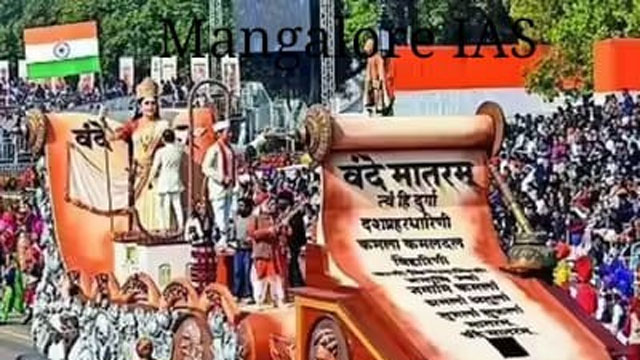
Vande Mataram' getting same legal status as national anthem
The Union Cabinet has approved a proposal to amend the Prevention of Insults to National Honour Act, 1971 to grant the national song 'Vande Mataram' the same legal status as the national anthem, 'Jana Gana Mana'. This means intentional disruption or insults to 'Vande Mataram' could result in up to three years of imprisonment or fines.
Key Details of the Decision
- Legal Protection: The amendment places 'Vande Mataram' under the same legal framework as the national anthem, national flag, and the Constitution, making disrespect a punishable, cognizable offence.
- Context: The decision comes as India marks 150 years since the song was written by Bankim Chandra Chattopadhyay in 1875.
- Guidelines: The Home Ministry has directed that all six stanzas of 'Vande Mataram' should be sung at official events, and it should be performed before the national anthem when both are included.
- Mandatory Standing: Reports indicate that standing in attention will be required during the singing or playing of the song, similar to the national anthem.
This decision aims to ensure that 'Vande Mataram' is accorded the same respect as the National Anthem, following its significance as a symbol of India's freedom struggle.
Q. With reference to the National Anthem and the National Song of India, consider the following statements:
- The National Song 'Vande Mataram' was originally composed in Sanskrit by Bankim Chandra Chattopadhyay.
- Under the Prevention of Insults to National Honour Act, 1971, 'Vande Mataram' and 'Jana Gana Mana' now enjoy the same legal protection against intentional disruption.
- The National Anthem was first sung at the Calcutta Session of the Indian National Congress in 1896.
Which of the statements given above is/are correct?
A) 1 and 2 only
B) 2 and 3 only
C) 1 and 3 only
D) 1, 2, and 3