Mangalore IAS - Current Affairs 2026
1. PM-VBRY Scheme
The Pradhan Mantri Viksit Bharat Rozgar Yojana (PM-VBRY) offers the employment incentive of up to Rs 15,000 for eligible the first-time employees who joins India’s formal employment sector. The programme is run by the Employees’ Provident Fund Organisation (EPFO) and seeks to promote formal employment and social security coverage. For eligibility, employees have to meet certain criteria related to past provident fund membership, salary, joining date, and bank account information. The incentive is payable in two installments, where the second installment is conditional on undertaking a financial literacy course.
What Is the PM-VBRY Scheme?
Pradhan Mantri Viksit Bharat Rozgar Yojana (PM-VBRY) is an employment-linked incentive scheme that encourages employment creation and formal employment for workers.
There are two parts to this scheme:
- Part A – Employee incentive: Offers incentive of up to Rs 15,000 to eligible first-time employees.
- Part B – Employer incentive: Promotes creation of more formal jobs by eligible employers through financial incentives for qualifying new employees.
2. Global Hunger Index 2026
India ranks 100th out of 122 countries with sufficient data in the 2026 Global Hunger Index (GHI) released on October 14, 2026.
Key Details from the 2026 Report
- GHI Score: India scored 24.1, placing it in the "serious" hunger category.
- Regional & Global Context:
• The South Asia regional GHI score is 23.5.
• The global average GHI score is 18.1 ("moderate" hunger).
- Child Nutrition Indicators:
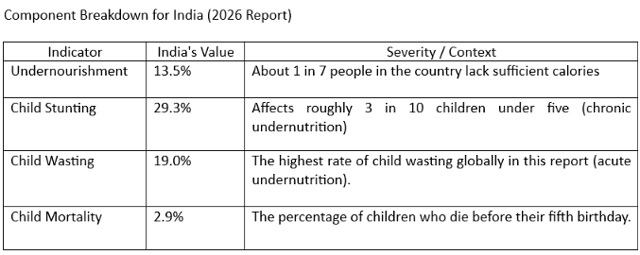
• Child stunting (low height for age) dropped from 50.0% in 2000 to 29.3% in 2026, though it still affects roughly 3 in 10 children under five.
• Child wasting (low weight for height, reflecting acute undernutrition) remains high at 19%.
- Comparison with Neighbors:
• Bangladesh ranks 84th.
• Pakistan ranks 106th with a score of 25.5.
The Global Hunger Index (GHI) scores are calculated based on four component indicators that together reflect the multidimensional nature of hunger:
- Undernourishment: The share of the population whose caloric intake is insufficient. This reflects the situation of the entire population (both children and adults).
- Child Stunting: The share of children under the age of five who have low height for their age. This reflects chronic undernutrition.
- Child Wasting: The share of children under the age of five who have low weight for their height. This reflects acute undernutrition.
- Child Mortality: The mortality rate of children under the age of five. This partially reflects the fatal mix of inadequate nutrition and unhealthy environments.
3. Index of Eight Core Industries
AI Mode conversation: Index of Eight Core Industries Grows 7.9% in September 2026
Index of Eight Core Industries Grows 7.9% in September 2026
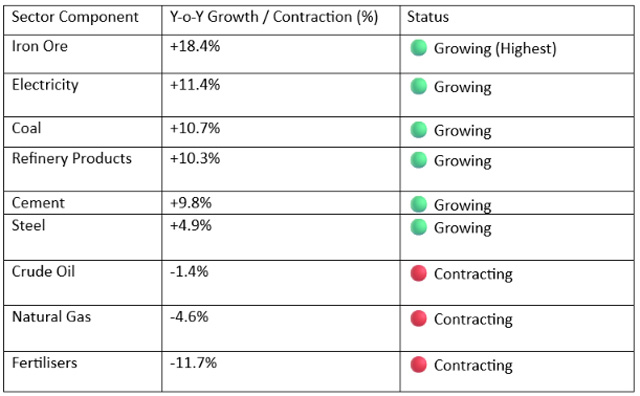
India's Index of Eight Core Industries (ICI) accelerated to a 30-month high of 7.9% year-on-year in September 2026, driven by a sharp rebound in infrastructure and industrial activity. According to provisional data released by the Ministry of Commerce and Industry on October 21, 2026, this figure marks a significant increase from the revised 5.9% growth recorded in August 2026, and 3.1% in September 2025. The cumulative growth for the first half of the fiscal year (April–September 2026) reached 5.1%, more than doubling the 2.5% expansion from the same period last year.
The industrial rally was primarily fueled by an expansion in six out of nine sectors under the updated core series index, which carries a 40.27% weight in the Index of Industrial Production (IIP).
"The Index of Eight Core Industries (ICI) serves as a vital lead indicator for industrial production in India. In light of the recent structural changes and uneven growth patterns across core sectors, critically analyze the challenges in sustaining India's manufacturing and infrastructure momentum." (15 Marks, 250 Words)
To score well, structure your answer using the following key dimensions:
- Introduction (approx. 40 words):
• Define the Index of Eight Core Industries (ICI) and mention its updated base year (2022-23).
• Briefly context-load with the latest data, noting that the index hit a 30-month high of 7.9% in September 2026, driven by sectors like iron ore, electricity, and coal.
- Body Paragraph 1: Significance as a Lead Indicator (approx. 60 words):
• Explain its 40.27% weight in the Index of Industrial Production (IIP).
• Highlight how it reflects the health of upstream, capital-intensive infrastructure industries that feed into downstream manufacturing.
- Body Paragraph 2: Core Growth Drivers vs. Areas of Concern (approx. 80 words):
• The Positives: Detail the massive expansion in heavy industries. Point out the double-digit growth in electricity (11.4%) and iron ore (18.4%) as clear indicators of robust urban and infrastructure demand.
• The Divergences: Analyze the hidden stress. Address the prolonged contraction in fertilisers (-11.7%), signaling sluggish rural/agricultural demand, alongside persistent declines in domestic crude oil and natural gas.
- Body Paragraph 3: Structural Challenges & Policy Remedies (approx. 50 words):
• Discuss structural hurdles like import dependency for crude oil, energy transition costs, and uneven rural economic recovery.
• Suggest policy corrections: accelerating green energy integration, enhancing raw material value-addition, and reviving rural purchasing power.
- Conclusion (approx. 20 words):
• Conclude with a forward-looking statement. Emphasize that while a 7.9% spike shows a powerful infrastructure push, achieving holistic economic growth requires bridging the gap between heavy infrastructure and primary sectors like agriculture.
4. AI Mode conversation: most unemployed degrees in india 2026
most unemployed degrees in india 2026
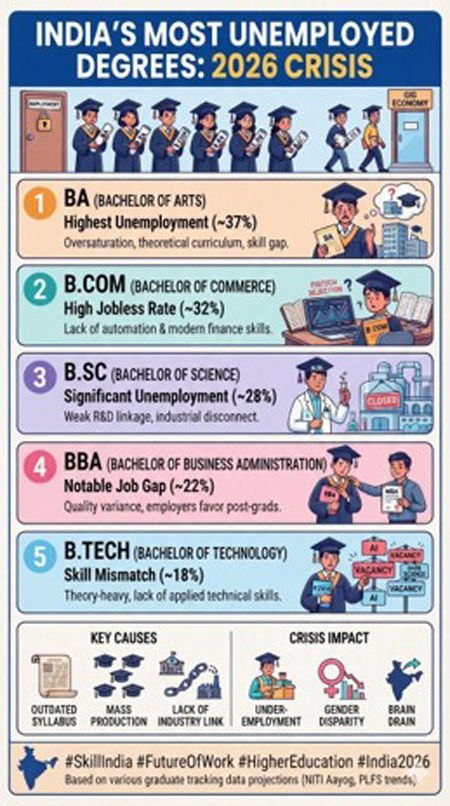
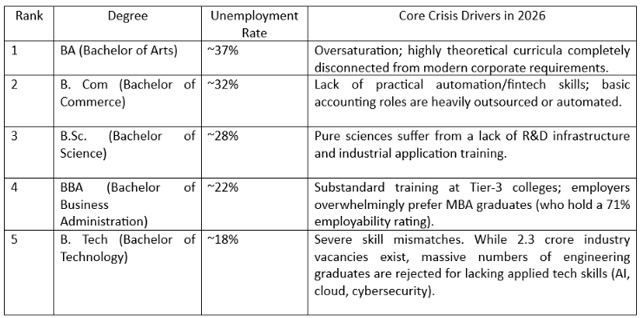
In 2026, India faces a severe graduate unemployment crisis, where higher educational qualifications paradoxically correlate with higher jobless rates. While the national unemployment rate hovers around 3.2% to 4.9%, multiple studies—including reports from NITI Aayog and Azim Premji University—reveal that graduate unemployment stands at over 13% overall, and spikes to nearly 40% for degree holders under the age of 25.
A major factor highlighted by NITI Aayog is the massive volume of students opting for general, non-technical degree programmes that lack market-aligned skills.
The Most Unemployed Degrees in India (2026)
According to current graduate tracking data, general arts and commerce streams suffer the highest unemployment rates, while technical and professional degrees face lower but still significant job-readiness gaps:
Key Takeaways from the 2026 Job Crisis
- The Skill Gaps vs. Job Shortage: Experts note that India is dealing with a job-readiness deficit rather than a absolute lack of vacancies. Only 42.6% of graduates possess immediately employable skills, mostly concentrated in Tier-1 institutions.
- Massive Underemployment: Over 90% of working graduates are employed in roles completely unrelated to their degrees. Many are forced into low-paying gig economy positions (e.g., delivery partners or quick-commerce agents) despite holding higher education certificates.
- Gender Disparity: The crisis hits educated women the hardest. According to data from the Periodic Labour Force Survey (PLFS), unemployment among graduate women is at 20.4%, which is significantly higher than their male counterparts
5. Shamonda Virus
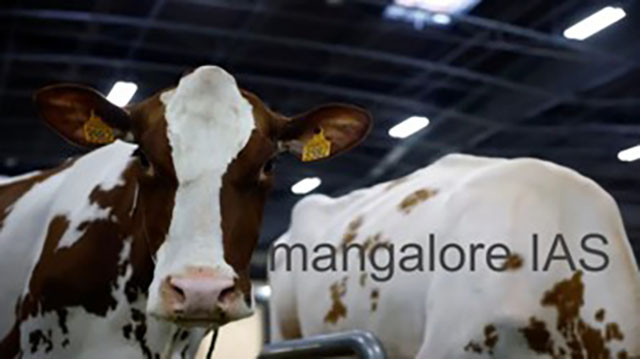
French health authorities confirmed the country’s first reported human case of Shamonda virus on 22 October 2026. The patient died after contracting the virus, which is primarily associated with livestock, particularly cattle.
Shamonda virus is an insect-borne virus transmitted by biting midges. Authorities said the leading hypothesis was that the patient had been infected in eastern France, where the virus had circulated among animals during spring and summer 2026.

6. SIMBEX-2026
The 33rd edition of the bilateral maritime exercise between Singapore and India (SIMBEX-2026) commenced on 21 October 2026 in Visakhapatnam, Andhra Pradesh. The joint exercise is being held between the Indian Navy and the Republic of Singapore Navy (RSN). This exercise seeks to enhance operational interoperability and coordination among other areas. The harbor phase will be held from 21-23 October while the sea phase will be held from 24-26 October in the Bay of Bengal. The naval ship RSS Supreme from Singapore has arrived for the exercise.
History of SIMBEX
SIMBEX was launched in 1994 under the name of Exercise Lion King. With the passage of time, it evolved into an important aspect of maritime cooperation between India and Singapore.
It has grown in scale and complexity and provided both navies with an opportunity to exchange experience, increase understanding and practice coordinated maritime operations.
This continuity highlights the growing significance of naval cooperation for the maintenance of maritime security and stability in the Indo-Pacific region.
Significance of SIMBEX-2026
India and Singapore have a common interest in safe maritime passages, maritime stability and rule-based order in the region. Conducting regular naval exercises allows them to develop trust and increase compatibility of their forces.
The following points highlight the significance of SIMBEX-2026,
Operational interoperability: Conducting joint exercises allows the navies to coordinate processes, communication and tactics.
Maritime security: Practice of ASW, ASUW and AAW will increase readiness for different situations at sea.
Indo-Pacific Cooperation: Conducting of the exercise will enhance defence relations between two countries which have common interests in maintaining peace and stability in the region.
7. Question
1. A train running at the speed of 60 km/hr crosses a pole in 9 seconds. What is the length of the train?
120 metres
180 metres
324 metres
150 metres
Answer:
Explanation:
Speed = 60 x 5 m/sec = 50 m/sec.
18 3
Length of the train = (Speed x Time). Train Speed Calculators
Length of the train = 50 x 9 m = 150 m.
Given:
Speed of train = 60 km/hr.
Time taken to cross a pole = 9 sec.
Formula:
=>Length of Train = Speed × Time.
Step 1: Convert speed into m/s.
=>60×(5/18).
=>(300/18).
=>(50/3) m/s.
Step 2: Calculate the length of the train:
Length= (50/3)×9.
=>50×3.
=>150 meters.
Another Shortcut Method:
=>60 ×(5/18) × 9
=>60 × (5/18) × 9
=>60 × (5/2)
=>30 × 5.
=>150 meters.

- Weekly Wisdom - October 18, 2026
- Weekly Wisdom - October 9, 2026
- Weekly Wisdom - October 3, 2026
- Weekly Wisdom - September 25, 2026
- Weekly Wisdom - September 18, 2026
- Weekly Wisdom - September 11, 2026
- Weekly Wisdom - September 4, 2026
- Weekly Wisdom - August 28, 2026
- Weekly Wisdom - August 16, 2026
- Weekly Wisdom - August 7, 2026
- Weekly Wisdom - August 1, 2026
- Weekly Wisdom - July 25, 2026
- Weekly Wisdom - July 18, 2026
- Weekly Wisdom - July 11, 2026
- Weekly Wisdom - July 3, 2026
- Weekly Wisdom - June 26, 2026
- Weekly Wisdom - June 19, 2026
- Weekly Wisdom - June 12, 2026
- Weekly Wisdom - June 5, 2026
- Weekly Wisdom - May 29, 2026
- Weekly Wisdom - May 22, 2026
- Weekly Wisdom - May 15, 2026
- Weekly Wisdom - May 8, 2026