Daijiworld Media Network - Mumbai
Mumbai, May 21: The iconic 7.5-acre Bandra Talao, a Grade II heritage waterbody in Mumbai’s Bandra area, has been completely dewatered for the first time in recent memory as part of a large-scale rejuvenation and restoration project.
The lake now appears as an exposed basin of mudflats and thick silt deposits, with excavation machinery and pumping systems actively removing sludge as part of Phase I of the restoration work. Officials said this stage involves complete dewatering followed by systematic desilting of the waterbody.
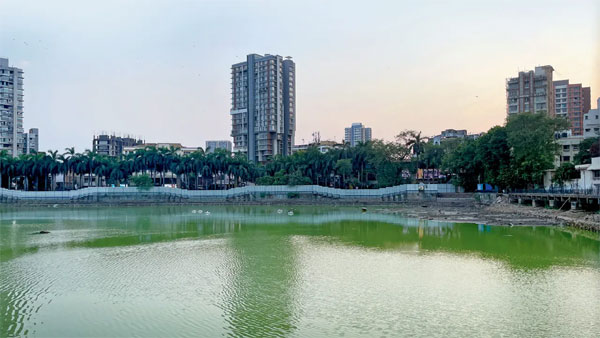
The project has been planned in multiple phases. While Phase I focuses on cleaning and desilting, Phase II will involve aesthetic development and public utility improvements around the lake’s perimeter.
According to civic officials, the waterbody has been under severe ecological stress for several years. Independent expert Milind Kulkarni, involved in preparing the detailed project report, said studies indicated a biochemical oxygen demand (BOD) level of around 100 mg/litre — significantly higher than the safe level of under 5 mg/litre for a healthy lake.
He said the findings suggest sewage seepage into the lake system, although there is no direct sewage inlet as the surrounding area is connected to the municipal sewerage network.
During the dewatering process, officials reported that no live aquatic species were found. Assistant Municipal Commissioner Dinesh Pallewad said only two dead turtles were recovered, underscoring the extent of ecological degradation.
Authorities also plan to construct a 1 million litres per day sewage treatment plant near the lake. The treated water will be reintroduced into the waterbody to improve circulation and address stagnation and low oxygen levels.
Ashish Shelar, who represents Bandra (West), said in a social media post that Bandra Talao is an important part of the area’s heritage and identity. He also directed officials to expedite the restoration work and ensure timely completion.
The desilting operation has been ongoing for nearly two weeks. Officials noted that earlier-installed aerators had become non-functional due to maintenance issues, power supply problems and long-term equipment damage.
However, former corporator Asif Zakaria questioned the justification for certain aspects of the project, arguing that the empty lake suggests limited sewage inflow. He said the deterioration could be linked more to long-term stagnation and lack of oxygenation rather than large-scale sewage discharge, raising questions about the necessity of an expensive treatment plant.