Daijiworld Media Network - Riyadh
Riyadh, Apr 2: A rare manuscript dating back nearly a thousand years has been unveiled in Saudi Arabia, offering valuable insights into early Qur’anic scholarship and classical Islamic studies.
The manuscript, titled “Gharib Al-Qur’an” (Rare Terms in the Qur’an), was revealed by the King Abdulaziz Public Library. It is attributed to renowned scholar Abu Ubaidah Ma'mar ibn al-Muthanna and dates to the 4th century AH.
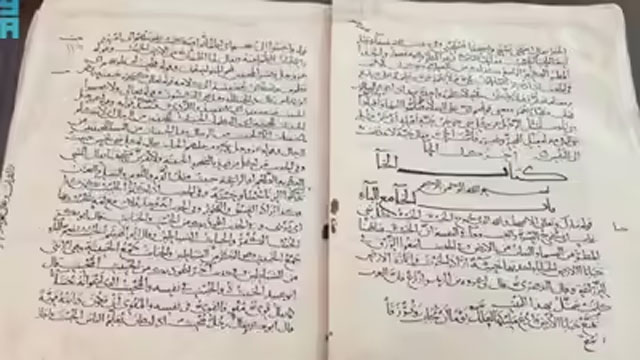
Comprising 23 folios measuring 17 by 22 centimetres, the manuscript is written in Andalusian script, while the names of surahs appear in Kufic script, reflecting a blend of classical calligraphic styles. The work remains unpublished and is considered a significant contribution to the study of Qur’anic vocabulary and interpretation.
The discovery forms part of a broader collection preserved by the library, which houses over 185 rare manuscripts related to Qur’anic exegesis and sciences. Among the notable works are I’rab Al-Qur’an wa Ma’anih by Abu Ishaq al-Zajjaj, Ta’wil Mushkil Al-Qur’an by Ibn Qutaybah al-Dinawari, and sections of Tafsir Al-Tabari by Al-Tabari.
The archive also includes Fi Ma’ani Al-Qur’an wa Tafsirih by Abu Bakr Muhammad al-Naqqash, along with several other classical texts covering grammar, linguistic analysis, recitation methods and interpretation of Qur’anic verses.
Officials said the manuscripts are systematically categorised into four main fields — exegesis (tafsir), recitations and tajwid, Qur’anic sciences, and original manuscripts or mushafs — providing a comprehensive resource for researchers.
By unveiling Gharib Al-Qur’an, the library aims to promote access to rare cultural and scholarly assets while encouraging deeper academic engagement with Islamic heritage. The initiative is also part of broader efforts to preserve historically significant manuscripts and make them available for future generations of scholars.