Daijiworld Media Network - New Delhi
New Delhi, Mar 11: Strategic competition in India’s neighbourhood is intensifying as China expands its influence across South Asia and the Indian Ocean through infrastructure projects, political engagement and technology partnerships alongside military power, Chief of Integrated Defence Staff Ashutosh Dixit said on Wednesday.
Addressing a seminar titled “Changing Dynamics in India’s Neighbourhood” in New Delhi, Air Marshal Dixit said China increasingly views India as a strategic competitor rather than a partner.
“China views India not as a partner but as a potential threat, a reality we can no longer afford to ignore,” he said.
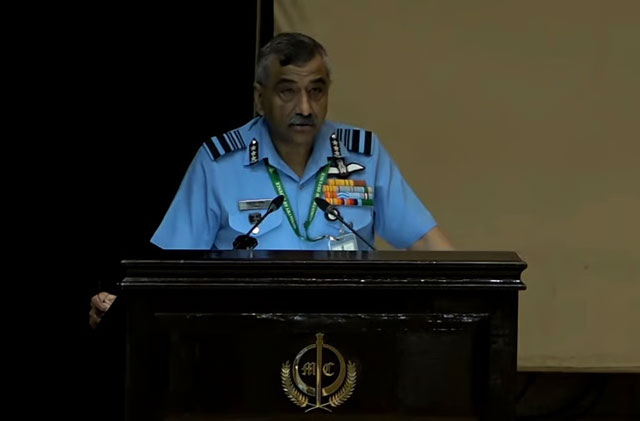
The official noted that India shares borders with two nuclear-armed adversaries, China and Pakistan, adding that the Indian Ocean, once considered relatively stable, has now become a theatre of intense geopolitical competition.
His remarks came a day after the Union Cabinet approved changes to India’s foreign direct investment policy governing investments from countries sharing land borders with India, including China, Pakistan and Bangladesh, aimed at streamlining approvals under the Press Note 3 framework introduced in 2020.
Air Marshal Dixit highlighted China’s Belt and Road Initiative projects across the region — including development of Gwadar Port and Hambantota Port — as creating a strategic network around India’s maritime periphery.
“These investments have stitched together a strategic footprint that now encircles India’s maritime domain,” he said, adding that the Indian Ocean is no longer a benign backyard but a competitive theatre.
The defence official cautioned that these projects should not be viewed as isolated infrastructure ventures but as part of a broader strategic design. “Every port updated, every road built, every political leader cultivated is a piece of a larger strategic puzzle,” he said, urging India to develop a coherent counter-strategy rather than reacting crisis by crisis.
Calling for a calibrated response, he emphasised the need to strengthen defence self-reliance and strategic partnerships. He said India must deepen the Aatmanirbhar Bharat push in defence sectors such as drones, air defence systems and semiconductors.
He also underlined the importance of the Quadrilateral Security Dialogue as a counterbalance to China’s regional ambitions, while managing economic decoupling from Chinese supply chains carefully to avoid unnecessary escalation.
Turning to Pakistan, Air Marshal Dixit said the country continues to pose a significant security challenge even after Operation Sindoor.
“Terrorism and military concentration remain instruments of Pakistani state policy,” he said.
He noted that Pakistan has announced the creation of an Army Rocket Force Command, modelled on Chinese missile forces, aimed at establishing a conventional deterrence capability capable of striking Indian military targets without crossing the nuclear threshold.
India, meanwhile, is also working on raising a rocket and missile force capable of operating conventional ballistic and cruise missiles along with multi-barrel rocket launchers, as announced earlier this year by Upendra Dwivedi.
The CISC also warned that recent constitutional changes in Pakistan have consolidated greater authority in the hands of the army chief, Asim Munir, potentially shortening escalation timelines during crises.
Air Marshal Dixit also pointed to emerging strategic shifts in Bangladesh following political changes in Dhaka. He noted Chinese-backed infrastructure development, expansion plans for Mongla Port and a joint China-Bangladesh drone venture in Bogra under the country’s Forces Goal 2030.
“These are not the decisions of an adversary, but those of a neighbour that no longer sees India as its default security provider,” he said, stressing the importance of sustained connectivity initiatives and engagement with Dhaka.
He added that the restoration of democratic politics in Bangladesh following the swearing-in of Tarique Rahman offered an opportunity to further strengthen bilateral ties between the two countries.