Daijiworld Media Network - Sydney
Sydney, Mar 29: Parts of Western Australia witnessed eerie, blood-red skies as powerful dust storms triggered by Tropical Cyclone Narelle swept across the region, creating dramatic visuals that stunned residents.
The phenomenon was most visible in Shark Bay and Denham, where strong cyclone winds lifted vast amounts of iron-rich red soil into the atmosphere. The dense dust particles scattered shorter blue wavelengths of light, allowing longer red wavelengths to dominate—resulting in a deep crimson glow that darkened the sky.
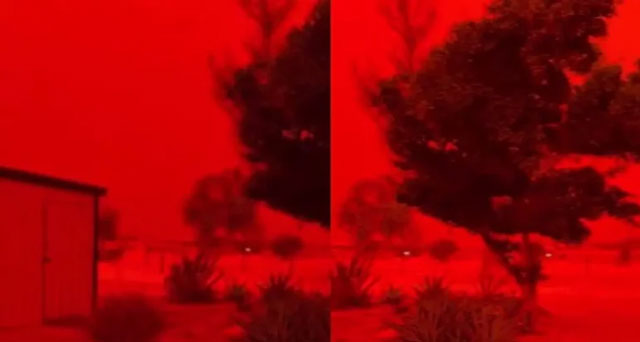
Residents reported daylight fading within minutes, with visibility dropping to near zero and the air turning thick with dust. The impact was felt across the Gascoyne region and extended to the Pilbara coast, including towns like Exmouth and Karratha.
Videos of the surreal skies quickly went viral, sparking debate online, with some users questioning their authenticity. However, locals clarified the visuals were real, often adding “no filter” captions to counter claims of digital enhancement.
Cyclone Narelle has been described as a rare “triple-strike” system. It initially hit Queensland’s Cape York Peninsula on March 20, moved through the Northern Territory, and later re-intensified over the Indian Ocean before making landfall in Western Australia.
At its peak, the cyclone reached Category 4 intensity, with wind gusts exceeding 200 km/h, causing structural damage including torn roofs in coastal towns such as Exmouth and Coral Bay. As of March 29, the system has weakened to Category 3 and is expected to further downgrade into a subtropical low as it moves southeast.
David Crisafulli noted that the storm brought some of the strongest winds experienced in parts of the state in years.
Experts say such red-sky events, while striking, are not unprecedented. A similar dust storm in 2009 turned Sydney’s skies orange. The phenomenon is largely driven by wind erosion, often worsened by dry conditions.
Despite the cyclone weakening, authorities have warned that conditions remain hazardous, with emergency alerts still in place across affected regions.