Daijiworld Media Network - Jerusalem
Jerusalem, Feb 25: Progress on the Gaza peace plan has stalled amid sharp disagreements over the disarmament of Hamas, with Israel warning it could return to full-scale war if the condition is not swiftly implemented.
The second phase of the US-brokered ceasefire, declared in January, envisaged Hamas laying down arms, Israeli forces withdrawing from Gaza, and a Palestinian interim administration taking charge of the enclave with the backing of a restructured police force and an international stabilisation force (ISF).
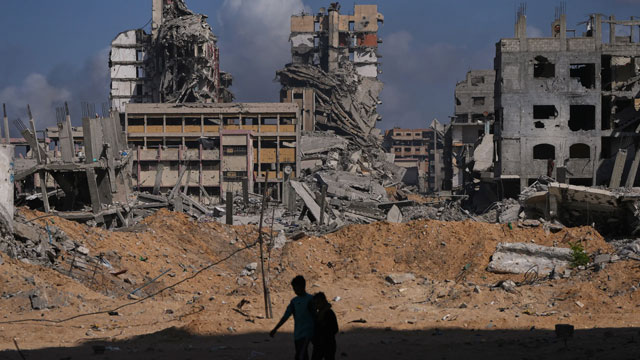
However, the 20-point framework — overseen by US President Donald Trump’s newly formed Board of Peace — remains vague on sequencing, triggering tensions between stakeholders.
The Israeli government is insisting that the complete disarmament of Hamas must precede any Israeli withdrawal or political transition. Israeli officials have indicated that Washington may soon issue a 60-day deadline for Hamas to comply.
Finance Minister Bezalel Smotrich said Hamas would soon face an ultimatum to “disarm and fully demilitarise Gaza,” warning that failure to comply would give the Israel Defense Forces (IDF) international legitimacy and American backing to resume operations.
Foreign Minister Gideon Saar reportedly told Israel’s security cabinet that Trump would deliver the ultimatum within days. However, the US president did not mention the issue in his recent State of the Union address.
Uncertainty also surrounds who would receive and oversee the surrender of Hamas’s weapons. The National Committee for the Administration of Gaza (NCAG), a group of 15 Palestinian technocrats meeting in Cairo, is preparing to assume governance but has yet to establish operational control in the territory.
A report in Israel Hayom claimed the NCAG may propose a phased six-month disarmament plan, beginning with heavy weapons and ending with light firearms. Hamas would reportedly be required to provide an inventory of its arsenal and disclose tunnel networks.
Analysts, however, described the plan as unrealistic. Michael Milshtein of Tel Aviv University said the proposal appeared more aspirational than actionable. Gaza analyst Muhammad Shehada of the European Council on Foreign Relations said Hamas would likely reject a plan requiring full disarmament without guarantees of Israeli withdrawal or parallel disarming of rival groups.
Efforts to assemble a 20,000-strong ISF have seen countries such as Indonesia, Morocco, Kazakhstan, Kosovo and Albania offer troops. However, its mandate remains undefined, and troop-contributing nations are reportedly reluctant to engage in forcible disarmament of Hamas.
Regional players including Egypt and Saudi Arabia are said to favour a phased decommissioning model similar to the Northern Ireland peace process, overseen by an independent commission.
Meanwhile, hardline voices within Israel have openly anticipated a collapse of the second phase. Smotrich said that in the long term Israel would occupy Gaza and establish a military government, asserting that renewed conflict was only a matter of time.
Observers warn that making the entire peace process conditional on Hamas’s immediate disarmament could derail the fragile ceasefire and push the region back into prolonged warfare, further deepening the humanitarian crisis in Gaza.