Daijiworld Media Network - Tehran
Tehran, Feb 25: As the United States assembles one of its largest military deployments in decades in the Middle East, anxious Iranians are bracing for a crucial round of negotiations with Washington in Geneva this week — talks widely viewed as a last opportunity to avert a potentially devastating conflict.
The high-stakes negotiations come against the backdrop of heightened tensions following US President Donald Trump’s 2018 withdrawal from the Iran nuclear deal and the reimposition of sweeping sanctions that have battered Iran’s economy.
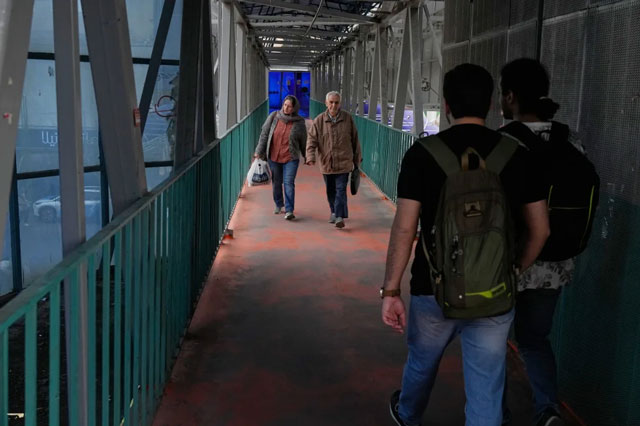
For many Iranians, the situation appears grim. The country recently witnessed one of the bloodiest crackdowns on dissent in its modern history, with security forces reportedly killing thousands and detaining tens of thousands during nationwide protests in January.
Despite the turmoil, Iranian Foreign Minister Abbas Araghchi struck a determined note ahead of Thursday’s talks in Geneva. In a post on X, he said Iran was entering negotiations “with a determination to achieve a fair and equitable deal — in the shortest possible time.”
As the Geneva talks approach, fears of a large-scale war loom large — one that many believe could surpass the devastation of the 1980s Iran-Iraq conflict.
“Every morning when I get up, my brain is full of chaos,” said Sepideh Bafarani, 29, who works at a women’s clothing store in Tehran. “It’s a possible war … and an ongoing bad economic situation.”
Rasool Razzaghi, a 54-year-old resident of Tehran, echoed the anxiety. “If both sides really mean what they are saying, a war will start,” he said.
Memories of the brutal 1980–88 war with Iraq remain deeply etched in the national psyche. “Even during the Iran-Iraq war in the 1980s it was not like this,” said Hassan Mirzaei, a 68-year-old taxi driver. “I am in shock without any hope — especially when there is word about war.”
For weeks, Trump has spoken of an “armada” positioned near Iran, including the aircraft carriers USS Abraham Lincoln and USS Gerald R. Ford, the latter described as the world’s largest aircraft carrier. According to US officials, at least 16 US Navy ships are being assembled in the region, along with hundreds of fighter jets and support aircraft.
The United States has also deployed 12 F-22 stealth fighter jets to a base in Israel, further reinforcing its regional presence.
The military build-up has drawn comparisons to Operation Desert Fox in 1998, when US and British forces launched airstrikes on Iraq over weapons inspection disputes.
Meanwhile, the CIA has reportedly published instructions in Farsi online detailing how Iranians can securely contact the agency — a move that has further heightened tensions.
Iranian state television has responded by broadcasting footage of military drills conducted by the Revolutionary Guard, including missile launches, drone flights and live-fire exercises along the country’s coast.
“It’s not an equal situation,” a passerby in Tehran told The Associated Press, speaking anonymously for fear of reprisals. “One side has entered the talks with a lot of power … Iran is in a weak position. They want total surrender, but that’s not viable.”
Trump’s special Mideast envoy, Steve Witkoff, recently questioned why Iran had not “capitulated” given the overwhelming US military presence. Iranian Foreign Ministry spokesperson Esmail Baghaei dismissed the remark, asserting that “the word ‘capitulation’ does not exist in the Iranians’ dictionary.”
Araghchi reiterated that Iran has no intention of developing nuclear weapons but insisted the country would not relinquish its right to peaceful nuclear technology.
“The Geneva talks are a historic opportunity to strike an unprecedented agreement that addresses mutual concerns and achieves mutual interests,” he wrote. “A deal is within reach, but only if diplomacy is given priority.”
However, major sticking points remain. Tehran insists on continuing uranium enrichment — something Trump has repeatedly said must cease. Iran has also refused to negotiate over its ballistic missile programme or its support for regional proxy groups.
Internet and phone disruptions following last month’s protests have made it difficult to gauge public opinion. Many Iranians are wary of speaking openly, suspecting journalists of government affiliation.
Some project defiance. Ami Mianji, a 33-year-old auto repair shop owner, said Iranians were unafraid of war. “Eventually, Iranians will push back any warmonger,” he said.
Others, however, fear catastrophic consequences. “Going to war with America, Israel and NATO will have very horrible and unpredictable consequences,” said one Tehran resident.
A student, speaking anonymously, expressed little optimism: “Iran is refusing to back down from its positions … The leaders of both countries are not willing to concede. So the likelihood for war is high.”
As the world watches the Geneva negotiations, the stakes could scarcely be higher — not only for Washington and Tehran, but for a region already fraught with volatility.