Daijiworld Media Network - Washington
Washington, Mar 16: US President Donald Trump on Sunday said his administration is in talks with seven countries to help secure the strategically crucial Strait of Hormuz amid the ongoing US-Israeli war against Iran, calling on oil-dependent nations to deploy naval forces to protect shipping through the vital waterway.
Speaking to reporters aboard Air Force One while travelling from Florida to Washington, D.C., Trump said countries that rely heavily on energy supplies from the Gulf have a responsibility to safeguard the strait, which carries nearly 20 percent of the world’s oil shipments.
“I’m demanding that these countries come in and protect their own territory because it is their territory. It’s the place from which they get their energy,” Trump said.
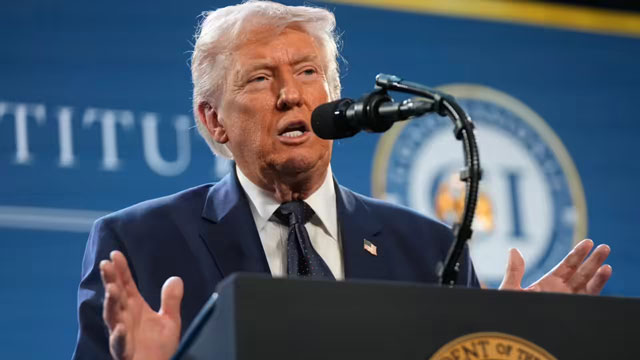
Although he did not name the seven governments contacted by Washington, Trump suggested in a social media post that countries such as China, France, Japan, South Korea and United Kingdom could join the effort by sending warships to escort vessels through the narrow shipping corridor.
In an interview with the Financial Times, Trump also increased pressure on European allies, warning that NATO could face a “very bad” future if member states fail to support Washington’s efforts to protect the maritime route.
The conflict, now in its third week, has created instability across the Middle East and disrupted global energy markets. The US and Israel launched large-scale strikes against Iran on February 28, targeting military and strategic sites across the country.
Trump said the US is still in contact with Iran but expressed doubts about Tehran’s willingness to engage in serious negotiations. Meanwhile, Iranian Foreign Minister Abbas Araqchi denied that Tehran had sought talks or a ceasefire.
“We have never asked for a ceasefire, and we have never asked even for negotiations. We are ready to defend ourselves for as long as it takes,” Araqchi said in an interview with CBS News programme Face the Nation.
US officials sought to reassure markets rattled by rising energy prices, predicting that the conflict could end within weeks and lead to a fall in oil prices. US Energy Secretary Chris Wright told ABC News that the war was likely to conclude soon.
“This conflict will certainly come to an end in the next few weeks — it could be sooner,” Wright said.
Trump also warned of additional strikes on Kharg Island, Iran’s primary oil export hub, claiming that earlier US attacks had “totally demolished” much of the facility. He said further strikes could follow as the US seeks to weaken Iran’s economic and military capabilities.
Reports in the Wall Street Journal said Washington could announce as early as this week that several countries have agreed to join a coalition aimed at escorting ships through the Strait of Hormuz, though discussions are ongoing about whether operations would begin during the conflict or after hostilities end.
Oil markets remained cautious on Monday amid the continuing Gulf tensions. Brent crude rose slightly to about $103 per barrel while US crude slipped below $98.
Despite waves of US and Israeli air strikes that have reportedly killed several Iranian leaders and damaged parts of the country’s naval and missile infrastructure, Araqchi insisted that Iran remains resilient.
“It’s not a war of survival. We are stable and strong enough,” he said.
With the Strait of Hormuz — a passage that handles roughly one-fifth of global oil and liquefied natural gas shipments — largely disrupted since the war began, analysts warn that prolonged hostilities could have serious implications for global energy supplies and the world economy.