Daijiworld Media Network - Washington
Washington, Feb 22: Indian-American lawyer Neal Katyal has strongly criticised US President Donald Trump over his decision to impose a 15 per cent global tariff, arguing that the President cannot bypass Congress to introduce sweeping tax measures.
Katyal’s remarks came shortly after the Supreme Court of the United States struck down most of Trump’s earlier tariff actions in a 6-3 ruling. The court held that the administration had overstepped its authority under the International Emergency Economic Powers Act (IEEPA) of 1977 and reaffirmed that the power to levy taxes primarily rests with Congress.
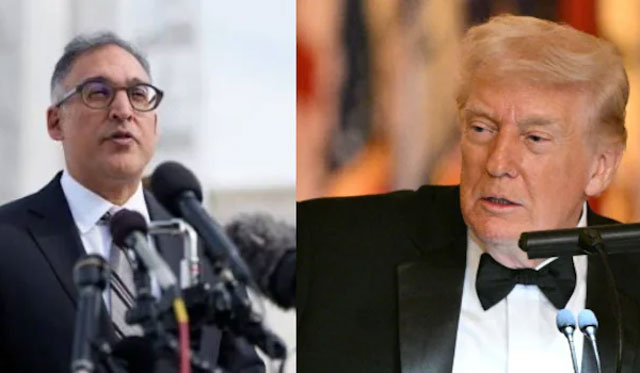
Katyal, who recently secured a major legal victory against Trump’s previous trade measures, also questioned the legal basis for the new 15 per cent tariffs under Section 122 of the Trade Act of 1974. He noted that the Department of Justice (DOJ) had earlier informed the court that Section 122 was not applicable in cases involving trade deficits, which are distinct from balance-of-payments deficits.
In a post on X, Katyal said it would be difficult for the President to rely on Section 122 when his own DOJ had argued otherwise before the court. He maintained that if Trump believes sweeping tariffs are necessary, he should seek Congressional approval in accordance with the Constitution.
“If he wants sweeping tariffs, he should do the American thing and go to Congress. If his tariffs are such a good idea, he should have no problem persuading Congress. That’s what our Constitution requires,” Katyal wrote.
Following the court ruling, Trump first announced a 10 per cent global tariff under Section 122 as a temporary surcharge permitted for up to 150 days. He later increased it to 15 per cent, describing the Supreme Court’s judgment as “extraordinarily anti-American” on Truth Social.
Economist and former IMF First Deputy Managing Director Gita Gopinath backed Katyal’s interpretation on X, stating that trade deficits and balance-of-payments deficits are not the same.
The development has implications for India as well. A White House official indicated that countries including India would fall under the new global tariff regime until an alternative authority is invoked. The move comes at a time when the United States and India are negotiating an interim bilateral trade agreement involving tariff adjustments on several goods.
Born in Chicago to Indian immigrant parents, Katyal is a graduate of Dartmouth College and Yale Law School and previously clerked for Justice Stephen Breyer of the US Supreme Court. Appointed Acting Solicitor General by President Barack Obama in 2010, he has argued more than 50 cases before the Supreme Court and is currently a partner at Milbank LLP and a professor at Georgetown University Law Center, specialising in constitutional and complex appellate litigation.