Daijiworld Media Network - Panaji
Panaji, May 19: Pramod Sawant on Tuesday stressed that sustainable and technology-driven mining practices must remain central to Goa’s mining revival as the state moves ahead with the resumption of operations across 18 auctioned mineral blocks with an estimated production capacity of 19 million tonnes per annum.
Addressing the International Conference on Iron Ore 2026 organised by Metalogic PMS in Panaji, Sawant said the revival of mining activities has started restoring economic confidence in the state after years of slowdown caused by the suspension of operations.
“Goa is globally recognised not only for its economic potential but also for its biodiversity, ecology, tourism and natural beauty. Therefore, mining activity in Goa must always balance economic development and environmental responsibility,” he said.
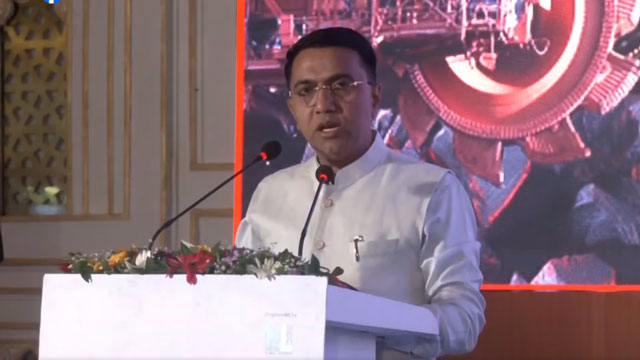
The chief minister said the state government remains committed to scientific mining practices, strict environmental compliance, reclamation measures, water conservation and community welfare while reviving the sector in a transparent and legally compliant manner.
Sawant noted that mining had historically been the backbone of Goa’s economy and supported lakhs of livelihoods directly and indirectly.
“The entire ecosystem developed around mining activities, including barge operations, truck transportation, machinery services, ship loading operations, local trade and thousands of small businesses,” he said.
Referring to the mining ban imposed after 2012, Sawant said the suspension had triggered one of the toughest economic phases in the state’s history.
“Economic activities slowed down considerably in mining-dependent regions. Thousands of workers lost employment. Transportation and the barge sector suffered heavily, and many small businesses faced serious financial difficulties,” he said.
Sawant said the government held continuous consultations with the Centre, legal experts, industry stakeholders and local communities to ensure mining operations resumed responsibly.
He added that the restart of mining activities has gradually revived employment opportunities, transportation services, port operations and businesses linked to the sector.
The chief minister also highlighted the government’s plans for scientific utilisation of low-grade iron ore dumps accumulated over several decades.
“These dumps represent both an environmental challenge and an economic opportunity. Through scientific recovery and resource utilisation, we aim to promote beneficiation, processing and value addition within the state,” he said.
Sawant stressed that India should reduce dependence on raw material exports and instead focus on value addition through pelletisation, steel manufacturing, downstream industries and advanced mineral processing.
“Every tonne of ore processed within India generates higher economic returns, greater employment opportunities and a stronger industrial ecosystem,” he said.
Highlighting India’s infrastructure expansion under Prime Minister Narendra Modi, Sawant said investments in highways, railways, ports, airports, metro rail, industrial corridors, renewable energy and defence manufacturing were boosting industrial competitiveness.
He referred to initiatives such as PM GatiShakti, Bharatmala, Sagarmala, the National Logistics Policy and Dedicated Freight Corridors as key drivers of supply chain efficiency.
Sawant said India had already become the world’s second-largest steel producer and was targeting steel production capacity of 300 million tonnes by 2030.
The chief minister also highlighted the role of Mormugao Port Authority and Goa’s inland waterways and barge transportation network in supporting sustainable logistics.
“The inland water transport system through barges has historically been one of Goa’s greatest strengths and remains one of the most sustainable and cost-effective transportation systems available for bulk cargo movement,” he said.
Sawant urged industries to adopt cleaner logistics systems, including mechanised handling infrastructure, covered transportation, pipe conveyor systems, advanced dust-suppression technologies and digital monitoring systems to minimise environmental impact.
“Responsible mining is not merely a regulatory requirement. It is essential for long-term economic sustainability and social acceptance,” he added.