Daijiworld Media Network - Washington
Washington, Jan 25: A massive winter storm battered large swathes of the United States over the weekend, forcing the cancellation of thousands of flights, knocking out power supply, and turning roads into sheets of dangerous ice, as authorities urged people to stay indoors.
More than 140 million people—over 40 per cent of the US population—were placed under winter storm warnings stretching from New Mexico to New England. The National Weather Service (NWS) forecast widespread heavy snow, sleet and freezing rain from Saturday through Monday, followed by several days of extreme cold.
“The snow and the ice will be very slow to melt and won’t be going away anytime soon, and that’s going to hinder any recovery efforts,” said Allison Santorelli, a meteorologist with the NWS.
President Donald Trump approved emergency declarations for at least a dozen states, with more expected. The Federal Emergency Management Agency (FEMA) pre-positioned emergency supplies, personnel and search-and-rescue teams across multiple states, Homeland Security Secretary Kristi Noem said.
“We just ask that everyone would be smart—stay home if possible,” Noem urged.
By Saturday, nearly 120,000 power outages were reported along the storm’s path, including around 50,000 each in Texas and Louisiana, according to poweroutage.us. In Shelby County, Texas, ice-laden pine trees snapped, bringing down power lines and blocking roads. Nearly a third of the county’s 16,000 residents were left without electricity.
“We have hundreds of trees down and a lot of limbs in the road,” said Shelby County Commissioner Stevie Smith, adding that crews were working round-the-clock to clear roads.
In Louisiana’s DeSoto Parish, vehicles reportedly struck fallen trees and some homes were damaged. “These trees are just completely saturated with ice,” said sheriff’s office spokesperson Mark Pierce.
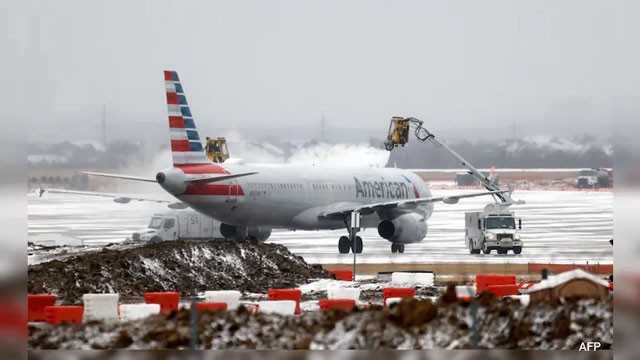
Flight operations were severely disrupted nationwide. Around 13,000 flights scheduled for Saturday and Sunday were cancelled across the US, according to FlightAware. All flights were cancelled at Will Rogers International Airport in Oklahoma City on
Saturday, with Sunday morning departures also scrapped. Dallas-Fort Worth International Airport saw more than 700 departing and nearly as many arriving flights cancelled.
Major disruptions were also reported at airports in Chicago, Atlanta, Nashville and Charlotte, North Carolina. At Ronald Reagan Washington National Airport, nearly all flights scheduled to depart on Sunday were cancelled by late Saturday afternoon.
Several states issued urgent travel advisories. New Jersey Governor Mikie Sherrill announced restrictions on commercial vehicle movement and imposed a 35 mph speed limit on highways. “We are expecting a storm the likes of which we haven’t seen in years. It’s a good weekend to stay indoors,” she said.
Georgia officials advised residents in the northern parts of the state to stay off roads for at least 48 hours. Senior state meteorologist Will Lanxton warned of the biggest ice storm in more than a decade, followed by unusually cold temperatures. “Ice is a whole different ballgame than snow. You can’t drive on it, and it’s much more likely to bring down power lines and trees,” he said.
After sweeping through the South, the storm was expected to hit the Northeast, dumping between one and two feet of snow from Washington to New York and Boston. New York City Mayor Zohran Mamdani urged residents to avoid travel and remain indoors to ensure safety.
The Midwest experienced brutal cold, with wind chills plunging to minus 40 degrees Fahrenheit. Rhinelander, Wisconsin, recorded its coldest temperature in nearly 30 years. Despite the conditions, emergency workers and volunteers continued outreach efforts to assist unhoused individuals.
The severe weather also led to widespread closures and cancellations. Schools in Philadelphia and Houston announced closures for Monday, while several universities in the South cancelled classes. Churches moved services online, Mardi Gras parades in Louisiana were postponed or cancelled, and Nashville’s Grand Ole Opry held its Saturday performance without a live audience.
Meteorologists described the storm as unusual due to its vast geographic spread and the extreme cold expected afterward. “You’ve got nearly 2,000 miles of the country impacted by snow, sleet and freezing rain, followed by record cold,” said Josh Weiss of NOAA’s Weather Prediction Center.