Daijiworld Media Network – Bengaluru
Bengaluru, Jul 8: Moving with slow, measured paces, his advanced age mirrored in a flowing white beard and waist-length hair, 72-year-old Saibanna Lingappa Natekar recently stepped through the heavy steel gates of the Parappana Agrahara Central Prison. For the first time in nearly four decades, he was breathing the air of a free man.
Saibanna was among 24 life-term convicts released by the Karnataka government under an Independence Day amnesty for good behaviour. Yet, his release does not mark a quiet story of rehabilitation; instead, it has pulled back the curtain on the longest continuous prison term in Indian history and exposed a chillingly unrepentant criminal mind.
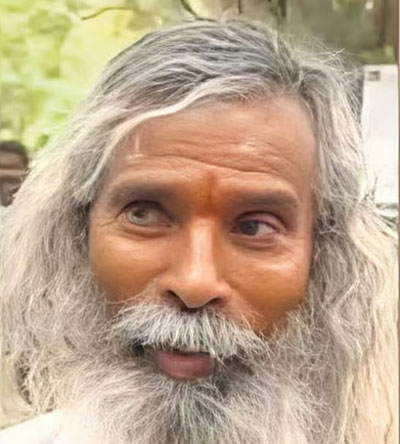
Serving over three and a half decades consecutively, prison department records confirm Saibanna has clocked the longest single incarceration period in the country. State director general of police (Prisons) Alok Kumar recalled his interactions with the inmate, noting that he observed Saibanna closely during his time at both Belagavi and Kalaburagi prisons, where his conduct inside the prison walls was entirely blameless.
However, this model prison behaviour stood in stark contrast to a lifetime completely squandered; originally a respected employee at a cooperative society, Saibanna’s violent outbursts cost him his livelihood, his entire family, and 10 acres of prime ancestral land valued today at upwards of Rs 1 crore.
Saibanna’s life story reads like a grim psychological thriller, defined by a recurring, lethal obsession with marital fidelity. His path of bloodshed began in 1988 when he was consumed by suspicions that his first wife, Malkawwa, was having an extramarital affair, leading him to murder her at their home in Kalaburagi.
By 1993, a local trial court found him guilty of homicide and sentenced him to life imprisonment. Displaying good behaviour, he was granted a one-month parole just a year later in 1994. Rather than laying low, he immediately remarried a woman named Nagamma.
It was in September 1994, while still out on parole, that his old paranoia flared up again with fatal consequences. In a manic fit of rage, Saibanna attacked Nagamma with a sharp weapon. When his terrified minor daughter, Vijayalakshmi, ran to shield her mother, he turned the weapon on her and hacked her down too, before stabbing himself in the gut in a failed suicide bid that he ultimately survived.
In 2003, horrified by the sheer savagery of this double murder of a wife and child, the trial court handed Saibanna the death penalty—a verdict later upheld by both the Karnataka High Court and the Supreme Court of India in 2005. However, two critical bureaucratic failures by the state ultimately saved him from execution.
First, for nearly a decade, Saibanna was kept in absolute isolation in a death cell, a treatment the high court later strictly reprimanded jail authorities for, calling it unlawful, unauthorised, and inhumane. Second, after Saibanna moved a mercy petition in 2005, it took the Governor and the President of India a staggering seven years and eight months to reject it in 2013.
Citing this systemic, agonising delay alongside the unlawful solitary confinement, the Karnataka high court ultimately commuted his death sentence back to life imprisonment. Having already spent over 35 years in active custody by that time, he became legally eligible for premature release on humanitarian grounds.
What has shocked the public, however, is Saibanna’s chillingly defiant demeanor upon release. Standing outside the prison gates, the frail-looking septuagenarian showed no signs of reform, choosing instead to aggressively rationalise his crimes to a huddle of reporters. He stated coldly that he had solid proof that his wives committed adultery.
He claimed that in the first case, the man who was with his wife managed to escape, so he killed her. In the second case, he blamed his mother-in-law for actively encouraging his wife down a treacherous path, concluding with the chilling statement that he wouldn't have cared if his wife was blind or crippled, as long as her absolute loyalty was maintained.
The release of these 24 men highlights the Karnataka government's progressive push towards prisoner rehabilitation. In handing over the release certificates, prison officials reiterated their philosophical hope that jails must transform from primitive dens of punishment into ‘correctional academies’, allowing reformed souls a chance to peacefully reintegrate into mainstream society.
Yet, as Saibanna walks back into the community completely unbowed by his past, his unapologetic remarks leave a disturbing question mark over the psychological limits of modern prison reform.