Daijiworld Media Network - Seoul
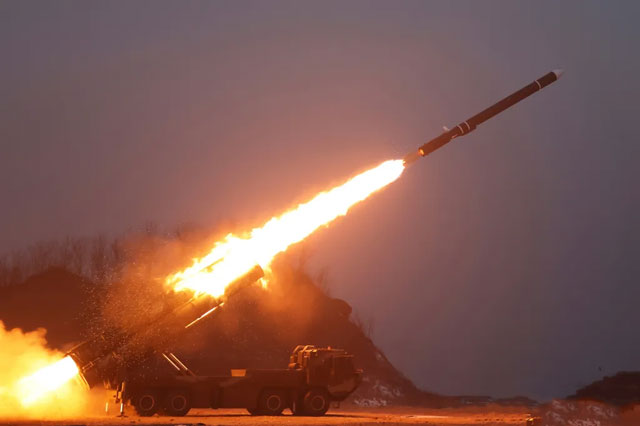
Seoul, Apr 27: North Korea has carried out a series of missile launches in recent weeks, with five tests conducted since late February, including four in April alone — the highest monthly count since January 2024, according to an AFP tally.
The launches come amid heightened global tensions following US-Israeli strikes on Iran, and signal Pyongyang’s continued push to strengthen its nuclear capabilities under leader Kim Jong Un.
Experts say the tests reflect a calculated strategy to align military advancements with evolving geopolitical dynamics involving the United States, Russia and China. Analysts believe North Korea is taking advantage of what they describe as a weakening of global norms to accelerate its nuclear programme.
Pyongyang has criticised US actions against Iran as “gangster-like”, but has notably avoided directly targeting former US President Donald Trump, amid speculation of a possible meeting between Trump and Kim during an upcoming summit in China.
The recent missile activity began soon after a key Workers’ Party congress in February, where Kim reiterated that North Korea’s status as a nuclear weapons state is “irreversible and permanent”. The tests have included ballistic and cruise missiles as well as cluster munitions, indicating growing technical sophistication and the ability to deploy dual-use weapons capable of carrying nuclear or conventional payloads.
Analysts say the country is moving beyond development into the “normalisation” of nuclear operations, including capabilities such as miniaturised warheads and “saturation attacks” designed to overwhelm missile defence systems.
Observers also link the increased activity to deepening ties between Pyongyang and Moscow, particularly in the context of the ongoing Russia-Ukraine war. In exchange for military support, including troops, Russia is believed to be providing North Korea with economic and technical assistance.
Recent engagements between the two countries include infrastructure projects, high-level visits, and expanded cooperation across sectors. Experts say this partnership allows North Korea to counter international sanctions and project strength despite diplomatic isolation.
However, some analysts believe the relationship may be temporary, largely driven by Russia’s immediate military needs.