Daijiworld Media Network - Hong Kong
Hong Kong, Jan 19: Asia-Pacific markets mostly traded lower on Monday as investors assessed fresh geopolitical tensions triggered by remarks from U.S. President Donald Trump on Greenland, alongside key economic data released by China.
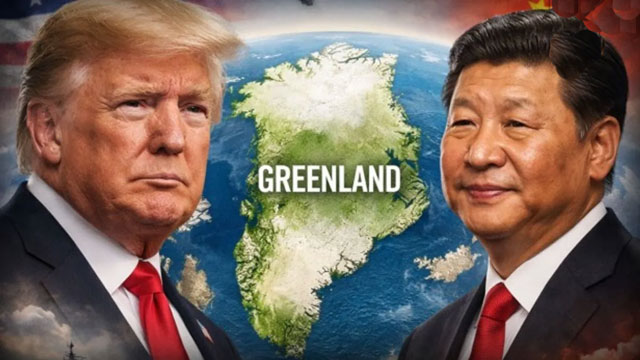
Over the weekend, Trump and European leaders exchanged sharp rhetoric over the Arctic territory, with the U.S. President threatening tariffs on eight European countries and reiterating demands for control over Greenland, which is part of Denmark. European leaders dismissed the comments as “completely wrong” and “unacceptable,” adding to global market unease.
In Asia, investor focus was also on China’s fourth-quarter GDP data and December figures for retail sales, urban fixed-asset investment and industrial output. Hong Kong’s Hang Seng index declined 1.05 per cent, while China’s CSI 300 slipped marginally.
Japan led regional losses, with the Nikkei 225 falling 0.97 per cent and the broader Topix down 0.47 per cent. Japanese government bond yields surged, with the benchmark 10-year JGB yield touching 2.244 per cent, its highest level since 1999. Yields on 20- and 30-year bonds also hit record highs.
South Korean markets bucked the weak trend. The Kospi rose 0.81 per cent and the small-cap Kosdaq gained 0.68 per cent. Shares of automaker Hyundai touched a record high, surging as much as 12.59 per cent during the session.
Australia’s S&P/ASX 200 fell 0.48 per cent, dragged down by technology stocks.
In commodities, precious metals rallied sharply, with both silver and gold hitting record highs. Spot silver climbed over 3.6 per cent to $93.17 per ounce, while gold rose 1.58 per cent to trade at $4,668.19 per ounce.
On Wall Street, markets ended a volatile week on a subdued note. The S&P 500 closed just below flat and posted a weekly loss, the Nasdaq Composite slipped 0.06 per cent, and the Dow Jones Industrial Average declined 0.17 per cent. Stocks dipped further after Trump said he may not appoint National Economic Council Director Kevin Hassett as the next U.S. Federal Reserve chair, unsettling investors who view Hassett as a more market-friendly choice than former Fed Governor Kevin Warsh.