Daijiworld Media Network - New Delhi
New Delhi, Dec 13: A team of Indian scientists has developed an artificial intelligence–powered framework that could significantly change the way cancer is understood and treated by doctors. The tool, named OncoMark, analyses the hidden internal mechanisms that cancer cells use to grow, survive and spread, offering a deeper view of the disease beyond what is visible in scans and clinical tests.
The research findings were published in the journal Communications Biology in October, marking an important step towards more precise and personalised cancer therapy.
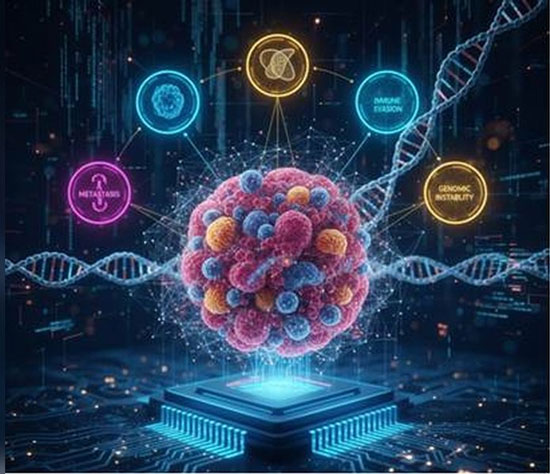
Cancer diagnosis has traditionally focused on visible features such as tumour size, location and spread. While these factors remain important, they do not reveal the molecular processes that cause normal cells to turn cancerous. Scientists have long identified specific “hallmarks of cancer” — core biological traits that define the disease, including unchecked cell growth, resistance to cell death, invasion of nearby tissues and evasion of the immune system. First outlined in 2011 with six traits, the list has since expanded to ten, capturing the fundamental internal behaviour of cancer cells.
These molecular changes begin much earlier than a tumour becomes detectable. Healthy cells are programmed to stop growing or die when necessary, but cancer cells disable these controls, allowing them to multiply uncontrollably and survive far longer than they should.
OncoMark uses artificial intelligence to analyse these hallmark processes at the genetic level. The model was trained on genetic data from 3.1 million cancer cells across 14 different cancer types, enabling it to learn how internal biological processes interact to drive tumour growth and resistance to treatment. When tested on five independent datasets, the system achieved accuracy levels of at least 96 per cent in predicting how aggressively cancer cells grow, spread or resist therapy.
By estimating the activity of each hallmark, the tool creates a detailed molecular profile of a tumour, helping doctors understand how dangerous a cancer truly is. This approach allows oncologists to design treatment strategies based on the actual biology driving the disease, rather than relying solely on outward clinical features.
Researchers say this could lead to more personalised and targeted cancer treatments, improving outcomes while reducing unnecessary or ineffective therapies for patients. The team now aims to integrate OncoMark into clinical settings so it can be used directly in patient evaluation. Plans are also underway to extend the research to blood cancers and rare cancer types, which differ significantly from solid tumours.
Though still under development, OncoMark represents a major advance towards a future where cancer treatment is guided not just by what doctors can see, but by a deeper understanding of the molecular strategies tumours use to survive.