Media Release
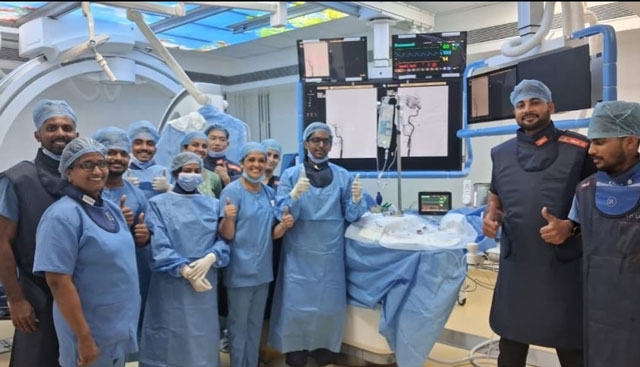
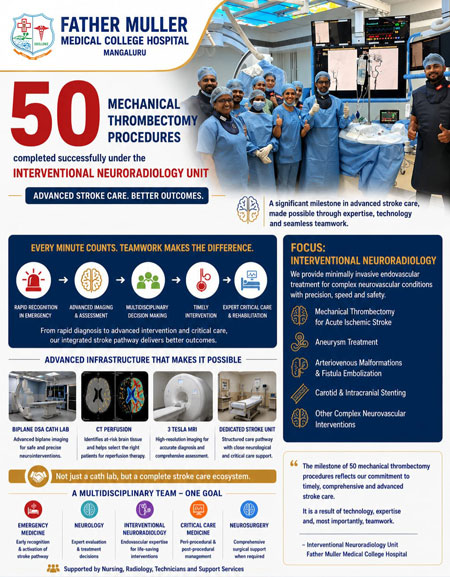
Mangaluru, Sep 23: The Interventional Neuroradiology unit at Father Muller Medical College Hospital, led by Dr Ariharan K, has achieved an important milestone with 50 mechanical thrombectomy procedures performed for patients with acute ischemic stroke.
The milestone marks the growing capabilities of the Interventional Neuroradiology unit in providing advanced minimally invasive treatment for stroke and other complex neurovascular conditions.
Mechanical thrombectomy is an endovascular procedure in which a blood clot blocking a major artery of the brain is removed using specialised devices. For appropriately selected patients with large-vessel occlusion stroke, timely restoration of blood flow can significantly improve neurological outcomes.
Dedicated Interventional Neuroradiology unit
The Interventional Neuroradiology unit is supported by a dedicated advanced biplane Cath Lab, allowing detailed real-time imaging of the cerebral circulation during complex neurovascular procedures.
Importantly, the service is complemented by CT perfusion and a 3 Tesla MRI, providing advanced assessment of brain tissue, cerebral vessels and perfusion. This combination of imaging and intervention allows patients to be evaluated rapidly and appropriately selected for endovascular treatment.
According to Dr Ariharan K, Interventional Neuroradiologist, “Mechanical thrombectomy has transformed the treatment of large-vessel occlusion stroke. The availability of a dedicated biplane system, CT Perfusion and 3 Tesla MRI allows us to integrate advanced imaging with endovascular treatment and provide timely, precise care to appropriately selected patients.”
The Interventional Neuroradiology unit is not limited to stroke intervention. It also provides minimally invasive treatment for cerebral aneurysms, cerebrovascular malformations and other complex vascular disorders of the brain and spine, expanding the range of advanced neurovascular services available at the institution.
A rapid and coordinated stroke pathway
Successful stroke intervention depends not only on the procedure itself but also on rapid recognition, imaging, patient selection and post-procedure care. The hospital has therefore developed a structured stroke pathway and stroke unit connecting the Emergency Department, Neurology, Interventional Neuroradiology and critical care services.
Dr Raghavendra, neurologist, said, “In stroke, time is brain. Early recognition, rapid imaging and appropriate patient selection are critical. A coordinated stroke pathway allows us to identify patients who may benefit from reperfusion therapy and facilitate their timely transfer for definitive treatment.”
Advanced imaging also enables assessment of appropriately selected patients presenting beyond conventional treatment windows or with an uncertain time of stroke onset.
Multidisciplinary neurovascular care
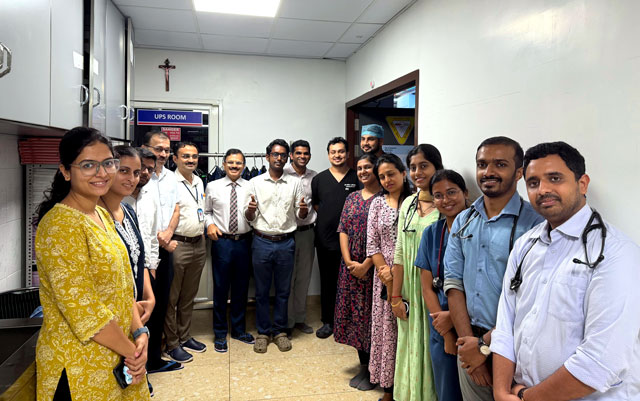
The growth of the Interventional Neuroradiology service has been supported by close collaboration between Emergency Medicine, Neurology, Interventional Neuroradiology, Critical Care and Neurosurgery, along with Radiology, nursing and technical teams.
Dr Geover Lobo, neurosurgeon, emphasised the importance of this collaborative approach: “Neurovascular emergencies require coordinated multidisciplinary care. The close collaboration between Neurology, Interventional Neuroradiology, Neurosurgery, Emergency Medicine and critical care ensures that patients can be assessed rapidly and receive the most appropriate treatment.”
Recognise Stroke — Act immediately
For patients and families, recognising the warning signs of stroke is critical. Sudden weakness or numbness of the face, arm or leg—particularly on one side, sudden difficulty speaking or understanding speech, facial deviation, sudden loss of vision, severe imbalance or sudden unexplained dizziness should be treated as a medical emergency.
A major artery blockage can cause rapid and extensive brain injury. Without timely restoration of blood flow in eligible patients, the affected brain tissue may become permanently damaged, potentially resulting in severe disability or death. Mechanical thrombectomy can remove the clot and restore blood flow in appropriately selected patients, making rapid presentation to a hospital with stroke and neurointerventional facilities essential.
If stroke symptoms occur, do not wait for them to improve and do not attempt to drive the patient yourself. Seek emergency medical attention immediately. Every minute matters.