Daijiworld Media Network - Assam
Assam, Sep 22: Parbati Barua, widely known as the ‘Hasti Kanya’ or ‘Daughter of the Elephant’, has carved out a unique place in India’s wildlife conservation history as the country’s first female elephant mahout. Born on March 14, 1953, into the royal family of Gauripur in Assam, she grew up surrounded by elephants and mahouts, an environment that shaped her lifelong bond with the majestic animals.
Barua was the daughter of Prakritish Chandra Barua, the last Gauripur royal to hold power and a renowned elephant catcher who had around 40 elephants in his royal stables. According to Barua, her father placed her on an elephant when she was just one month and 17 days old. She grew up accompanying him to the forests and observing mahouts at work.
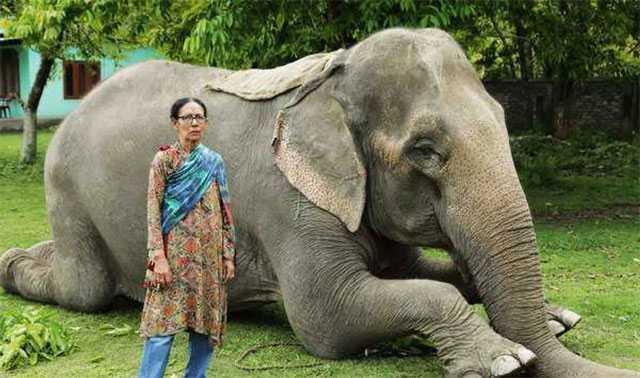
Although she later graduated in Political Science from Gauhati University, Barua chose a path that was traditionally dominated by men. At the age of 14, she domesticated her first elephant in Assam’s Kochugaon forest. Between 1975 and 1978, she successfully tamed 14 wild elephants through mela shikar, a traditional Assamese method of capturing elephants using trained elephants and lassos rather than tranquiliser guns.
Her work eventually took her beyond Assam to forests in North Bengal, including Jalpaiguri and Darjeeling. Over the years, she trained more than 500 elephants and worked closely with forest officials in Assam, Kerala, West Bengal, Uttar Pradesh and Uttarakhand. She helped train mahouts and field staff and assisted authorities in dealing with human-elephant conflicts as well as injured, ailing and so-called rogue elephants.
Barua also became involved in the wider conservation community. She participated in international workshops and seminars on elephants and represented India at a Food and Agriculture Organization workshop on domesticated Asian elephants in Bangkok in 2001. She was also a member of the Asian Elephant Specialist Group of the International Union for Conservation of Nature (IUCN).
Her experience gave her a distinctive perspective on elephant behaviour and traditional methods of working with the animals. In recent years, Barua has spoken about the limitations of relying heavily on tranquilizers and has advocated greater attention to traditional knowledge and methods of handling elephants.
Her contribution has received recognition at both national and international levels. In 1989, she received the United Nations Environment Programme’s Global 500 Award for her work in the welfare and management of wild and captive elephants. In 2003, the Assam government felicitated her as the Honorary Chief Elephant Warden of Assam for her lifetime work with elephants. She has also received a Lifetime Achievement Award from the Kolkata International Wildlife & Environment Film Festival and other honours.
In 2023, Barua was conferred the Asom Gaurav, Assam’s highest civilian award. In 2024, she was awarded the Padma Shri by the Government of India for her contribution to wildlife conservation. The recognition also highlighted the traditionally male-dominated profession of mahouts and the dedication involved in caring for and managing elephants.
From a young girl who found herself drawn to elephants in the forests of Assam to a pioneering woman who trained hundreds of elephants and worked alongside conservation authorities, Parbati Barua’s journey reflects a rare combination of traditional knowledge, courage and lifelong dedication to wildlife. Her story has also helped bring greater attention to the role of mahouts in elephant conservation and human-elephant conflict management.