Daijiworld Media Network – Tel Aviv
Tel Aviv, Feb 27: Mohamed Al Khaja, the UAE Ambassador to Israel, called for coexistence and defended the Abraham Accords while warning that extremist groups seek to inflame tensions during the holy month of Ramadan.
Speaking at a Ramadan iftar hosted by the Emirati embassy on Thursday, Al Khaja addressed a gathering that included Israeli President Isaac Herzog, Foreign Minister Gideon Sa'ar, and Knesset Speaker Amir Ohana.
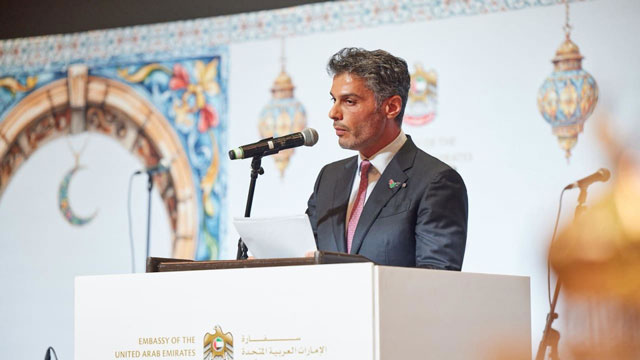
Al Khaja said Ramadan is intended to strengthen family and community bonds but alleged that “terrorist groups and forces of darkness” attempt to exploit the month to “ignite tensions, spread division, and promote violence, oppression, and racism.”
“I regret to say that the month of Ramadan in Israel is not like other places,” he remarked, pointing to what he described as efforts by extremists to deepen divisions.
He also referred to continued violence in Arab communities within Israel, stating that “violence and killing continue in Arab cities and villages,” and that trust-building efforts are being “systematically obstructed.” He called for what he termed “a responsible pause from all of us.”
Framing peace as a strategic necessity, the UAE envoy said, “There is no alternative to peace,” linking the UAE’s policy to the future of the region and coming generations, especially amid rapid geopolitical changes.
Al Khaja, who has served as ambassador for over five years, stressed the importance of preventing younger generations from inheriting prolonged conflict. He criticised the spread of conspiracy theories, hatred, and racism, asserting that the UAE seeks to demonstrate that “the impossible has no place in our region.”
Quoting the UAE’s founding leader Zayed bin Sultan Al Nahyan, he said: “Nothing is everlasting at all, neither man nor wealth; what endures is the homeland and work,” describing it as reflective of the UAE’s emphasis on humanitarian action and development.
Highlighting religion’s place in society, Al Khaja warned against its politicisation. “The most dangerous thing that threatens our homelands is the politicization of religion or its weaponization,” he said, adding, “Religion is for God, the homeland is for all, and terrorism has no religion.”
Defending the Abraham Accords, he said predictions of their collapse following the October 7 attacks had not materialised. “Peace endured, because it is based on common interests and mutual respect,” he noted.
Referring to the diverse gathering at the iftar, he said the event symbolised what normalization can achieve. “Thanks to this peace, I can today, as an Emirati Arab Muslim, be among you in the State of Israel,” he said, describing the opportunity to break the fast alongside Jews, Muslims, and Christians under one roof.
Al Khaja concluded by expressing hope that such gatherings would help “bring hearts closer,” “heal wounds,” and reinforce shared interests, while offering prayers for security and peace in the region and beyond.