Daijiworld Media Network - Panaji
Panaji, Jan 23: The discovery of a new species of blind caecilian, Gegeneophis valmiki, at Paneri–Palashi in Maharashtra’s Satara district has brought cheer to wildlife researchers, further highlighting the rich but largely unexplored biodiversity of the Western Ghats. With this addition, the number of species in the Gegeneophis group in the Western Ghats has risen to 11, four of which have been documented in Goa.
The newly identified species has been named after the Maharshi Valmiki Mandir located on the Valmiki plateau in the northern Western Ghats. Caecilians of the Gegeneophis genus are commonly referred to as blind caecilians, as their eyes are hidden beneath a bony cranium. These limbless amphibians live underground, inhabiting soil and humus-rich organic matter.
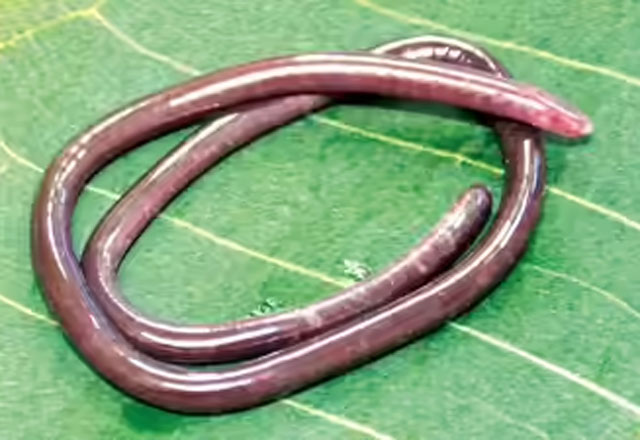
Goa has so far recorded six species of caecilians, of which four — Gegeneophis goaensis, Gegeneophis mhadeiensis, Gegeneophis danieli and Gegeneophis pareshi — belong to the Gegeneophis group. The other two species found in the state are Ichthyophis bombayensis and Ichthyophis davidi.
Goan herpetologist Nirmal Kulkarni, a member of the research team, said the first specimen of Gegeneophis valmiki was discovered in 2017. “We studied the species for several years, and the research paper was finally published in December 2025,” he said.
Welcoming the discovery, Varad Giri, head scientist at the Reliance Foundation, said it was encouraging news for researchers. “It shows that there is a diversity not yet known to science. Caecilians are among the most unexplored vertebrates in India, but their ecological role is as important as that of any other organism,” he noted.
The Western Ghats are home to 26 endemic species of caecilians, though no new species of the Gegeneophis genus had been recorded for over a decade. One of the last discoveries in the northern Western Ghats was made near Cotigao Wildlife Sanctuary and was named after Paresh Porob, a former range forest officer, in recognition of his contributions to forest conservation.
A second specimen of Gegeneophis valmiki was also recently found at the Valmiki plateau. Kulkarni pointed out that identifying caecilians is particularly challenging, as their worm-like appearance closely resembles earthworms. “They are usually found by chance, as they do not produce vocal calls like frogs,” he added.
The study was jointly published in the international journal Phyllomedusa by KP Dinesh, senior scientist at the Zoological Survey of India, who collected the first specimen, along with his colleague Sahil Shikalgar and three other experts.
Dinesh said the formal scientific recognition of such species brings national and global attention to one of the most elusive groups of subterranean amphibians. Echoing the sentiment, Giri said, “I feel grateful to those few who continue to research caecilians, as these small life forms are often ignored despite their ecological significance.”