Daijiworld Media Network - New Delhi
New Delhi, Mar 30: Union Home Minister Amit Shah on Monday said Naxalism is in its “last breath” and has been nearly wiped out from Bastar in Chhattisgarh, once considered the epicentre of Maoist violence, under the government led by Prime Minister Narendra Modi.
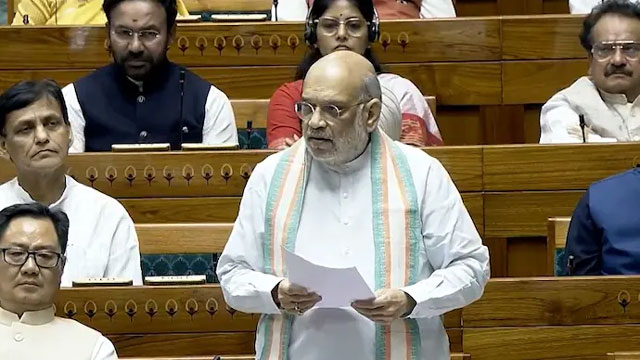
Speaking in the Lok Sabha ahead of the March 31 deadline set by the Centre to eradicate Naxalism, Shah said Bastar is now on the “path of development” and credited security forces, state police and local tribal communities for the transformation.
He said over 4,800 Naxals have surrendered and joined the government’s rehabilitation programme, while only two districts in the country remain affected by Naxalism. Highlighting the Centre’s aggressive crackdown, Shah noted that 706 Naxals were gunned down in the past three years.
Targeting the Congress, Shah accused the party of failing to ensure development and welfare for tribals in Naxal-affected areas. Rejecting the argument that underdevelopment led to insurgency, he asserted that Naxalism is rooted in ideology.
“The root cause of Naxalism is not the demand for development. It is an ideology that Indira Gandhi embraced in 1970 to win the presidential election. Naxalism spread because of this Leftist ideology,” he said.
He also accused the Opposition of sympathising with Naxal elements and questioned why the issue was not resolved earlier despite decades in power.
Placing the issue in a historical context, Shah said tribal communities, once inspired by leaders like Birsa Munda, Tilka Manjhi and Rani Durgavati, were drawn towards Maoist ideology due to governance gaps in the past.
He said Maoist violence has claimed nearly 20,000 lives and impacted around 120 million people, calling it a major failure of previous governments that tribal communities remained deprived of development.
At its peak, Shah said, Naxalism had spread across 12 states, including Chhattisgarh, Jharkhand, Odisha and Maharashtra, forming the so-called “Red Corridor” where governance had collapsed.
Referring to former Prime Minister Manmohan Singh’s remark that Naxalism was once a bigger threat than terrorism in Kashmir and insurgency in the Northeast, Shah said no effective action was taken at the time.
Highlighting initiatives since 2014, he said several long-pending issues have been addressed, including the abrogation of Article 370 and 35A, implementation of GST and CAA, construction of the Ram Temple, and reservation for women.
Shah reiterated that India is close to becoming Naxal-free, stating that welfare schemes have reached even the most remote villages. “Schools, ration shops and hospitals are being set up. People now have Aadhaar and ration cards, and LPG cylinders are being distributed,” he said.
Striking a firm note, he added, “This is the government of Narendra Modi. Whoever takes up arms will be dealt with firmly. Violence has no place in democracy.”
He also noted that 92 per cent of weapons used by Naxalites were looted from police forces, underlining the intensity of the insurgency.
Shah paid tribute to security personnel and civilians who lost their lives in the decades-long conflict and credited CAPF forces, state police and tribal communities for bringing Naxalism to the brink of elimination.