Daijiworld Media Network – Tehran
Tehran, Feb 18: Iran on Tuesday announced the temporary closure of the Strait of Hormuz for live-fire military drills in a rare show of force, even as its negotiators held another round of indirect talks with the United States over Tehran’s disputed nuclear programme.
Iranian state media reported that forces fired live missiles toward the strategic waterway and would shut it for several hours citing “safety and maritime concerns.” The Strait of Hormuz, through which nearly 20 per cent of the world’s oil supply transits, is a critical global energy chokepoint.
It was the first time in recent years that Tehran publicly declared a closure of the strait, a move that risks heightening tensions in a region already on edge. Analysts said any prolonged disruption could trigger sharp geopolitical and economic consequences.
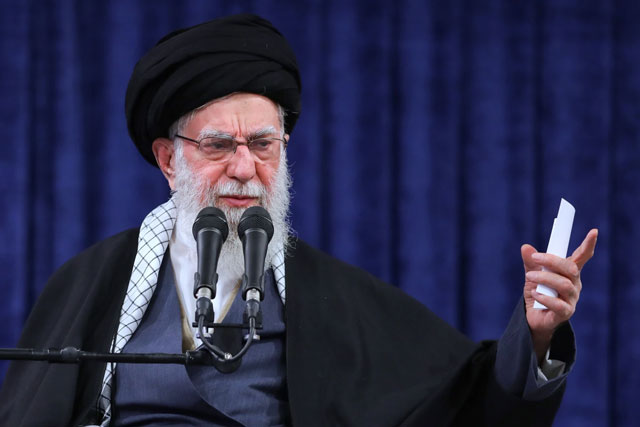
Supreme Leader Ali Khamenei issued a stern warning, saying “the strongest army in the world might sometimes receive such a slap that it cannot get back on its feet.” He also cautioned Washington against attempting to predetermine the outcome of the negotiations.
In contrast to the strong rhetoric, Iran’s Foreign Minister Abbas Araghchi struck a more conciliatory tone in Geneva, where indirect talks were held with US representatives inside the residence of Oman’s envoy.
“A new window has opened,” Araghchi said at a UN disarmament conference, expressing hope that negotiations would yield a sustainable and mutually beneficial agreement. He reiterated, however, that Iran remained prepared to defend itself against any aggression and that consequences of an attack would not be limited to its borders.
Oman, a long-time regional mediator, had earlier hosted a previous round of discussions on February 6.
On the US side, envoys Steve Witkoff and Jared Kushner led the delegation. Vice President JD Vance said the talks went well “in some ways,” but noted that President Donald Trump had set “red lines” that Iran was yet to fully acknowledge.
A US official indicated that while progress had been made, several key details remained unresolved. The Iranian side is expected to present more detailed proposals in the coming weeks.
The diplomatic manoeuvring unfolded against the backdrop of heightened military deployments. The US recently ordered the deployment of the aircraft carrier USS Gerald R. Ford to the Middle East, where it is expected to join the USS Abraham Lincoln and accompanying guided-missile destroyers already stationed in the region.
Last week, US forces reportedly shot down an Iranian drone that approached the Lincoln, while Iran attempted to halt a US-flagged vessel in the Strait of Hormuz.
Iran’s Revolutionary Guard had earlier commenced drills in the Strait of Hormuz, the Persian Gulf, and the Gulf of Oman. Experts noted that while Tehran frequently conducts exercises in the area, an announced closure represents a significant escalation. Iran last effectively closed the strait during the 1980s war with Iraq, when it mined the waterway.
Despite the tensions, oil prices fell after the talks concluded, reflecting cautious optimism over a possible diplomatic breakthrough. US crude slipped 1.3 per cent to $62.06 per barrel, while Brent crude declined 2.3 per cent to $67.03 per barrel.
The Trump administration is pushing for a deal to curb Iran’s nuclear programme and prevent it from developing nuclear weapons. Tehran maintains that its programme is peaceful and has resisted demands to halt uranium enrichment or surrender its stockpile of highly enriched uranium.
Before the outbreak of a 12-day conflict with Israel in June, Iran had been enriching uranium to 60 per cent purity — technically close to weapons-grade levels. During that conflict, the US struck Iranian nuclear facilities, while Israeli attacks targeted air defences and ballistic missile capabilities, disrupting ongoing negotiations.
With Gulf Arab nations warning that any direct confrontation could spiral into a broader regional war, the coming weeks are likely to prove critical for both diplomacy and regional stability.