Daijiworld Media Network - Tehran
Tehran, Jan 17: Iranian President Masoud Pezeshkian held a telephone conversation with Russian President Vladimir Putin on Friday, during which he expressed gratitude for Moscow’s support of Iran at the United Nations and other international forums, according to a statement from the Iranian presidency.
Pezeshkian praised Russia for defending what he described as Iran’s legitimate rights on the global stage. He also outlined his administration’s domestic priorities, emphasising a people-centric approach focused on addressing public concerns and mitigating the economic hardships caused by what he termed “cruel” international sanctions.
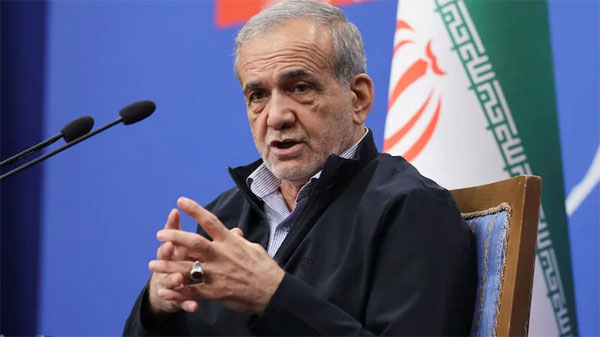
During the call, the Iranian President briefed Putin on recent unrest in the country, alleging direct involvement by the United States, Israel, and certain European nations in fueling the disturbances, Xinhua news agency reported.
Pezeshkian further highlighted the strong and expanding cooperation between Tehran and Moscow across multiple sectors, including trade, investment, transport, and energy. He noted that joint projects were progressing smoothly and without major obstacles.
Responding to Pezeshkian, President Putin said Russia was closely monitoring developments in Iran and described the recent unrest as resembling “colour revolution” tactics. He condemned the violent actions of what he called rioters, including attacks on public institutions, religious sites, and security forces, which he said were carried out with foreign backing.
Putin expressed hope that Iran’s economic situation would improve through the measures being implemented by its government. He added that Russia was actively engaging in diplomatic efforts to clarify Iran’s position internationally and to prevent further escalation.
Reaffirming Moscow’s commitment to deepening ties with Tehran, Putin said Russia remained open to expanding bilateral relations and welcomed the steady progress in joint cooperation initiatives.
The conversation came against the backdrop of protests that have spread across several Iranian cities since late December, triggered by the sharp fall of the national currency, the rial. Iranian authorities have acknowledged the demonstrations and signalled willingness to address economic grievances, while cautioning against violence and unrest.
While the protests initially began peacefully, they later escalated into violent clashes, particularly on January 8 and 9, resulting in casualties and damage to public infrastructure, mosques, banks, and government buildings. Iranian officials have blamed the violence on interference by the United States and Israel.