Daijiworld Media Network - New Delhi
New Delhi, Dec 28: The Viksit Bharat Shiksha Adhishthan (VBSA) Bill, 2025, introduced in the Lok Sabha on December 15, has triggered an intense debate, with academics and opposition parties calling it the most far-reaching overhaul of higher education governance since the creation of the University Grants Commission (UGC) in 1956.
Projected by the Centre as a reform aligned with the National Education Policy (NEP) 2020 and the vision of a ‘Viksit Bharat’, the bill seeks to dismantle existing regulatory structures and replace them with a single apex body. Critics, however, argue that it revives the controversial Higher Education Commission of India (HECI) framework proposed in 2018, which had been withdrawn following widespread opposition.
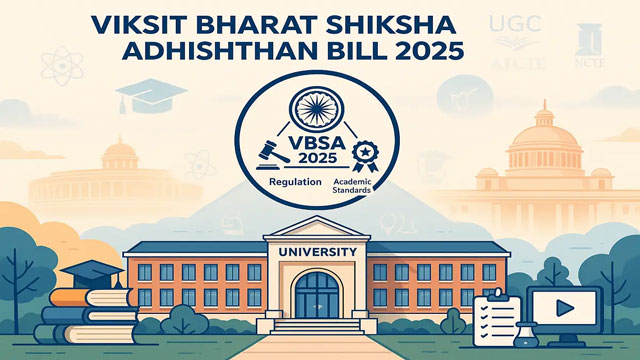
The bill proposes repealing the UGC Act, 1956, the AICTE Act, 1987, and the NCTE Act, 1993, and replacing them with the Viksit Bharat Shiksha Adhishthan, which will oversee higher education excluding medical and legal education. The new body will function through three councils — the Higher Education Regulation Council, the National Accreditation Council and the General Education Council — concentrating regulatory, accreditation and academic standard-setting powers at the Centre.
While the government says this separation of functions will reduce bureaucratic overlap and promote trust-based governance and institutional autonomy, academics point out that substantive authority remains centralised. Concerns have also been raised about federalism, as education is on the Concurrent List and the bill allows the Centre to issue binding policy directions and supersede the commission.
One of the most debated aspects of the bill is the delinking of regulation from funding. Unlike the UGC, which had statutory responsibility for grants and fellowships, the VBSA will have no direct funding mandate. Public funding will instead be routed through ministerial schemes and discretionary funds, raising fears that universities will be forced to rely more heavily on fees, loans and private partnerships.
Experts warn that this shift could hit public universities, especially those serving first-generation learners and marginalised communities, the hardest. They also caution that compulsory accreditation, penalties and performance-linked autonomy could intensify compliance-driven governance and undermine academic freedom.
Supporters of the bill argue that provisions for degree-granting autonomy, curricular flexibility and credit mobility will improve efficiency and global competitiveness. However, critics counter that such autonomy will largely benefit well-resourced institutions, deepening inequality within the higher education system.
With shrinking public funding, contractualisation of faculty and growing pressure on universities to generate internal revenue, many in the academic community view the VBSA Bill as an extension of a long trend towards centralisation and market-oriented governance. The bill has now been referred to a Joint Parliamentary Committee, even as the broader question remains unresolved — whether higher education in India will continue as a public responsibility or evolve into a tightly regulated market.