Daijiworld Media Network - New Delhi
New Delhi, Dec 26: A month after the deadly blast near Delhi’s Red Fort, Union Home Minister Amit Shah on Friday revealed that 40 kilograms of explosives were used in the explosion, while nearly three tonnes of explosives were recovered and seized before they could be detonated, averting a much larger catastrophe.
Shah was speaking after inaugurating the two-day ‘Anti-Terrorism Conference–2025’, organised by the National Investigation Agency (NIA), where he reiterated the Centre’s zero-tolerance policy towards terrorism.
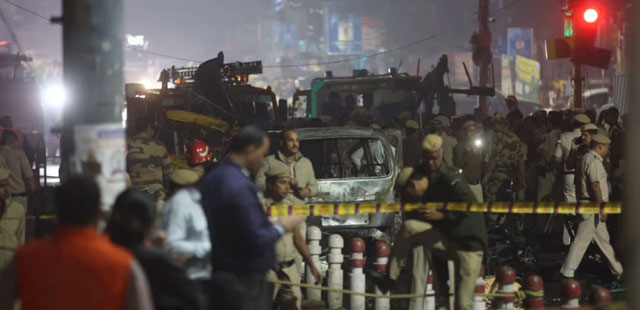
Commending the probe led by the Jammu and Kashmir Police and central agencies, Shah said the investigation was carried out with exceptional efficiency. “In the Delhi blast, 40 kg of explosives detonated, but three tonnes were seized before they could explode. The entire team involved in the conspiracy was apprehended before further damage could be caused,” he said.
Calling the investigations into the Delhi blast and the Pahalgam terror attack “outstanding examples of watertight investigation,” Shah said these cases went far beyond routine policing. “They demonstrate how constant vigilance by our officers can save the country from massive crises,” he added.
So far, the NIA has arrested nine persons linked to Dr Umar-un-Nabi, who allegedly drove the car that exploded near Red Fort on November 10, killing 15 people and injuring several others.
Referring to the Baisaran Valley attack in Jammu and Kashmir, Shah said terrorists aimed to disrupt communal harmony and derail the revival of tourism in the region. “Based on extremely precise intelligence, our forces neutralised all three terrorists, sending a strong message to Pakistan,” he said.
He added that the planners of the attack were punished through Operation Sindoor, while the terrorists who executed the attack were neutralised under Operation Mahadev. “At both ends, India has given a befitting reply to Pakistan’s terrorist masters,” Shah said.
Shah further asserted that the investigation into the Pahalgam attack would place Pakistan “in the dock on international platforms,” adding that global agencies would study India’s handling of the case.
The Home Minister also urged directors general of police to move ahead with trial-in-absentia proceedings against absconding terrorists. “This will force fugitives to return to the country. Central agencies and state police must work as ‘Team India’ for national security,” he said.
During the event, three major initiatives were launched — an updated NIA crime manual, the Organised Crime Network Database, and the Lost/Looted and Recovered Weapon Database. Shah said these platforms would strengthen India’s ability to counter evolving, technology-driven terror threats.
Warning that organised crime networks often morph into terror-financing channels, Shah said ransom and extortion rackets abroad eventually fuel terrorism at home. “Every state must use this database, in coordination with the NIA, CBI and IB, to eliminate such networks,” he said.
As India emerges as the world’s fourth-largest economy, Shah cautioned that security challenges would grow proportionately. “Secure borders begin miles inward. We need multi-layered grids to counter cyber warfare, economic misuse and hybrid terrorism,” he said, announcing a forthcoming comprehensive crackdown on organised crime networks linked to terror financing.