Daijiworld Media Network - Beirut
Beirut, Feb 2: More than a year after Israel’s war on Lebanon and months after a ceasefire came into effect, tens of thousands of people across the country remain displaced, struggling to rebuild their lives amid continued insecurity, limited aid and widespread destruction.
Ali (name withheld for safety), a farmer from Haddatha village in southern Lebanon’s Bint Jbeil district, said his life was uprooted when Israel intensified its attacks in September 2024. Haddatha, located barely 12 km from the Israeli border, was once surrounded by greenery and dependent on agriculture. That changed after what residents described as “hellfire”.
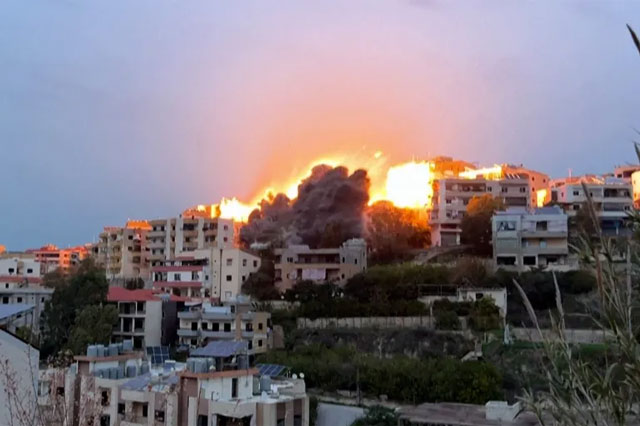
On September 17, 2024, thousands of pagers exploded almost simultaneously across Lebanon, killing at least nine people and injuring nearly 3,000, including Iran’s ambassador to Lebanon. Six days later, Israel escalated its offensive across southern Lebanon, killing nearly 600 people in a single day — the deadliest since the end of Lebanon’s civil war in 1990 — and displacing over one million residents.
“Our house was destroyed,” Ali told Al Jazeera. He fled north to Burj Qalaway, around 20 km from his village. Despite a ceasefire announced on November 27, 2024, he has not returned home. Like tens of thousands of others, Ali says the limited assistance provided by the Lebanese state and Hezbollah is insufficient to rebuild homes or livelihoods.
Under the ceasefire agreement, Hezbollah was to withdraw north of the Litani River and Israel was to pull back troops that entered southern Lebanon in October 2024. However, Israeli forces continue to occupy five strategic points in the south, and attacks have not ceased. Lebanese authorities have recorded more than 2,000 Israeli violations of the ceasefire in just three months of 2025.
“The south is not safe,” Ali said, expressing fear of sudden air raids. Israeli strikes continue almost daily across southern Lebanon and the Bekaa Valley. Since the ceasefire, more than 330 people, including at least 127 civilians, have been killed in Israeli attacks, according to local figures.
The International Organization for Migration estimates that over 64,000 people remained internally displaced as of October 2025. Many are unable to return because entire villages near the border have been razed.
Melina (name changed), from the border village of Odaisseh, said she has been unable to visit her hometown. “Psychologically, I can’t bear to see our house, which was completely destroyed, and the entire village razed to the ground,” she said. She added that security conditions remain extremely dangerous, with movement possible only under Lebanese army escort.
Human rights groups have also raised concerns over Israeli attacks on reconstruction efforts. Human Rights Watch said Israeli forces have targeted reconstruction equipment, making it even harder for residents to rebuild. “After reducing many towns to rubble, the Israeli military is now making it much more difficult for residents to return,” said HRW Lebanon researcher Ramzi Kaiss in a December 2025 report.
The war also reached Beirut’s southern suburbs. On July 30, 2024, Israeli air raids levelled a building in Haret Hreik, killing senior Hezbollah commander Fuad Shukr. Resident Ramez (name changed) recalled how dust and debris filled the air as the neighbouring building collapsed. His family survived, but their home was heavily damaged.
Ramez said his family received only a one-time government payment of 30 million Lebanese pounds (about $330). Hezbollah assessed the damage but, according to residents, compensation was limited and inconsistent. Reuters had reported in December 2024 that Hezbollah planned to pay around $77 million in aid and rent support, but many say assistance has since dwindled.
Lebanon’s crisis is compounded by a severe economic collapse now nearing seven years, described by the World Bank as one of the worst globally in over a century. The currency has lost more than 90 percent of its value, bank deposits remain frozen, and reconstruction costs are far beyond the reach of most families.
With fears of renewed conflict and ongoing Israeli strikes reported again over the weekend, displaced families like Ali’s continue to wait in uncertainty.
“We love life, but the situation is not good,” Ali said. “Wars break your back. War is the most terrible thing in the world.”