Daijiworld Media Network - Nagpur
Nagpur, Apr 24: Ongoing excavation at a megalithic site in Virli Khandar in Maharashtra’s Bhandara district has unearthed distinctive burial architecture, rare artefacts and unusual pottery arrangements, shedding fresh light on ancient funerary practices in the Vidarbha region.
The site in Pauni tehsil, first reported in 2008 by researchers from Rashtrasant Tukadoji Maharaj Nagpur University (RTMNU), is currently being excavated under archaeologist Dr Prabash Sahu, head of the Department of Ancient Indian History, Culture and Archaeology.
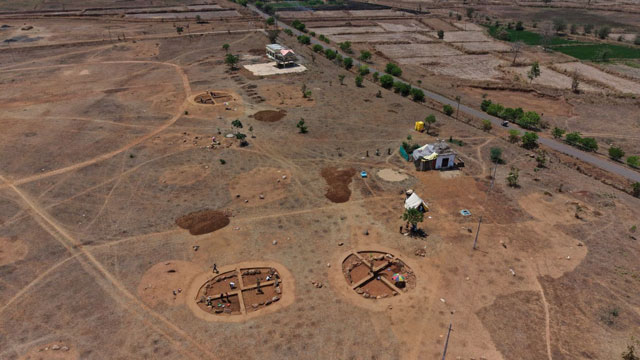
Researchers said the site is notable for its composite megalithic structure, featuring stone circles along with upright menhirs, representing a rare combination of two burial types.
So far, 69 megalithic burials have been documented through drone mapping and field surveys, of which four have been selected for excavation.
Significant artefacts recovered from one of the burials include copper objects such as a necklace, iron implements including axes, chisels, ladles and arrowheads, semi-precious etched carnelian beads, and a gold earring. Fragmentary bone remains have also been found.
Among the most striking discoveries is a unique cluster of nearly 50 pots arranged in a systematic pattern, including at least 23 paired vessels in which large bowls were covered by inverted bowls.
Archaeologists said the deliberate upside-down placement of almost all pottery, including larger vessels, is an unusual feature not previously reported in the Vidarbha region.
Researchers believe the vessels may have contained food, grains or liquids placed as burial offerings, and samples have been collected for chemical and residual analysis.
The excavation has also yielded charcoal remains that are expected to help determine the site’s age through Accelerator Mass Spectrometry dating. Preliminary assessments suggest the site may be at least 2,500 years old.
According to Dr Sahu, the findings could significantly enhance understanding of megalithic cultures and burial traditions in the region.
The excavation, which began on March 10, is in its final stages, though researchers say new evidence continues to emerge.