Daijiworld Media Network - Beijing
Beijing, Apr 19: In a remarkable display of technological advancement, the second edition of the humanoid robot half marathon was held on Sunday at Beijing E-Town, drawing participation from more than 100 teams, including five international entries. According to official data, the event featured 26 brands and over 300 humanoid robots, underscoring the rapid evolution of robotics on a global scale.
A remotely controlled “Lightning” robot from an Honor team was the first to cross the finish line, clocking 48 minutes and 19 seconds. However, under the event’s weighted scoring system, an autonomous-navigation variant of the same model secured the overall title with a net time of 50 minutes and 26 seconds.
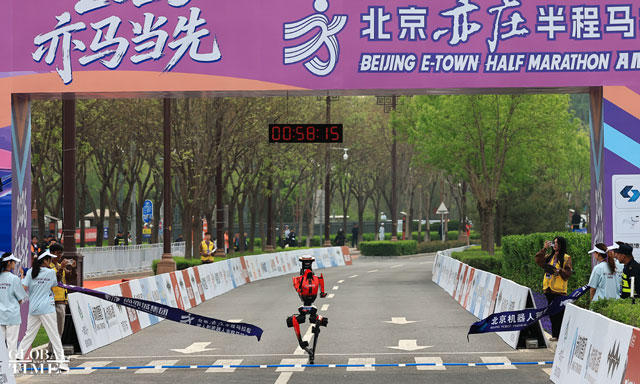
The competition witnessed a significant leap in performance compared to the previous year. At the 2025 World Humanoid Robot Games, the winning robot had taken over two and a half hours to complete the race, highlighting the dramatic improvements in speed, balance, and endurance achieved within a short span.
Participants included advanced models such as Honor’s Yuanqi Zai and Lightning, Unitree’s H1, Tiangong Ultra series, and Noetix Robotics’ B2. Experts noted that while the inaugural edition focused on testing feasibility, this year’s event reflected the growing maturity of the industry, shifting towards evaluating real-world performance and integrated capabilities.
Observers reported noticeable improvements in running posture and stability, with most robots executing smooth starts and maintaining balance throughout the race—an area where many had struggled in the past. Enhanced terrain adaptability, endurance, and resistance to external interference were among the key upgrades seen across competing machines.
The Tiangong ULTRA-2026 robot returned with a focus on high-speed performance and complex terrain handling, while Unitree’s H1 demonstrated impressive long-distance capabilities, aided by refined gait-control algorithms. Notably, the H1 has previously showcased the ability to run 100 meters at speeds nearing those of elite human sprinters.
This year’s event, nearly five times larger than its inaugural edition, also marked increased global participation, with teams from France, Germany, and Brazil joining the competition. The scale and sophistication of the marathon signal a shift in the robotics sector—from proving technological viability to competing on performance, efficiency, and real-world applicability.