Daijiworld Media Network - Karkala
Karkala, Oct 31: An inscription dating back to the Vijayanagara period has been discovered at Dasanda Bakimar, near the Jumadi temple in Kedinje of Belman village in Karkala taluk.
Prof T Murugeshi, founder-trustee of the Adimakala Trust, Udupi, says that the inscription is written in the Kannada language and script, though it also contains several Tulu words. The beautifully carved record is inscribed on green schist or soapstone, measuring 46.5 cm in height and 23 cm in width.
The lower rectangular panel features 34 lines of text. The upper panel showcases intricate bas-relief depictions, including a Lingam in the centre, a feeding cow on the left, and a lamp post alongside a 'kadsale' (a type of sword used in Bhuta worship) on the right.
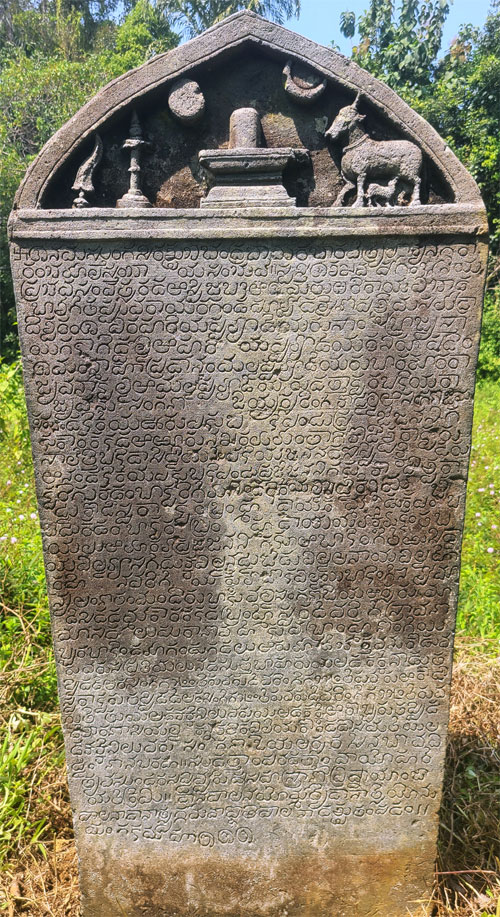
The text begins with the auspicious Swastika symbol, followed by an invocation to Lord Shiva. Although the dating details mention the Saka year 1039, Prabhava Samvatsara, Bahula 3, this does not align with the Vijayanagara period. Prof Murugeshi noted that the intended date was likely Saka year 1309 (corresponding to 1387 AD), which matches the Prabhava Samvatsara.
The inscription praises King Harihara II as the overlord of the three oceans (Purva Dakshina Paschima Samudradhisvaram). It records that by the royal order of Hariyappa Vodeya, Maha Pradhana (prime minister) Mallappa Vodeya was ruling over the Barakur Rajya. The record states that Mallappa Vodeya granted the Dattaluva kingdom to Sanganna Jaya Arasa.
In turn, Sanganna Jaya Arasa granted two 'balikes' (land grants) to Kotishvaralva and Kadambalva in Nandalike as 'Brahmadaya', free from all taxes. Out of these two land grants, six 'mude' of paddy were to be given to a Brahmin who taught the Puranas.
The record mandates the two brothers to provide this offering every year without fail, as per the deed of dharma established by Jaya Arasa. It further warns that if the state or any individual evades this dharma, a penalty of 250 gadyana must be paid to the king, and 150 gadyana to the deity.
The inscription was inscribed by Senabova Vittanna, associated with Jaya Arasa, and concludes with standard imprecatory passages.