Daijiworld Media Network - Mangaluru/Thiruvananthapuram
Mangaluru/Thiruvananthapuram, Aug 23: The long-standing demand to bring Mangaluru’s railway administration under Karnataka has gained fresh momentum with the Centre issuing a Gazette notification to shift the Mangaluru railway area from Southern Railway’s Palakkad division to the Mysuru division of South Western Railway (SWR), even as Keralam has mounted political opposition and decided to seek the Centre’s intervention.
The Gazette notification, issued on August 21, revises the jurisdictional boundaries of the Mysuru division, Konkan Railway and Palakkad division, citing operational requirements. The changes will come into effect from October 1.
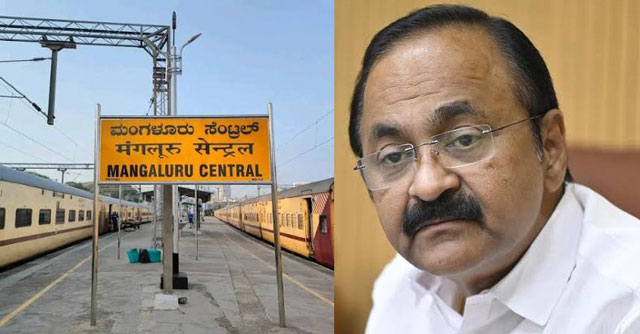
Under the existing arrangement, the divisional/zonal boundary between Mysuru division and Palakkad division is fixed at kilometre 872.900 on the Shoranur Junction–Mangaluru Central section. The revised arrangement will shift the boundary between the two divisions from Padil to Ullal.
The existing boundary between Konkan Railway and Southern Railway will become the boundary between Konkan Railway and SWR. Similarly, the existing boundary near Thokur between Palakkad division and Konkan Railway will become the boundary between Konkan Railway and the Mysuru division of SWR.
The move has been welcomed in Karnataka but has triggered strong opposition in Keralam, where Chief Minister V D Satheesan termed the Railway Board’s decision “unilateral” and unacceptable.
Satheesan said the decision was taken without informing the state government or holding discussions with it and described its reconsideration as Keralam’s “united demand”. He warned that excluding strategically important Mangaluru Junction would substantially reduce Palakkad division’s revenue and adversely affect its development.
The transfer of the area from Ullal to Mangaluru, currently under Southern Railway, to SWR would also cause a major loss to Southern Railway and Keralam, he said.
“We will approach the Centre seeking an urgent solution to the issue. Letters will be sent to the Prime Minister and the Union Railway Minister. With the cooperation of the state’s MPs, pressure will be exerted on the Centre to reconsider the decision,” Satheesan said.
Senior Congress leader and Kasaragod MP Rajmohan Unnithan also criticised the move, calling it another example of the Railways’ alleged neglect of Keralam, particularly the Malabar region. He described it as a continuing “stepmotherly attitude” towards Keralam and said it would not be accepted under any circumstances.
Unnithan warned that losing the Mangaluru region, including the New Mangalore Port Authority (NMPA), which he described as the lifeline of Palakkad division, could eventually leave the division vulnerable to a merger with either Salem or Thiruvananthapuram division on the grounds that it was no longer operationally profitable. He demanded immediate withdrawal of the decision and said he had written to the Railway Minister and senior Railway officials.
Palakkad MP V K Sreekandan alleged that the division was being split without informing Keralam’s MPs or the state government. He accused the Centre of attempting to weaken and eventually eliminate Palakkad division by reducing its revenue and funding.
“Palakkad is one of the highest-revenue divisions in South India. The decision to divide it was taken without explaining the reason or consulting anyone,” he said, adding that protests would be held inside and outside Parliament.
Sreekandan also claimed the decision was taken “overnight” and warned that the transfer would mean Palakkad would no longer have long-distance trains, while the revenue loss could seriously affect the division and railway development in Keralam.
Objections to Keralam CM’s statement
Several people have also objected to the statement attributed to the Kerala Chief Minister. In Mangaluru, however, the decision has been hailed as a major victory. Hanumanth Kamath, former member of the Palakkad Division Railway Users’ Consultative Committee, said people had for years maintained that Keralam was receiving 75% of Palakkad division’s revenue.
“Our money should be used for our state. We have got justice. There is no problem for the development of Keralam. Even small railway stations in Keralam have been developed. The Palakkad division had adopted a stepmotherly attitude towards us. We were in a position where we had to beg. Now we have achieved a major victory,” he said.
Karunakar M questioned the logic of Kerala’s objection, saying that Mangaluru is in Karnataka and that it was appropriate for the railway area to be operated from Karnataka.
M Krishna said the Palakkad division had not done any significant work for Mangaluru Junction and that the Railway Board’s decision was appropriate.
Others, including Harish Bharadwaj K and Agastya, questioned whether Keralam needed Mangaluru’s railway revenue for its development.
C G Prashanth said Keralam had been receiving the revenue for the past 24 years and that the Palakkad division should now operate independently and generate its own revenue.
Senior Mysuru divisional railway officials are expected to visit the Palakkad divisional office after Onam to discuss the transfer, including railway assets and continuation or transfer of staff.
MP Captain Brijesh Chowta called the Gazette notification “historically significant”, saying Mysuru would become the single administrative centre for operations, infrastructure and services.
“Administratively, Mysuru will now be the single centre for operations and for seeking infrastructure and services. There will no longer be the confusion that existed earlier. There will no longer be the confusion that existed earlier. Locally, railway-related contracts and outsourcing opportunities are also expected to increase for local people,” he said.
Karnataka Legislative Assembly Speaker U T Khader said the move fulfilled a long-standing demand and would benefit development in the region and the state. Khader also congratulated union minister of state for railway V Somanna, chief minister D K Shivakumar and MP Captain Brijesh Chowta for their role in the process.