Daijiworld Media Network - Washington
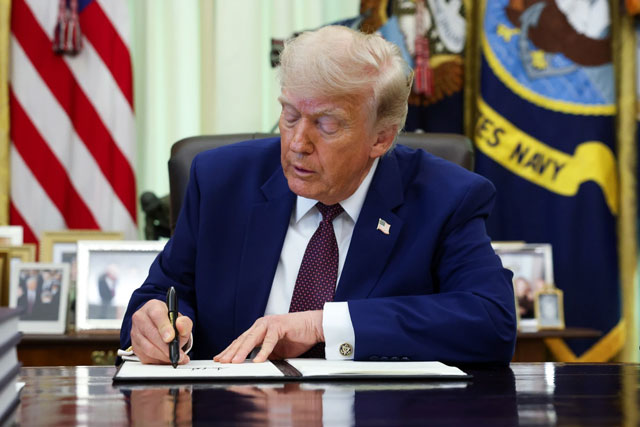
Washington, Jun 23: US President Donald Trump on Monday signed executive orders aimed at accelerating quantum technology research, encouraging government adoption and strengthening American defences against future cyberattacks.
Trump said the measures would help make the United States “the world leader” in the emerging quantum technology sector.
“We’re already the leader by a lot, and we’re going to be now the leader by a lot more,” Trump said at the White House.
Quantum computing remains an early-stage technology but has become a major area of competition between the United States and China due to its potential impact on national security, scientific research and cybersecurity.
Trump was joined at the signing event by Alphabet President Ruth Porat and International Business Machines Corp (IBM) Chief Executive Officer Arvind Krishna. IBM shares rose 2.4 per cent in after-hours trading following the announcement.
The first executive order will launch an initiative to develop a quantum computer capable of carrying out important scientific calculations. White House officials said they expect such a computer could be developed by 2028.
The order also directs federal agencies to prepare plans to deploy quantum-enabled sensors and networks within the next five years. It includes efforts to work with international allies to protect quantum technology intellectual property and strengthen supply chains.
A second executive order focuses on protecting US systems from quantum-powered cyberattacks by accelerating the adoption of post-quantum cryptography.
Officials said federal agencies will be required to migrate high-value assets to quantum-resistant security standards by 2031 at the latest.
Quantum computers, while not yet practical at large scale, could eventually become powerful enough to break current encryption systems used to protect sensitive information, including financial transactions and private communications.
The US Commerce Department in 2024 approved three encryption algorithms designed to withstand potential quantum attacks. Efforts to address quantum cybersecurity risks have been ongoing for years, including work by a Commerce Department office since at least 2016.
Senior White House officials said the government would work with domestic technology companies to implement the new measures, though they did not name specific firms.
The initiative could provide a boost to the growing quantum industry, where company valuations have increased amid investor interest in next-generation technologies following the artificial intelligence boom.
Officials said the Department of Energy would establish technical requirements for a research-focused quantum computer, which would be placed at a national laboratory or another Energy Department facility.
The Trump administration has also positioned itself to support the sector financially. In May, the Commerce Department announced plans to provide more than $2 billion in funding in exchange for non-controlling equity stakes in quantum companies, including IBM and GlobalFoundries.
Scientists and engineers have spent decades trying to harness quantum physics to develop machines far more powerful than conventional computers. While major advances have been made, researchers are still working to overcome challenges in making the technology reliable and scalable.
The new orders also include measures to protect the quantum sector from espionage and expand the workforce through apprenticeships and training programmes.
----------------------------------------------------
US senators question Pakistan, Qatar role in Iran talks over terror links
Daijiworld Media Network - Washington
Washington, Jun 23: Two Republican US senators have raised concerns over the involvement of Qatar and Pakistan in negotiations linked to Iran, citing their past associations with terrorism, following Vice President J D Vance’s remarks expressing support for Islamabad.
Senator Rick Scott of Florida, in a post on X on Monday, said Qatar and Pakistan had “long histories of harbouring terrorists” and questioned their role in efforts aimed at securing a peace agreement with Iran.
“It should be clear to everybody by now who our friends really are. Qatar and Pakistan have long histories of harbouring terrorists, and right now they seem far more invested in propping up Iran's decades-long terror campaign than achieving a meaningful peace,” Scott said.
His remarks came after Vance, while speaking in Switzerland during talks involving Pakistan and Qatar, said “we love Pakistan” as officials discussed technical aspects of a possible agreement with Iran.
Scott said there was still a possibility of reaching a workable deal but insisted that Iran must not be allowed to develop nuclear weapons.
“There is zero chance Iran comes out of this able to build a nuclear weapon,” he said.
Montana Senator Tim Sheehy also criticised Pakistan’s role, pointing to the case of former Al Qaeda leader Osama bin Laden, who was killed in Pakistan in 2011.
“Pakistan hid bin Laden for a decade,” Sheehy said in an interview with Fox News, alleging that Pakistan’s intelligence agency ISI had supported militant activities.
He argued that if Pakistan and Qatar were part of the negotiations, countries such as the UAE, Israel and Saudi Arabia should also be included, describing them as key US allies in the Middle East.
Sheehy also accused Qatar of allowing financial support networks linked to terrorist organisations for decades.
“The Pakistanis through the ISI funded insurgencies against us and hid bin Laden. So to assume they're going to be objective middlemen here, I don't think is accurate,” he said.
Meanwhile, Vance on Sunday spoke positively about Pakistan Army Chief Field Marshal Asim Munir, describing him as one of two “very important people” in his life.
Vance said that after Munir welcomed him along with Pakistan Prime Minister Shehbaz Sharif in Islamabad, he often joked that one important person in his life was his Indian wife and the other was Munir.
He added that over the past three months he had spoken with Munir more than “anybody else.”