Daijiworld Media Network - Jerusalem
Jerusalem, Apr 20: Israel’s military has released details of a planned “buffer zone” in southern Lebanon, outlining a wide ?????ry belt extending several kilometers into Lebanese land. The proposed zone stretches from the Mediterranean coastline to the Mount Hermon region near the Syrian border, forming what officials describe as a continuous defensive line.
Prime Minister Benjamin Netanyahu and Defence Minister Israel Katz have both stated that Israeli forces will remain in the area despite a temporary ceasefire that came into effect late last week. Katz indicated that structures within the zone could be demolished, drawing parallels to military operations in Gaza, and warned that individuals identified as members of Hezbollah would be targeted.
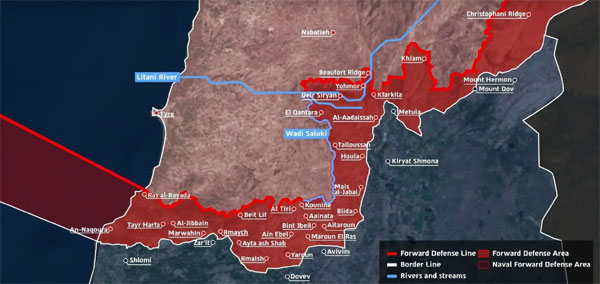
According to the military, five divisions supported by naval units are currently operating inside Lebanese territory to establish what it calls a “Forward Defense Line.” The objective, officials say, is to prevent threats to communities in northern Israel.
The released map also highlights a maritime component along the Naqoura–Ras al-Bayada coastline. The buffer zone extends beyond several key locations, including Bint Jbeil, Aita al-Shaab, and Khiam, reaching toward the Litani River in certain areas. Both Lebanon and Syria have rejected the move.
Despite the ceasefire, hostilities appear to have continued. National News Agency reported intensified Israeli operations in southern Lebanon on Sunday, including demolitions and shelling in affected areas. In Bint Jbeil, tanks were seen patrolling heavily damaged neighborhoods, while explosions were reported in nearby towns such as al-Bayada and al-Naqoura. Roads were also blocked with earth barriers, and shelling targeted the town of Kounine.
There has been no immediate response from Israeli authorities regarding these reports.
The development comes shortly after United States announced a 10-day ceasefire between Israel and Hezbollah following weeks of intense clashes that began in early March. A previous ceasefire in November 2024 had similarly seen continued Israeli strikes in parts of southern and eastern Lebanon, underscoring the fragility of such agreements.