Every infrastructure discussion in Indian boardrooms eventually lands on the same fork in the road: Bare metal or cloud? And no, this isn’t a theoretical debate anymore.
With stricter compliance norms, cost pressure, unpredictable traffic spikes, and performance-hungry applications, choosing between bare metal vs cloud has become a business decision, not just a technical one.
At a high level, the choice looks simple. Bare metal gives you raw, dedicated power. Cloud gives you speed, elasticity, and abstraction. But once you factor in workload determinism, compliance, predictable throughput, and long-term cost curves, the answer becomes far more nuanced, especially in the Indian enterprise context.
Understanding Bare Metal and Cloud Environments
A bare metal server is a single-tenant physical machine. No hypervisor. No noisy neighbors. No shared CPU cycles. You get dedicated CPU cores, memory, storage, and network fabric, end to end.
Key characteristics of bare metal servers:
- Zero virtualization and no hypervisor overhead
- Hardware-level control and kernel customization
- CPU affinity, memory pinning, NUMA optimization
- Predictable performance and I/O consistency
- Full control over Linux server configuration
Earlier, bare metal meant long procurement cycles and rack-and-stack ops. Today, with modern bare metal hosting India providers, metal provisioning can happen via APIs, sometimes in minutes. Same physical control, far less friction.
On the other hand…
Cloud infrastructure abstracts hardware into virtual machines running in a multi-tenant environment. Resources are carved out using hypervisors, wrapped with automation, autoscaling, and managed services.
Key features of cloud infrastructure for enterprises:
- Infrastructure abstraction
- Rapid provisioning and autoscaling
- Pay-as-you-use (pure opex)
- Managed networking, storage, databases
Public cloud (AWS, Azure, OVHcloud, GCP), private cloud, and managed cloud all fall under this umbrella. The strength of cloud lies not in raw power, but in operational velocity.
Performance Comparison: Speed, Isolation & Throughput
This is where cloud vs bare metal servers truly diverge.
Bare metal shines when performance must be consistent.
- No system jitter from neighboring workloads
- Dedicated CPU cores ensure workload determinism
- Storage locality improves latency-sensitive apps
- Zero virtualization means predictable throughput
This matters in:
- High-frequency fintech systems
- Core banking workloads
- Media rendering pipelines
- Large transactional databases
- AI/ML training where node exclusivity matters
You control the kernel, tune the scheduler, optimize NUMA, and squeeze every drop from the hardware. For performance isolation, nothing beats bare metal.
Cloud performance is usually good enough, until it isn’t.
- Hypervisor overhead is real, though small
- Multi-tenant contention can introduce variability
- Network fabric is abstracted
- I/O consistency depends on instance class
For web apps, SaaS platforms, APIs, and bursty workloads, cloud works brilliantly. But for latency-sensitive or throughput-critical systems, the unpredictability becomes noticeable.
Security and Compliance: Control vs Abstraction
Indian enterprises don’t just worry about breaches, they worry about audits.
With bare metal server deployments in India, you get:
- Full data isolation (single tenant)
- Easier alignment with RBI, IRDAI, DPDP Act
- Custom security hardening
- Clear audit boundaries
For BFSI, healthcare, and regulated SaaS, bare metal simplifies compliance conversations. You know where the data lives. You know who touches the hardware.
Cloud providers offer strong security, but responsibility is shared.
- Provider secures infrastructure
- You secure OS, apps, access, configurations
Misconfigurations remain the biggest risk. Compliance is achievable, but it requires mature governance, logging, and access control.
Cost Considerations: Capex vs Opex in the Indian Market
Cost is where many IT infrastructure decisions in India quietly go wrong.
Cloud Cost
Pros:
- Zero upfront cost
- Easy experimentation
- Ideal for variable demand
Cons:
- Always-on workloads get expensive
- Egress charges surprise finance teams
- Performance-optimized instances cost more
Cloud looks cheap early on. Over time, steady workloads bleed budget.
Bare Metal Cost
Pros:
- Fixed monthly pricing
- Better price-performance ratio at scale
- No surprise bills
Cons:
- Higher commitment
- Requires ops discipline
For 24×7 workloads, bare metal often wins on total cost of ownership. This is the quiet reason many mature startups move off public cloud.
Hybrid Cloud and Bare Metal: A Strategic Mix
Most Indian enterprises don’t choose one. They blend.
Hybrid cloud and bare metal strategies typically look like:
- Core databases on bare metal
- APIs and frontends on cloud
- Burst workloads scale into cloud
- Compliance-critical data stays isolated
This gives you control where it matters and agility where it helps.
India-Specific Considerations: Data, Latency, Compliance
Infrastructure decisions in India have local gravity.
Key factors:
- Data residency requirements
- Latency across regions
- Availability of local support
- Regulatory scrutiny
Using a bare metal server configuration hosted in-country reduces compliance risk and improves user experience. For media and fintech platforms, milliseconds matter.
Some enterprises use providers like OVHcloud that offer bare metal servers and public cloud services under a single control plane, making hybrid cloud and bare metal architectures easier to operate without excessive vendor sprawl.
Decision Framework: When to Choose What?
Instead of debating philosophy, Indian IT leaders benefit more from a simple workload-first lens. The table below is how many infrastructure architects actually decide in practice.
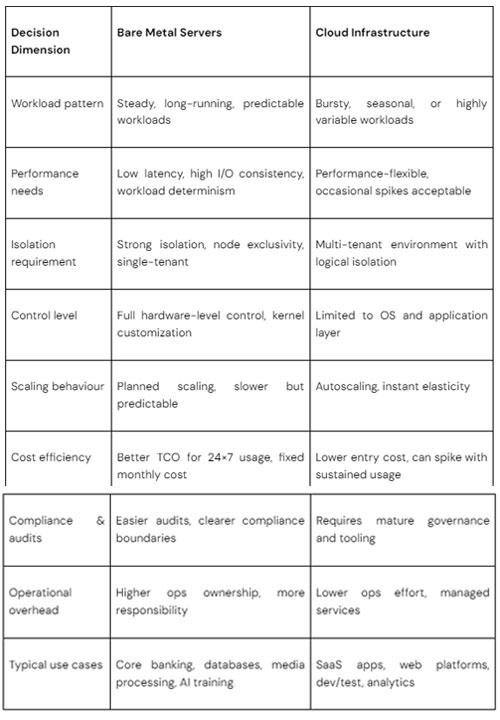
Choose Bare Metal When:
- Workloads are stable and intensive
- Performance must be predictable
- You need hardware-level control
- Compliance demands isolation
Choose Cloud When:
- Traffic is unpredictable
- Speed of deployment matters
- You rely heavily on managed services
- Ops bandwidth is limited
Choose Both When:
- You’re scaling fast but regulated
- Cost efficiency matters long term
- Different workloads behave differently
This is where dedicated servers vs cloud stops being an argument and becomes architecture.
Conclusion: Smart Infrastructure Choices for Indian Tech Leaders
There is no universally correct answer in the bare metal vs cloud debate. There is only context.
Bare metal offers certainty, performance isolation, predictable throughput, and deep control. Cloud offers velocity, autoscaling, abstraction, and speed. Indian enterprises that win are the ones that understand both deeply and deploy them intentionally.
Today, CIOs don’t ask which is better? They ask which workload deserves what? That mindset, not the technology, defines modern enterprise’s IT infrastructure in India.