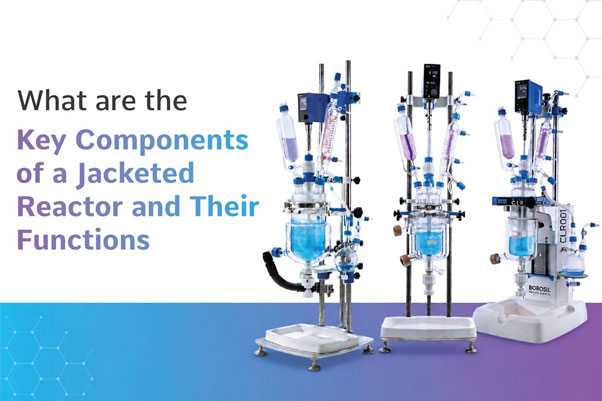
A jacketed reactor is a very important piece of equipment in chemical and pharmaceutical research, process development, and industrial scale-up. Whether in a small-scale laboratory glass reactor or a pilot-scale system, the reactor is designed to carry out chemical reactions under controlled temperature pressure, mixing, and residence time. It provides the environment where molecules interact, break bonds, form new ones, and create the desired product. These reactors provide precise temperature control, mixing, and reaction monitoring.
A reactor balances four engineering pillars:
- Reaction Kinetics: rate laws, activation energy catalyst activity
- Heat Transfer: jackets, coils, limpet, internal exchangers
- Mass Transfer: gas-liquid absorption, diffusion, kLa, film resistance
- Hydrodynamics: mixing patterns, back-mixing, pressure drop, fluidization
Instrumentation (cascade temperature control, feed flow control, SIS/ESD) ensures safe and stable operation.
Understanding the key components and their functions helps researchers optimise processes, reduce operational downtime, and achieve consistent results, and this guide will help you do that.
Reaction Vessel: The Core of the System
The reaction vessel is the heart of a jacketed reactor, where the actual chemical or physical reaction occurs.
- Material Considerations: Reaction vessels are typically made of borosilicate glass or stainless steel, depending on chemical compatibility and process needs.
- Jacketed Design: The double-walled structure allows precise temperature regulation by circulating heating or cooling fluids within the jacket.
- Volume Flexibility: Laboratory-scale vessels typically range from 250mL to 5 L, whereas pilot reactors like COMET from Borosil Scientific can scale up to 20 L, COSMOS can scale up to 50L ensuring a seamless transition from R&D to industrial production.
For small-scale research, systems like the Compact Lab Reactor from Borosil Scientific offer quick vessel replacement with a user-friendly clamping system, ensuring minimal process interruptions.
Stirring Mechanism: Ensuring Homogeneous Mixing
Efficient mixing is important for uniform heat distribution, reactant dispersion, and process consistency.
- Stirrer Drive System: Offers consistent shear force and mixing intensity, preventing local overheating or concentration gradients.
- Easy Stirrer Drive Adjustment: Many systems, including the Borosil Scientific ACADEMIX and Mini Lab Reactor, feature motor lifting mechanisms that simplify alignment and adjustment.
- Impeller Selection: Depending on viscosity, propeller, turbine, or anchor-type impellers are used.
A well-designed stirring mechanism ensures effective heat and mass transfer, critical for reaction kinetics and yield optimisation.
Heating and Cooling Jacket: Temperature Precision
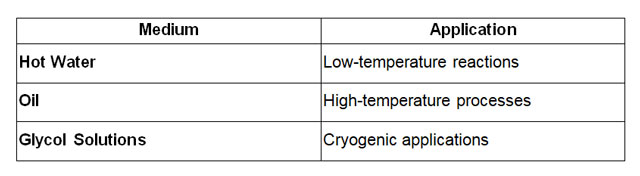
The jacket surrounding the reactor vessel allows precise temperature control by circulating heating or cooling media such as:
Sealing System: Preventing Leaks and Contamination
The integrity of a jacketed reactor depends on a robust sealing system that maintains vacuum or inert atmospheres during reactions.
- Spring-Loaded Securing Mechanism: Provides a secure and user-friendly setup, reducing the risk of leaks.
- Protective Cap on Reaction Vessel: Shields contents from atmospheric moisture, ensuring accurate extractions.
- Vacuum Tight Seals: Particularly critical in laboratory glass reactors, these help in achieving the vacuum even during the continuous agitation.
A well-sealed system prevents contamination and enhances the distillation operation.
Reactor Support and Clamping System: Stability and Safety
A secure mounting system ensures the reactor remains stable during operation.
- Quick-Release Vessel Clamp: Found in the Borosil Scientific ACADEMIX reactors, enabling rapid vessel replacement.
- Spring-Loaded Knobs: Provide easy tightening while ensuring secure placement.
- Hose Clip and Support Structure (HCSS): Keeps tubing organised and in place, especially in multi-reagent systems.
Stable reactor setups improve safety and operational efficiency, reducing risks of breakage and spills.
Effluent and Spill Management: Preventing Contamination
Chemical processes often involve handling volatile solvents and reaction byproducts. Efficient waste handling improves lab safety and hygiene.
- Drip Trays: Integrated beneath the Borosil Scientific Compact Lab Reactor and Mini Lab Reactor, ensuring accidental spills are contained.
- Closed Loop Solvent Recovery: Helps reduce solvent waste, optimising resource utilisation..
Proper spill management enhances lab safety, prevents cross-contamination, and improves workflow efficiency.
Scalability Considerations: From Lab to Industrial Production
Scaling up reactions from lab to industrial levels requires maintaining consistent process parameters.
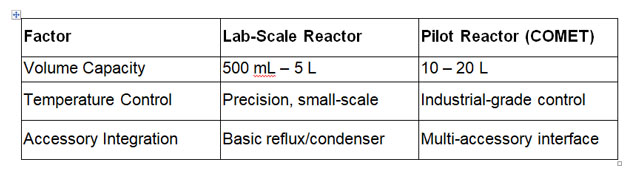
The COMET Jacketed Pilot Reactor from Borosil Scientific ensures seamless scalability by maintaining identical mixing and heat transfer properties, enabling industrial transition without process deviations.
Accessory Integration: Enhancing Functionality
Modern jacketed reactors support additional accessories for enhanced reaction flexibility.
- Fractional Distillation Columns: Integrated into pilot reactors for precise solvent recovery.
- Liquid-Solid Dosing Systems: Found in COMET reactors by Borosil Scientific, optimising reagent addition for process efficiency.
- Vacuum Control Systems: Ensure controlled pressure conditions for sensitive reactions.
Versatile accessory integration makes sure reactors meet the specific demands of various applications.
Conclusion
A jacketed reactor is an indispensable tool in chemical, pharmaceutical, and industrial process development. Understanding its key components, from reaction vessels and stirring mechanisms to temperature control and monitoring systems, ensures optimal reaction efficiency and reproducibility.
With modular systems like the COMET Jacketed Pilot Reactor, researchers can seamlessly scale reactions, integrating advanced stirrer adjustment mechanisms, phase separation units, and solvent recovery systems to enhance operational efficiency.
For precise laboratory control, compact systems like the Borosil Scientific ACADEMIX and Mini Lab Reactor provide flexible setups with quick vessel replacements, secure clamping, and efficient spill management.
By selecting the right jacketed reactor components, researchers can improve process control, reaction safety, and overall efficiency, making them essential for laboratory and industrial applications alike.