Daijiworld Media Network - New Delhi
New Delhi, Mar 2: India and Canada took a significant step in strengthening bilateral relations by signing a landmark uranium supply agreement valued at $2.6 billion. The pact was formalised during talks between Prime Minister Narendra Modi and his Canadian counterpart Mark Carney at Hyderabad House in the national capital.
The agreement ensures a long-term supply of uranium for India’s civil nuclear energy programme, bolstering efforts in clean and reliable power. Both leaders underscored that the deal would enhance collaboration in advanced nuclear technologies, including small modular reactors and next-generation nuclear reactors.
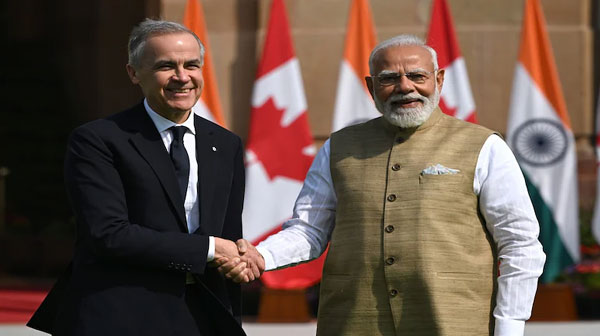
In parallel, India and Canada agreed to accelerate negotiations on a Comprehensive Economic Partnership Agreement (CEPA), with the aim of concluding it by the end of 2026. Prime Minister Modi highlighted ambitions to expand bilateral trade to $50 billion by 2030, fostering investment and employment opportunities in both countries.
Several Memorandums of Understanding were also signed, covering cooperation in critical minerals, promotion of renewable energy, and cultural exchange. These were exchanged by S. Jaishankar and Anita Anand in the presence of the two prime ministers. The agreements on critical minerals aim to create robust and reliable supply chains for future energy and industrial needs.
Prime Minister Modi lauded Carney for energising India-Canada relations, noting that both nations share democratic values, respect for diversity, and a commitment to global well-being. He emphasised that these shared principles would guide a deeper strategic partnership.
The talks also expanded collaboration in renewable energy and climate action, with Canada joining initiatives such as the International Solar Alliance and the Global Biofuel Alliance. On technology and innovation, Modi highlighted growing ties in areas including artificial intelligence, quantum technologies, supercomputing, and semiconductors, underscoring the natural alignment of the two countries in science and technology development.