Daijiworld Media Network - New Delhi
New Delhi, Feb 2: India’s rabi sowing has registered a healthy rise this winter, with the total area under crops increasing by 15.88 lakh hectares to 676.84 lakh hectares as of January 30, according to data released by the Ministry of Agriculture and Farmers Welfare. This marks a notable jump from 660.96 lakh hectares recorded during the same period last year.
The expansion in acreage is expected to translate into higher agricultural output, offering a dual benefit of improved farm incomes and added support in containing food inflation.
Crop-wise data reveal that wheat continues to dominate rabi cultivation, with its sown area rising by 6.13 lakh hectares to 334.17 lakh hectares, compared to 328.04 lakh hectares a year ago. Pulses have also seen strong growth, with crops such as urad, lentil (masur), gram and moong covering 139.55 lakh hectares—up by 5.03 lakh hectares from last year’s level.
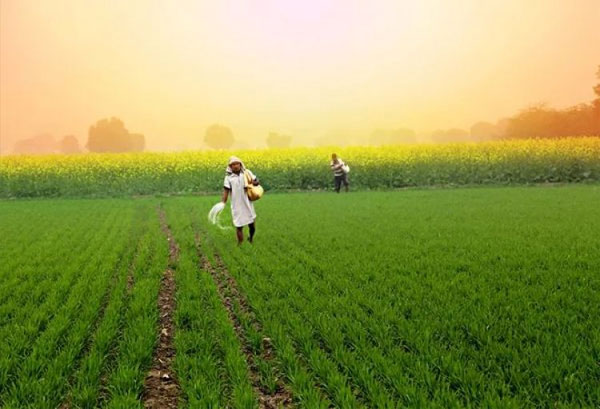
Cultivation of coarse cereals and millets, including jowar, bajra and ragi, has edged up by 0.94 lakh hectares to reach 60.93 lakh hectares so far this season. Oilseeds, led by rapeseed and mustard, have recorded an increase of 3.52 lakh hectares, taking the total area under these crops to 97.19 lakh hectares.
Officials attribute the overall rise in sowing to favourable monsoon conditions, which have supported planting in rain-fed regions. Such areas account for nearly half of India’s total farmland, making rainfall a crucial factor in agricultural performance.
In a parallel policy push, the Cabinet Committee on Economic Affairs had approved a hike in the minimum support prices (MSP) for all mandated rabi crops on October 1 last year for the 2026–27 marketing season. The move is aimed at ensuring remunerative prices for farmers and encouraging informed cropping decisions ahead of the sowing cycle.
Among the crops, safflower has received the steepest MSP increase at ?600 per quintal, followed by lentil (masur) with a ?300 hike. MSPs for rapeseed and mustard, gram, barley and wheat have been raised by ?250, ?225, ?170 and ?160 per quintal, respectively.
The revised MSP framework aligns with the Union Budget 2018–19 commitment to fix support prices at a minimum of 1.5 times the all-India weighted average cost of production. Under this formula, farmers are expected to earn margins of 109 per cent for wheat, 93 per cent for rapeseed and mustard, 89 per cent for lentils, 59 per cent for gram, 58 per cent for barley and 50 per cent for safflower.
According to the ministry, the cost of production calculation factors in all paid-out expenses such as labour, machinery, leased land rent, seeds, fertilisers, irrigation, fuel, depreciation, interest on working capital, miscellaneous costs and the imputed value of family labour—ensuring a comprehensive and farmer-friendly pricing structure.