Daijiworld Media Network – New Delhi
New Delhi, Oct 24: While many children reach for an iPad for entertainment, four-year-old Arjun Prajapati, a Gujarati-origin boy living in Canada, prefers to lose himself in books. Having read more than 3,000 books, the young learner has scored an IQ of 141, ranked in the 99.7th percentile in a standardised cognitive assessment and qualified for membership of two internationally recognised high-IQ societies, Mensa and Intertel.
Arjun's learning journey began when he was just 18 months old. Born into a family originally from Vadodara, Gujarat, he now lives in Canada with his parents. According to his family, his appetite for knowledge extends well beyond science, technology, engineering and mathematics (STEM) to microbiology, immunology, human physiology, astronomy and ancient civilisations.
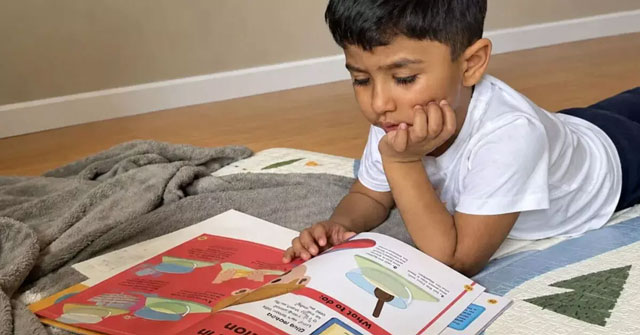
While children his age may be engrossed in the fictional worlds of Harry Potter and Sherlock Holmes, Arjun gravitates towards non-fiction and science-based explanations. In an era when digital devices increasingly occupy children's attention, his preference for printed books as a primary source of knowledge has set him apart.
IQ assessment places him among top performers
At around four years of age, Arjun underwent a standardised cognitive assessment using the Stanford-Binet Intelligence Scales, Fifth Edition (SB5). According to the report shared by his family, he scored 141 in the Full Scale IQ (FSIQ) assessment, placing him in the 99.7th percentile.
His other scores were equally striking. He scored 149 in non-verbal IQ, placing him in the 99.99th percentile; 144 in fluid reasoning, corresponding to the 99.8th percentile; and 146 in working memory, placing him in the 99.9th percentile.
The results qualified him for membership of Mensa and Intertel, two high-IQ societies with stringent entry criteria. Mensa generally admits individuals who score within the top two per cent of the population on a recognised intelligence test, while Intertel requires candidates to rank within the top one per cent.
Every question becomes a learning opportunity
Arjun's mother, Mahita Prajapati, said his curiosity and eagerness to learn became apparent when he was very young. His reading journey began with picture books featuring illustrations and introductory letters. Recognising his interest, she patiently answered his questions and helped him learn phonics and numbers.
His parents regularly took him to a nearby library, where he typically read nine to 10 books per visit. His enthusiasm was such that he would also pick up books left on tables by other readers and start reading them.
“However unusual or complicated Arjun's questions may seem, we have always tried not to dismiss them. When we do not know the answer, instead of simply saying, ‘I don't know’, we tell him, ‘That's a wonderful question! I don't know the answer yet either. Shall we find it together?’ Sometimes, his questions give us, as parents, an opportunity to learn something new as well,” his parents said.
Books accompany him from morning till bedtime
For Arjun, books are a constant companion. Whether at breakfast, before bedtime, during school holidays or on car journeys, he spends much of his time reading. He even sleeps with a book under his pillow and often begins the day by reading as soon as he wakes up.
Google, YouTube and children's video channels are not his first choices when he wants to explore something new.
Mahita said the family had consciously cultivated habits that limited the time he spent in front of screens.
“Even if he feels bored and frustrated at weekends, I will not hand him a digital device just to watch meaningless content,” she said.
She believes that allowing children to experience boredom can encourage them to explore their interests, ask questions and discover new things independently.
Arjun also watched his mother read printed books instead of using a tablet. Whenever he encountered an unfamiliar word, he would ask her about its meaning. Mahita would bring out a dictionary and look up the word with him. These seemingly small but consistent practices helped nurture his growing love of reading.
Reading opens the door to Genetics and Biology
Arjun's interest in books has introduced him to concepts in genetics and human biology. He has learnt that the human body contains 23 pairs of chromosomes and has even explained the concept to his parents.
“Dad, you have XY chromosomes and Mum has XX chromosomes,” he reportedly told his father.
His intellectual abilities and curiosity have also earned him an invitation to attend a session at the Canadian Legislative Assembly on October 28. The young boy is excited about the opportunity.
Arjun's story offers a glimpse into how curiosity, access to books and encouragement at home can nurture a child's enthusiasm for learning. At a time when screen-based entertainment is increasingly woven into everyday life, his journey underlines the value of reading, asking questions and exploring the world beyond digital devices.