Daijiworld Media Network - Mumbai
Mumbai, Aug 17: They were healthy children who played, laughed and went to school. Years after suffering measles, some began experiencing falls, memory loss and behavioural changes before gradually losing their ability to walk, speak and see.
For many families in Maharashtra, the diagnosis eventually came as Subacute Sclerosing Panencephalitis (SSPE), a rare and progressive neurological disorder associated with measles infection.
Parents of affected children say they have sold gold and land, exhausted their savings and taken loans to meet the continuing costs of medicines, medical equipment, rehabilitation and caregiving. Many claim that government assistance has been limited or non-existent.
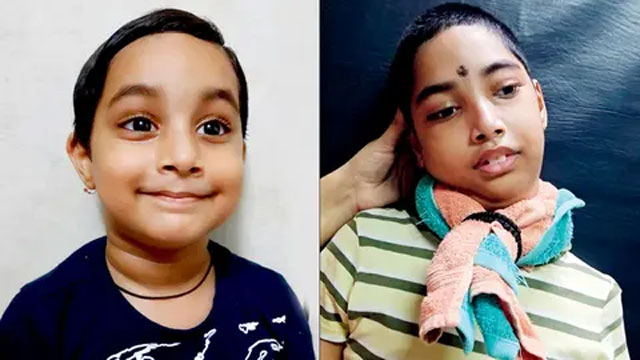
Among them is Kalpana Jagtap-Bhosale, whose son Shaurya was a cheerful and active child when he joined Junior KG five years ago. Today, the nine-year-old is bedridden and unable to see, speak or move independently.
According to his mother, Shaurya initially began suffering from repeated falls and buckling of his legs, followed by memory loss and sudden behavioural changes. He was subsequently diagnosed with SSPE.
Jagtap-Bhosale said Shaurya's condition deteriorated rapidly and that he became bedridden within two months of his diagnosis. For the past five years, the family has provided round-the-clock care while struggling with the expenses involved.
"The lively, cheerful child who once went to school and dreamed of a normal future has been reduced to an extremely fragile existence. He is either silent or howling in pain," she said in a representation.
Jagtap-Bhosale has now approached the Maharashtra State Legal Services Authority (MSLSA), seeking assistance for Shaurya and other families affected by SSPE.
Case before High Court
A petition has also sought a comprehensive healthcare and welfare policy for people suffering from SSPE.
During a hearing on Apr 17, 2026, the Bombay High Court recorded that Maharashtra did not have a specific policy for SSPE. The Centre had taken the position that SSPE was not covered under the National Policy for Rare Diseases on the ground that the condition is not curable.
The court directed the Centre to file a reply. Families said the matter was last heard in April and has not been listed for further hearing since.
The petition seeks, among other measures, financial assistance for affected families and greater medical support.
Mother seeks wider support
Jagtap-Bhosale's appeal is not limited to her son's treatment. She wants the legal services machinery to help affected families understand and pursue available relief and assist them in the pending court proceedings.
"We are desperately seeking compassionate support and meaningful intervention so that children like my child are not forgotten," her representation said.
After five years of caring for a child who went from walking into school to becoming completely dependent on others, she is seeking assistance with the cost of keeping him alive and cared for, as well as a system that does not leave families battling a rare disease on their own.
Five years of care
Shaurya was attending Junior KG and leading a normal childhood before symptoms emerged.
His initial symptoms included falls, buckling of the legs, memory loss and behavioural changes. He was diagnosed with SSPE and, according to his mother, became bedridden within two months.
At nine, he requires assistance with basic daily needs and constant medical care.
What families are seeking
Families affected by SSPE are seeking monthly financial or maintenance assistance, free or subsidised medicines and treatment, medical equipment, physiotherapy and rehabilitation, nursing and other caregiving support, and legal assistance in pursuing the pending public interest litigation.
The families say the continuing cost of care has exhausted their savings in several cases. They also claim there is no reliable statewide mapping of children living with SSPE, leaving families to shoulder much of the medical and financial burden themselves.
Concerns over vaccination
The representation has also raised concerns regarding measles vaccination.
The families claim that around 90% of affected children had been vaccinated against measles, while some were vaccinated late or contracted measles at around six or seven months of age, before the standard vaccination schedule.
They are seeking clarity on what responsibility the government bears in cases where children who were reportedly vaccinated subsequently developed SSPE.
The parents say they are seeking not only answers but also government accountability and support for families living with the consequences of the disease.
Number of affected children
The representation refers to 60 to 62 children affected by SSPE in Maharashtra. However, a letter written by Maharashtra Public Health Minister Prakash Abitkar to the Union Health Minister in July 2025 referred to 67 diagnosed cases in the state.
Families have submitted representations to the Chief Minister, Deputy Chief Minister and Public Health Minister. They have also held a peaceful protest outside Mantralaya seeking support for children suffering from SSPE.
They are demanding a system that can help meet the continuing expenses for medicines, specialised equipment, rehabilitation and caregiving rather than leaving individual families to bear the burden themselves.
Legal services authority's response
An official associated with the district legal services authority, requesting anonymity, said the representation submitted by Jagtap-Bhosale had been received and forwarded to the concerned legal services authority.
"We have a limited role to play in the matter, as it concerns other authorities. Our hearts go out to the families, but there is little we can do beyond that," the official said.
For families caring for children with SSPE, the demand remains for sustained medical, financial and institutional support so that they do not have to fight the disease and its enormous costs alone.