Daijiworld Media Network – Dubai
Dubai, Jul 14: The United States launched multiple waves of airstrikes on Iran early Monday following Tehran's attack on a container ship in the Strait of Hormuz that left the vessel ablaze and a crew member missing, as Iran retaliated by launching missile and drone attacks against countries hosting US military forces across West Asia.
Missile alert sirens sounded at dawn in Bahrain, home to the US Navy's Fifth Fleet, while Kuwait said its air defences intercepted incoming Iranian missiles. Jordan also confirmed that it had shot down four missiles launched by Iran. Bahrain activated its missile warning sirens twice on Monday amid the attacks.
Kuwait's military said its air defence systems were engaged in response to the Iranian strikes but did not immediately report any casualties or damage. Jordan's state-run Petra news agency, quoting the military, said the missiles were intercepted successfully and the incident caused no casualties or material damage.
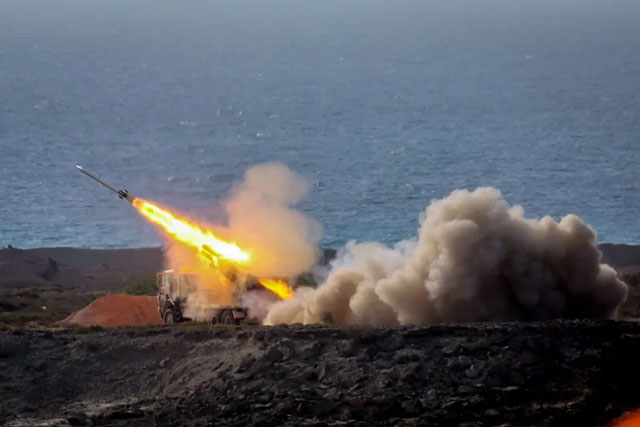
Iran had earlier claimed it had targeted Jordan, which hosts US military personnel.
Iranian state media acknowledged that fresh US strikes hit several locations across the country early Monday, reporting explosions in multiple areas and at least one fatality.
The latest escalation follows Sunday's attacks, during which Iran targeted Bahrain, Kuwait, Qatar, Jordan and Oman, countries that host US military facilities or lie close to the strategically vital Strait of Hormuz.
The narrow waterway, through which nearly one-fifth of global oil and liquefied natural gas shipments once passed, has emerged as the central point of dispute in the fragile interim agreement between Washington and Tehran.
The two countries are nearly halfway through a 60-day interim arrangement intended to pave the way for negotiations on a permanent end to the conflict. Instead, the deal has deteriorated into repeated military exchanges over control of the Strait of Hormuz, raising fears that the war could escalate further.
"A return to full-scale hostilities would have catastrophic consequences," United Nations Secretary-General Antonio Guterres said in a statement.
The US military said it struck around 140 Iranian targets on Sunday, including missile and drone launch sites, ammunition depots, communications infrastructure and other military installations, marking one of its largest operations since the conflict intensified.
"We bombed the hell out of them last night," US President Donald Trump said during an interview with NBC's Meet the Press.
Iran responded by launching attacks against countries hosting US forces while reiterating that it alone has the authority to control navigation through the Strait of Hormuz and may impose charges on vessels passing through the waterway.
"The era of one-sided deals is OVER. We told you: keep your word or pay the price. Reality is knocking," Iranian Parliament Speaker and senior negotiator Mohammad Bagher Qalibaf posted on social media.
While Iran maintained that the Strait of Hormuz remained closed, the US military and President Trump insisted that shipping through the waterway continued uninterrupted.
Since the conflict began on February 28 following the killing of former Supreme Leader Ayatollah Ali Khamenei, Iran has repeatedly targeted commercial shipping in the region in an effort to deter maritime traffic through the strait.
However, the US military has continued escorting vessels along an alternative southern route close to Oman's coastline, a move that has drawn repeated attacks from Iran.
Although Iran's actions initially triggered a sharp rise in global oil prices, crude has since retreated from wartime highs of around USD 120 per barrel.
Diplomatic efforts to salvage the ceasefire also continued despite the escalating violence. Although Trump said last week that the interim agreement was effectively "over", mediators including Pakistan, Qatar and Egypt have continued efforts to revive negotiations.
A regional official involved in the mediation process said talks aimed at preserving the ceasefire continued on Sunday. Pakistan confirmed that its foreign minister had spoken with Iran's top diplomat and urged both sides to de-escalate the conflict.
Meanwhile, Iran's new Supreme Leader Ayatollah Mojtaba Khamenei, making his first public statement since the funeral of his father Ayatollah Ali Khamenei, vowed that Iran would avenge his father's killing.