Daijiworld Media Network – New Delhi
New Delhi, Jan 30: Group Captain Shubhanshu Shukla, India’s first astronaut to fly to the International Space Station (ISS), has added another milestone to his growing list of achievements — he is now a published scientist.
His first peer-reviewed research paper has been published in the US-based journal PLOS One. Interestingly, the work was not carried out in space, but in a laboratory on Earth at the Mechanical Engineering Department of the Indian Institute of Science (IISc), Bengaluru, where Shukla is currently pursuing his Master’s degree.
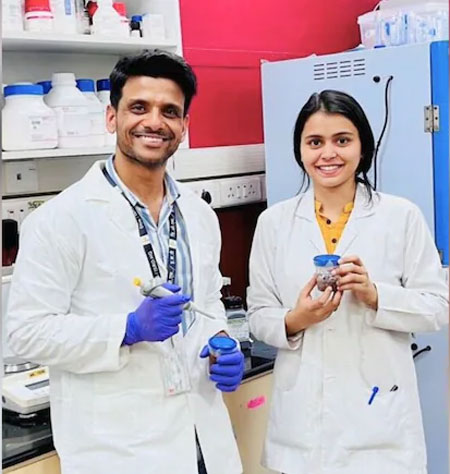
The study examines a futuristic question that could play a crucial role in human missions to Mars: can bacteria help build structures on the Red Planet, even when the soil is toxic?
With scientists across the world, and private space players, envisioning long-term human settlements on Mars, transporting construction material from Earth would be nearly impossible. Shukla says the solution lies in using resources already available there.
“If we don’t have to carry construction material from Earth, and instead use resources available on Mars, it becomes much easier to support long-term missions,” he said.
Mars may appear like a barren desert, but its soil contains perchlorate — a chlorine-based compound found by several space missions. Perchlorate is toxic to most Earth life, damaging cells and disrupting metabolism, making survival difficult for microbes.
This poses a major challenge for the concept of “living construction” on Mars, where bacteria could be used to turn loose soil into solid bricks for roads, landing pads and even habitats.
To understand whether such construction is possible, researchers at IISc explored how bacteria respond to perchlorate-rich Martian soil.
The team focused on a process called Microbially Induced Calcite Precipitation (MICP), where certain bacteria act like microscopic builders. When fed nutrients such as urea and calcium, they produce calcium carbonate — a natural cement that binds soil particles into solid blocks.
Earlier IISc studies had already shown that Sporosarcina pasteurii could convert simulated lunar and Martian soil into “space bricks”, aided by guar gum, a natural adhesive that strengthens the material and supports bacterial survival.
For the latest research, the team used a hardy bacterial strain isolated from Bengaluru soil. Genetic analysis found it closely related to Sporosarcina pasteurii, making it suitable for biocementation.
When exposed to perchlorate levels similar to those found on Mars, the bacteria showed clear stress — growth slowed down, survival dropped, and the microbes changed shape under the microscope. They became rounder and clumped together, forming structures resembling simple multicellular clusters.
The stressed bacteria also released large quantities of extracellular matrix (ECM), a sticky substance that formed tiny “microbridges” linking bacterial cells to mineral deposits.
While perchlorate alone negatively impacted the bacteria, the results turned unexpected when the microbes were used to make bricks from simulated Martian soil.
Most synthetic Martian soils used in labs avoid perchlorate due to its flammable nature. However, to study real-world impact, the IISc team added magnesium perchlorate to a widely used Mars Global Simulant-1.
Bricks were created using bacteria, calcium, urea, guar gum and a small amount of nickel chloride, which enhances the bacteria’s cement-forming enzyme. The outcome surprised researchers — bricks formed in the presence of perchlorate were stronger, but only when guar gum and nickel were also present.
Without guar gum, strong bricks could not be produced. With it, perchlorate appeared to improve compressive strength, possibly due to stress-induced ECM and additional mineral deposits acting as extra binding agents.
While India does not yet have a declared plan for permanent settlements on the Moon or Mars, the research highlights how Indian scientists are already preparing for future deep-space challenges.
The work fits into the concept of in-situ resource utilisation — building using local materials rather than transporting everything from Earth — which could significantly reduce the cost and complexity of long-duration missions.
Such technology could also help address practical challenges, including stabilising uneven terrain for landing sites, rover paths and launch pads.
For Shukla, the publication is being seen as a symbolic scientific milestone. PLOS One is among the world’s leading open-access journals, and publishing a first paper there is considered a major achievement for any researcher.
The study also reflects how astronauts are increasingly becoming scientists in their own right, contributing not only during missions but through research that shapes future missions long before launch.
Incidentally, Group Captain Shukla had carried out seven basic scientific experiments during his 20-day ISS stay as part of Axiom-4 or Mission Akash Ganga. Observers say this new scientific journey could help him design more meaningful microgravity experiments for India’s ambitious Gaganyaan programme.
“Mars is an alien environment. Understanding how Earth organisms respond to such conditions is a very important scientific question we must answer,” said Aloke Kumar, Associate Professor of Mechanical Engineering at IISc and the corresponding author of the study, as well as Shukla’s research advisor.
At 40, Shukla’s career appears to be entering a new phase — where the white lab coat may stand alongside the white space suit, both pointing towards Mars.