Daijiworld Media Network - Mumbai
Mumbai, Jan 1: India’s equity market posted its tenth straight year of positive returns in 2025, but gains lagged significantly behind global peers amid geopolitical tensions, foreign outflows, and currency weakness.
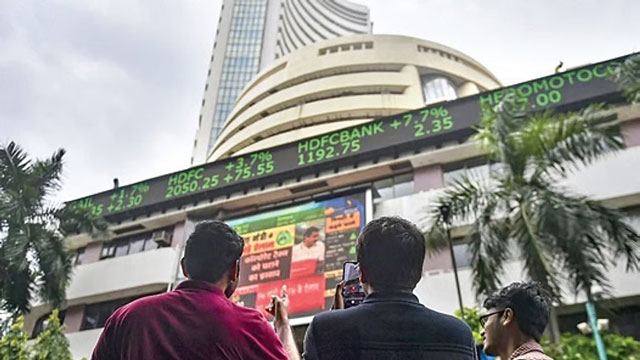
The BSE Sensex surged 9%, adding 7,080 points to close at 85,219, while the Nifty50 climbed 10.5%, gaining 2,485 points to 26,130. Despite these local gains, the performance was muted in a global context.
Major international markets outperformed India last year: the US Dow Jones rose 13%, the Nasdaq Composite jumped 26%, and China’s stock markets recovered 22%. Japan’s Nikkei 225 surged 28%, Taiwan gained 27%, while standout performers like South Korea’s Kospi and Spain’s IBEX soared 76% and 48%, respectively.
A sharp depreciation in the Indian rupee further curtailed returns for foreign investors, reducing Nifty’s dollar-denominated gains to roughly 5.5%, nearly half of its local-currency performance.
The market grappled with multiple challenges last year. Geopolitical tensions, including the Iran-Israel conflict and rising India-Pakistan hostilities, weighed heavily on investor sentiment. US trade policy ambiguities, coupled with President Donald Trump’s steep tariff measures, stalled the proposed US-India trade deal, adding to uncertainty. Foreign institutional investors (FIIs) pulled out Rs 1.44 lakh crore, intensifying pressure on the market.
Domestic factors provided some relief. Domestic institutional investors (DIIs) infused over Rs 7 lakh crore, cushioning the impact of FII outflows. Lower crude prices and steady domestic fundamentals also supported the market, especially in the closing quarter of 2025.
Analysts remain cautiously optimistic for 2026, expecting easing geopolitical tensions and potential tariff moderation to support equities. However, concerns over the US-India trade deal, potential rupee weakness, and global monetary developments, including Japanese bond yields, may cap upside.
India, the world’s fourth-largest equity market by valuation, continues to navigate a challenging global and domestic landscape, balancing foreign outflows with strong domestic participation.