Daijiworld Media Network – New Delhi
New Delhi, Dec 12: A fresh political storm erupted on Friday after the Congress strongly countered Union Home Minister Amit Shah’s allegation of “vote chori” involving Jawaharlal Nehru, calling the charge a “blatant lie”. The party cited noted historian and former MP Rajmohan Gandhi’s detailed clarification, asserting that the 1946 Congress presidential election had no connection to the prime ministership.
Congress communication in-charge Jairam Ramesh took to social media platform X to share a video of Rajmohan Gandhi — grandson of Mahatma Gandhi — where he debunked the claims made in Parliament. Ramesh said the historian had exposed “one more falsehood” levelled by the Home Minister.
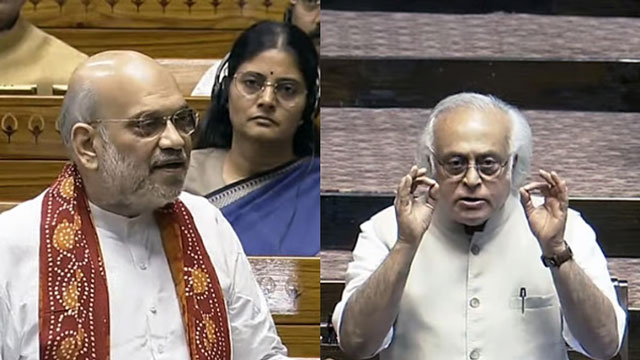
In the 13-minute video, Rajmohan Gandhi explained the political context of the time, pointing out that Pradesh Congress Committees (PCCs) were tasked only with recommending names for the Congress president, not the prime minister.
Rajmohan Gandhi highlighted that after the Quit India movement, thousands of political prisoners were released in 1945 and Maulana Abul Kalam Azad continued as Congress president since 1940, as the party had been banned during the struggle.
In 1946, when the question of electing a new Congress president arose, several PCCs proposed Sardar Vallabhbhai Patel’s name, while a few supported Acharya Kripalani. Notably, none proposed Nehru’s name at this stage.
“The issue of prime ministership was simply not under discussion,” he stated, adding that British–Indian negotiations were still underway.
Rajmohan Gandhi explained that Mahatma Gandhi traditionally reviewed the names proposed by PCCs and suggested the final choice, which was usually accepted unanimously. He stressed that this system — though debatable — was the norm at the time.
Gandhi ji requested both Patel and Kripalani to withdraw their names, and they reportedly did so without hesitation. The Working Committee then proposed Jawaharlal Nehru as Congress president.
“When the agreement with the British was finalised, Nehru, as Congress president, was the natural choice to form the government,” he added.
Countering claims that Patel was the true choice for PM, Rajmohan Gandhi said no historical records, resolutions, or newspaper reports indicated any such dissatisfaction. “People were very happy with Nehru becoming prime minister — Sardar Patel included,” he said.
He also referenced Patel’s October 1950 speech in Indore, where the Iron Man reportedly said that Gandhi’s decision to make Nehru leader was correct and beneficial for the country. Patel passed away two months later in December 1950.
The controversy began when Amit Shah, during a Lok Sabha debate on election reforms, alleged instances of “vote chori” by Nehru, Indira Gandhi and Sonia Gandhi. He claimed that Patel received 28 votes and Nehru only 2, yet Nehru became prime minister — a remark that sparked uproar in the Opposition benches.
Congress dismissed these allegations as “fiction” and “political distortion”, reiterating that the 1946 process had no bearing on PM selection.
With Rajmohan Gandhi’s historical account adding fresh weight to Congress’ rebuttal, the debate over one of India’s most pivotal political transitions has once again taken centre stage in the national narrative.