Daijiworld Media Network – Mangaluru (NJC)
Mangaluru, Nov 29: Growing communalism, economic inequality, electoral malpractice and the weakening of democratic institutions came under sharp criticism at a discussion held as part of Jananudi-2026 at Bishop Jathanna Auditorium in Mangaluru.
Political leaders from different ideological backgrounds called for collective action to safeguard democracy and uphold constitutional values amid mounting challenges.
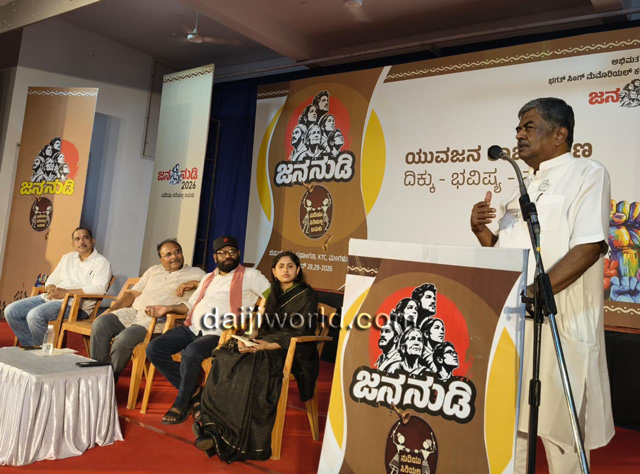
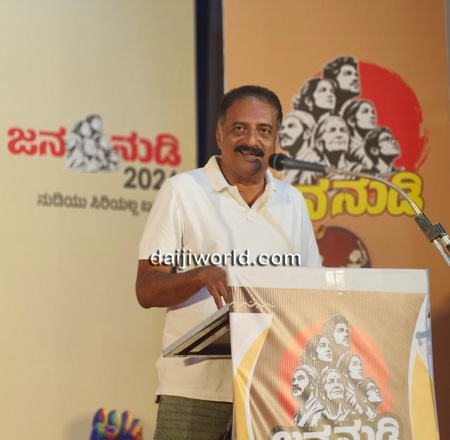
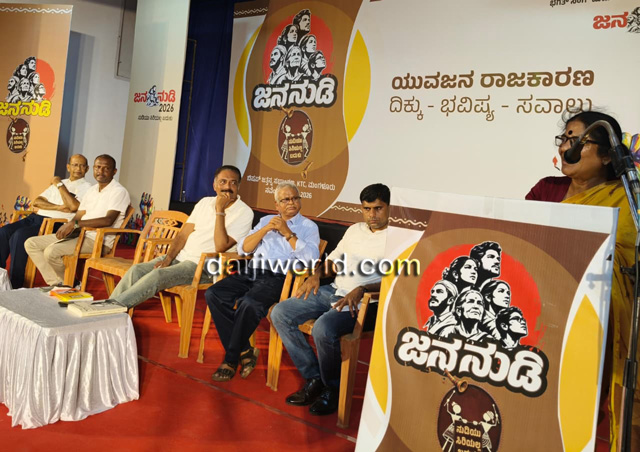
The session, titled ‘The Survival and Decline of Democracy – The Role of Ideologies’, featured senior Congress leader and KPCC chief B K Hariprasad, CPI state secretary Sathi Sundaresh and CPI(M) state secretary Dr K Prakash, who examined the challenges confronting Indian democracy from their respective political and ideological perspectives.
Hariprasad flags communalism, money power and concerns over Election Commission
Addressing the gathering, B K Hariprasad stressed that Indian democracy was still relatively young and needed constant protection. He identified fundamentalism, communalism and religious polarisation as major challenges to democratic values.
Highlighting the growing influence of money in elections, he said democracy could not survive unless the nexus between money and votes was broken. He called for an end to vote-buying practices and urged the younger generation, particularly members of Generation Z, to take an active role in creating electoral awareness.
Hariprasad also questioned the independence of the Election Commission, alleging that changes introduced through the 2023 law governing the appointment of election commissioners had weakened its autonomy. He particularly criticised the exclusion of the Chief Justice of India from the selection committee.
Expressing concern over attempts to impose uniformity through initiatives such as ‘One Nation, One Election’, he alleged that democratic institutions, freedom of expression and constitutional values were coming under increasing pressure.
He also called for greater representation of Dalit, backward-class and tribal women under the proposed women's reservation framework.
Sundaresh highlights widening rich-poor divide, housing crisis
Focusing on social and economic inequality, CPI State Secretary Sathi Sundaresh said India had yet to realise the ideals of political, social and economic democracy.
Drawing attention to the stark contrast between luxurious multi-storey residences and families living in abject poverty, he said the widening gap between the rich and the poor exposed the limitations of the existing economic system.
He also highlighted Karnataka's housing crisis, pointing out that lacs of families continued to live without proper homes.
Arguing for a socialist approach to strengthening democracy, Sundaresh said resources and opportunities needed to be distributed equitably to ensure social and economic justice.
Prakash flags threats to federalism, warns against privatisation of public services
CPI(M) state secretary Dr K Prakash focused on the challenges facing India's federal structure. He alleged that the financial autonomy of states was being undermined by changes in centrally sponsored schemes and growing dependence on private participation in public services.
He also raised concerns over contractual employment, outsourcing and the proposed introduction of the Public-Private Partnership (PPP) model in government medical colleges across 11 districts of Karnataka.
Criticising neoliberal economic policies, Prakash said the excessive emphasis on profits had weakened the focus on public welfare, particularly in the vital sectors of education and healthcare.
Calling for collective resistance to neoliberalism, communalism and fascism, he stressed the need for unity among Left, democratic and secular forces to safeguard constitutional principles and democratic institutions.
Unity among democratic forces stressed
Presiding over the programme, Dr B R Manjunath said the changing political circumstances had made it increasingly necessary for parties with differing ideologies to come together to defend democratic values.
He observed that the challenges posed by the BJP and RSS had made such unity a historical necessity.
The discussion brought together leaders from different political traditions to deliberate on the state of Indian democracy, growing socio-economic disparities and the need to protect constitutional institutions and democratic principles.
Dhanalakshmi Devaraj compered the programme.