
Taxation is key to financial planning, but not all your income may be taxable. The Income Tax Act of 1961 allows certain kinds of income to be exempted from paying tax, which helps you plan your finances in a better manner. It is useful to understand various sources of tax-free income so that you may optimise your taxation.
Whether you are preparing for your retirement life, safeguarding the future of your family members, or investing in your diverse investment portfolio, it is important to have information about taxable and non-taxable income.
What Is Tax-Free Income in India? **
Tax-free income, or non-taxable income, means that certain incomes do not come under the purview of income tax according to the rules of the Income Tax Act. There are some incomes that are fully exempted from taxation, while others are eligible for non-taxation provided certain criteria are met.
These exemptions will help them take informed decisions regarding finances and invest in their financial planning in a way that they save on taxes.
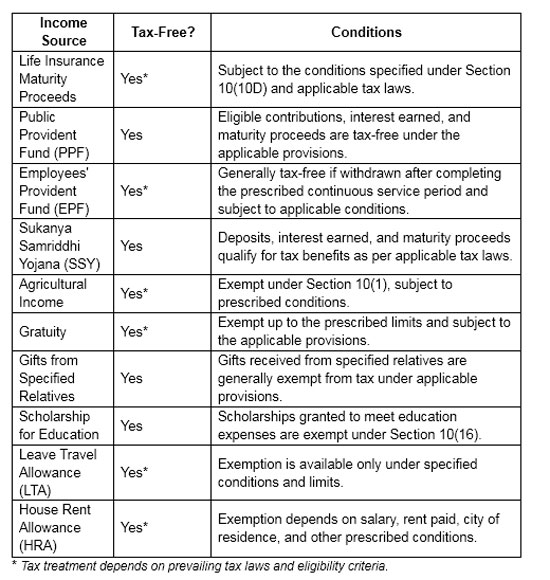
Quick Comparison: Common Tax-Free Income Sources in India
Different types of income qualify for tax exemption under different provisions of the Income Tax Act. While some incomes are fully exempt, others remain tax-free only if certain conditions are met. The table below provides a quick overview.
What Are the Top 10 Tax-Free Income Sources in India? **
1. Life Insurance Maturity Proceeds
The maturity amount received from eligible life insurance policies is one of the most common tax-free income sources in India. As per Section 10(10D) of the Income Tax Act, maturity amounts along with bonuses received from the life insurance policy will be tax-exempt subject to the fulfillment of certain conditions.
In addition to ensuring financial security for your family members, life insurance policies can help build wealth and do so in a tax-efficient manner.
2. Public Provident Fund (PPF)
The Public Provident Fund (PPF) is an investment avenue that is backed by the government and qualifies for Exempt-Exempt-Exempt (EEE) status. Investments made in PPF, the income generated, and the returns on maturity are exempt from taxes as per the relevant laws.
PPF can be termed as one of the safest options for making investments and also generates income that is tax-free for individuals planning their retirement.
3. Employees' Provident Fund (EPF)
The Employees' Provident Fund (EPF) is yet another source of tax-free income for salaried individuals. If the requirements are fulfilled, any withdrawal of EPF post completion of the required tenure period, together with the interest thereon, is usually non-taxable.
Apart from helping employees save up for their retirement, EPF is an excellent tool for tax savings.
4. Gratuity Received from Your Employer
Gratuity is a retirement scheme whereby the employer pays the employee after completion of the specified period of service. The amount received is either fully or partially tax-exempt depending on the exemptions and the category of employment.
Since gratuity is a retirement allowance, it helps in achieving financial stability as well as minimizing tax liability for qualified employees.
5. Agricultural Income
Agricultural income from land in India typically qualifies for tax exemption under Section 10(1), provided specific conditions are met. Even though it is an exempt income, it is considered while computing the rate of tax if the individual derives income that is taxable.
6. Sukanya Samriddhi Yojana (SSY) Maturity Amount
The Sukanya Samriddhi Yojana is a savings scheme introduced by the government to ensure the financial security of the girl child in the future. Eligible amounts, accumulated interest, and maturity money earned from the scheme are tax-free, thus providing a lucrative investment avenue.
For families planning for future educational and marriage expenses, SSY provides an effective savings scheme.
7. Unit Linked Insurance Plans (ULIPs)
Eligible unit-linked insurance plans offer both life insurance and market-linked investments. Based on the prevailing rules of taxation and the amount of premiums, the maturity gains of such ULIPs could qualify for exemption according to Section 10(10D).
If an investor is interested in wealth creation and insurance coverage, he/she could use the eligible unit-linked insurance plans as yet another source of tax-free income.
8. Leave Encashment on Retirement
Encashment earned at the time of retirement by government employees is normally completely exempt from tax. In the case of non-government employees, the limit for tax exemption will be as per the prescribed limit under the Income Tax Act.
Knowing about these limits helps the employees plan better for their retirement while improving overall financial planning.
9. Scholarships for Education
According to Section 10(16), the scholarships awarded for educational expenditure are not taxable irrespective of the amount that has been received. The reason is that such scholarships are considered to be received with an educational motive.
The other aspect related to the scholarship is that it also comes under tax-free income due to a reduction in the cost of education.
10. Certain Government Compensation and Welfare Benefits
Certain forms of government compensation, welfare benefits, and certain family pensions are exempted from taxation under the Income Tax Act as well. The form of tax treatment is determined by the nature of the payments and the laws regulating the same.
Taxpayers need to consult the most recent regulations in order to establish if the above payments are tax-exempt income.
How Can You Maximize Tax-Free Income Through Smart Financial Planning?
Even though getting money that is exempt from tax is advantageous, proper selection of the type of investment to make is also critical. Investing in a variety of schemes, including PPF, EPF, qualifying life insurance schemes, and ULIPs, will help you reach your financial objectives and be more tax-efficient.
It is also recommended to keep yourself aware of current tax rules, as changes can be made to the amount of the exemption limit and its qualifications from time to time. Before making any investment, you should calculate the taxes using the income tax calculator.
Conclusion
The knowledge about various sources of tax-free income is useful for making wise decisions and ensuring that you save more in the long run. Tax-free income may be derived from such sources as life insurance policies, provident funds, gratuity, government savings schemes, and qualified unit-linked insurance plans.
When investing, make sure you comply with the recent tax regulations and the eligibility criteria. The use of several sources of tax-free income, along with careful financial planning, will allow you to lower your taxes, increase wealth, and come closer to your financial objectives.
** Tax benefits are subject to the prevailing tax laws and regulations, which are subject to change.
Frequently Asked Questions
Is life insurance maturity amount tax-free?
Life insurance maturity proceeds may be tax-free under Section 10(10D) of the Income Tax Act if the policy satisfies the prescribed conditions. However, certain high-premium policies and specific cases may not qualify for full exemption. It is advisable to check the applicable provisions before filing your income tax return.
Is PPF completely tax-free?
Yes. The Public Provident Fund (PPF) is generally considered an Exempt-Exempt-Exempt (EEE) investment. Eligible contributions qualify for tax benefits under Section 80C, while the interest earned and maturity proceeds are generally exempt from tax, subject to applicable tax laws.
Is EPF taxable after five years?
Generally, withdrawals from the Employees' Provident Fund (EPF) after completing five years of continuous service are tax-free, subject to the applicable provisions of the Income Tax Act. Withdrawals before completing the prescribed period may attract tax under certain circumstances.
Is gratuity always tax-free?
No. Gratuity is not always fully tax-free. The exemption depends on factors such as the employee's category, the amount received, and the applicable limits prescribed under the Income Tax Act. Any amount exceeding the eligible exemption limit may be taxable.