Daijiworld Media Network – Rome
Rome, Jul 27: Researchers from Italy have developed a new chiral organic material that exhibits an exceptionally strong optical response in thin films, a breakthrough that could accelerate the development of next-generation optoelectronic and spintronic devices, including circularly polarised OLEDs, photodetectors and advanced electronic components.
The study was carried out by Gianluigi Albano of the University of Parma, Lorenzo Di Bari of the University of Pisa and their collaborators.
The research focuses on chiral organic π-conjugated materials, which have attracted growing interest for their potential applications in circularly polarised organic light-emitting diodes (CP-OLEDs), circularly polarised organic photodetectors and spintronic devices that utilise the chirality-induced spin selectivity (CISS) effect. However, producing stable and intense chiroptical responses in thin films has remained a major scientific challenge.
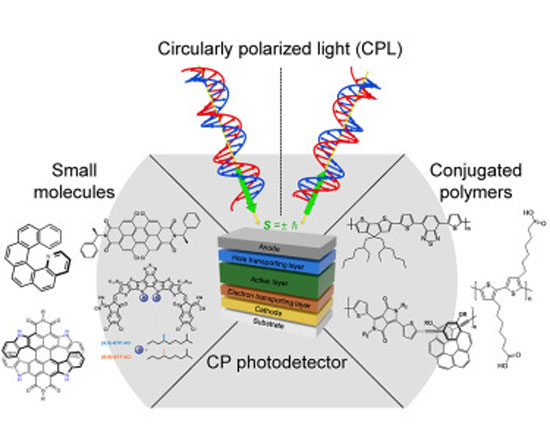
To address this, the researchers developed a new dye known as chiral indaceno[1,2-b:5,6-b′]dithiophene bis-thiophenylpropynone (IDT-TPO). The molecule combines a rigid indacenodithiophene core with two thiophenylpropynone units that act as the light-absorbing chromophore. Chirality was introduced using enantiopure side chains derived from natural citronellol.
The material was synthesised through a five-step process starting from commercially available indacenodithiophene.
The researchers found that while the dye remained optically inactive in solution, its behaviour changed dramatically when deposited as a thin film. Simply allowing the films to age at room temperature caused them to spontaneously reorganise into highly ordered structures with an exceptionally strong chiroptical response.
After 24 hours, drop-cast films exhibited an ellipticity of 18,000 millidegrees, one of the highest values reported for thin films made from neat chiral small organic molecules. The films also displayed dissymmetry factors exceeding 0.1 and reaching as high as 0.3, indicating highly efficient interaction with circularly polarised light.
To understand the phenomenon, the team employed advanced characterisation techniques, including circularly polarised microscopy and synchrotron radiation Mueller matrix polarimetry imaging at the Diamond Light Source in the United Kingdom, along with time-dependent density functional theory calculations.
The analysis revealed that the giant optical response resulted from the spontaneous formation of highly ordered right-handed helical supramolecular structures during the ageing process.
Unlike similar materials studied previously, where optical activity mainly arose from two-dimensional molecular arrangements, the new material derives its strong response from intrinsic three-dimensional chiral organisation, producing homogeneously distributed structures throughout the film.
The researchers also observed an unexpected relationship between film thickness and performance. The strongest optical response was achieved in a relatively thin film measuring about 400 nanometres rather than in the thickest samples, a finding that could prove advantageous for practical optoelectronic devices, where excessively thick active layers often reduce performance.
The researchers said the study demonstrates that exceptionally strong chiroptical properties can be achieved through a simple room-temperature ageing process without requiring complex post-deposition treatments.
They believe the findings offer fresh insights into the design of chiral organic materials and could contribute to the development of more efficient optoelectronic, photonic and spintronic technologies in the future.