Daijiworld Media Network – Gaza
Gaza, Dec 3: In the shattered landscape of southern Gaza, 54 Palestinian couples walked hand-in-hand through the rubble on Tuesday, celebrating a mass wedding that offered a rare glimmer of hope after two years of relentless conflict.
Among them were 27-year-old Eman Hassan Lawwa, dressed in traditional Palestinian prints, and Hikmat Lawwa, wearing a suit as they joined the procession in Khan Younis. “Despite everything that has happened, we will begin a new life,” Hikmat said, expressing hope that the ceasefire will mark an end to the turmoil. “God willing, this will be the end of the war.”
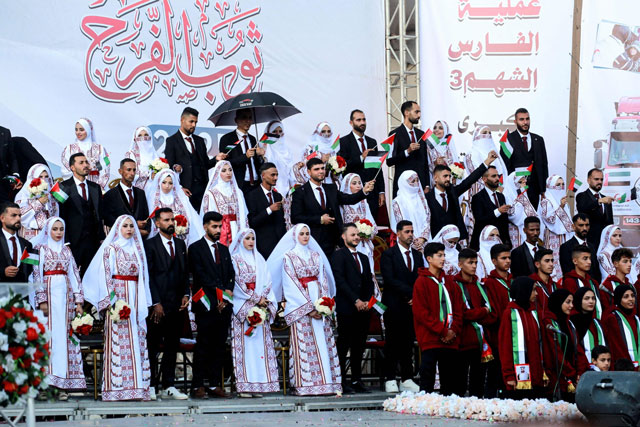
Weddings—an essential part of Palestinian culture—had nearly disappeared during the war. Now, even as the fragile truce holds, celebrations have returned in much simpler forms. Yet, for many, the joy is overshadowed by Gaza’s dire humanitarian crisis. Nearly all of Gaza’s 2 million people, including the young couple, have been displaced. Cities lie in ruins, and daily life remains marred by shortages of food, shelter and medical aid.
The Lawaas, who are distant relatives, fled to Deir al-Balah during the war and have struggled for basic necessities. “We want to be happy like the rest of the world,” Hikmat said. “I used to dream of having a home, a job… today, my dream is to find a tent to live in.” He added that even though life is slowly returning, “it’s not like we hoped it would.”
The mass celebration was organised by Al Fares Al Shahim, a UAE-backed humanitarian initiative, which provided the couples with modest financial assistance and essential supplies to begin their married lives.
Traditionally, Palestinian weddings are elaborate, days-long festivities filled with music, dance, and community gatherings. According to Randa Serhan, a sociology professor at Barnard College, weddings also symbolize resilience. “With every new wedding will come children, and it means that the memories and lineages are not going to die,” she said. “The couples are going to continue life in an impossible situation.”
On Tuesday, decorated cars carrying the couples moved through devastated neighbourhoods as families danced and waved Palestinian flags. Eman, dressed in white, red and green, said the celebration brought momentary relief from years of suffering but admitted the pain of losing her parents and other relatives in the war hung heavily over her.
“It’s hard to experience joy after such sorrow,” she said, tears rolling down her cheeks. “God willing, we will rebuild brick-by-brick.”