October 8, 2026
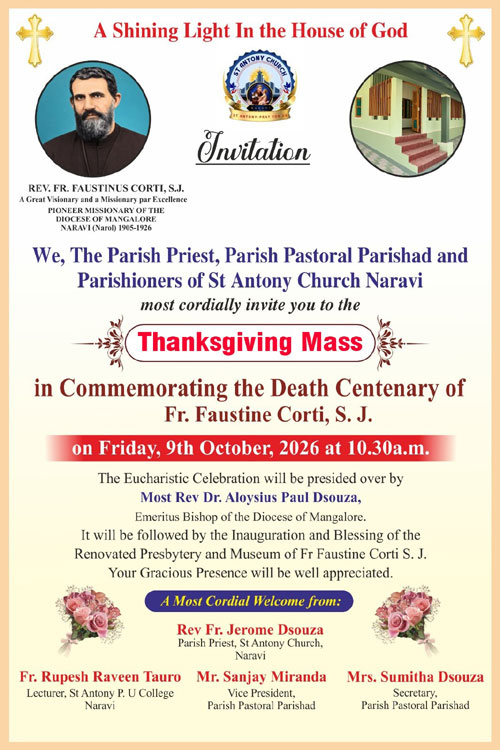
Exactly a hundred years ago, a Jesuit priest, suffering with fever, breathed his last on Saturday, 9th October 1926. That Jesuit was Fr Faustine Corti, SJ — a missionary from Switzerland who, for his service, earned the affectionate names — “Mansere Guru” (the priest of Pariahs or the Guru of Harijans) and “Living God” from the poor of Naravi and the hills around it.
An unlikely calling
Born on 5 November 1856 in Curio, Switzerland as the ninth child of Francis and Lucy, Corti lost his mother at eleven, and his father — needing him at home in his old age — refused to let him join the Jesuits, until he secretly slipped out and joined the order in 1878. Word of the Jesuit mission in far-off Mangalore reached him during his formation, and never left him. He reached Mangalore in 1884, and spent his first two years at Jeppu, learning and teaching Tulu and Konkani. He was ordained a priest in 1891 and spent a decade teaching mathematics at St Aloysius College — steady, respectable work that gave him nothing but restlessness for the mission field.
To Naravi, and a change of heart
His chance came in 1905, when he was sent to Naravi, a remote town in the foothills of the Western Ghats some 70 km from Mangalore. Corti’s earliest strategy was similar to the famed missionary Robert de Nobili’s — to immerse himself among the people, expecting a trickling-down effect. After Two years, he was happy to see the fruit of his labour. Corti turned to the Pariahs and the people who are the region’s most marginalised communities, and found his true ministry there.
A life stripped bare
Corti lived in the same conditions as they did — his hut had no bed, table or chair, except a mat on which to sit, a few medicine bottles and, always, people around him. He fed his own cooked rice to children who wandered in at mealtime, and served food on old newspapers — for want of plates. He once even gave his cassock to clothe a Pariah man who had none. When his Bishop, surprised at his poverty, asked what he needed, Corti’s answer was simply — an umbrella!
He taught catechism so that the people would know about the Christ and the Church. When the dreaded smallpox broke out in the Dalit settlement at Ramara Guttu, he lived in their huts and nursed them through the plague, rather than taking a safe distance.
Kempi- His horse
No story of him can be complete without Kempi, his horse — so devoted that she once launched him — and herself — into a swollen river to outpace those who against Fr Corti — just in time for him to reach the court and win a case for a Dalit client. She avoided a pit dug to kill them both, on another occasion.
A fight with the abusers, and recognition
Corti’s fight for the rights of the Dalits made him an enemy of others. He fought for the rights of the Dalits. For his work for the Dalits, the government awarded him the Kaisar-i-Hind Medal (sources differ on the year — 1911 and 1918 are both cited), but the recognition is well-documented. His circuit widened to include Moodbidri, Perady, Shirthady, Alangar, Arva, Badyar, Venor, Madanthyar, Ujire, Penchar, Nellikar and Homapadavu. In 1920, still based out of Naravi, he started the mission at Alangar, spending a few days there each month to catechise the local families, and started St Thomas School.
A parish takes root, and a memory that lasts
The tiny substation chapel which once served for Corti’s needs was declared an independent parish and mission station in December 1928. The new church building work started on 6 January 1929, which was blessed and opened on 7 May 1930, along with a convent built alongside it. Fr Corti did not live to see any of this. Because he had no rest during his missionary work. He died on 9th October 1926. Naravi did not forget him — and his name lived on as 'Mansere Guru'. In 2012, Mangalore Diocese Bishop Dr Aloysius Paul D’Souza (presently Bishop Emeritus) unveiled a statue of Fr Corti at Naravi.
A hundred years on from his passing, the small Catholic communities scattered across the hills which he once traversed on Kempi, continue to carry pieces of his memory with them, even as they face the ordinary struggles of the rural parish life. And on his death centenary, that seems to be the fitting question to ponder — whether the debt owed to a man like Fr Corti is best paid in monuments, or in the continued, unglamorous work of tending to the people he gave his life to.
Sources: Unpublished article ‘A Study on Father Corti and His Work’ (Mr Urban D’Souza, St Aloysius College, Mangalore); Daijiworld; Deccan Herald; St Antony Church, Naravi; Diocese of Mangalore; Karnataka Jesuits Province archives.