September 16, 2026
No matter how much progress a country makes in any field, that progress is meaningless if its benefits don't reach the common citizen. India is achieving unprecedented progress on the global stage in economy, space research, and digital infrastructure. However, the country's healthcare delivery system remains fragmented and financially unaffordable for ordinary citizens even today. Despite governments formulating hundreds of schemes on paper, the poor still find themselves dependent on public crowdfunding on social media for hospital bills. It is in this context that "One Nation, One Health" (ONOH) has been proposed — a plan designed to provide every citizen of the country with equal and free healthcare.
Satwaadi Mithun Shetty, an emerging social activist from Kundapura, prepared a comprehensive policy proposal on this subject and submitted it through the Central Government's Centralized Public Grievance Redress and Monitoring System (CPGRAMS), to which India's National Health Authority (NHA) responded positively.
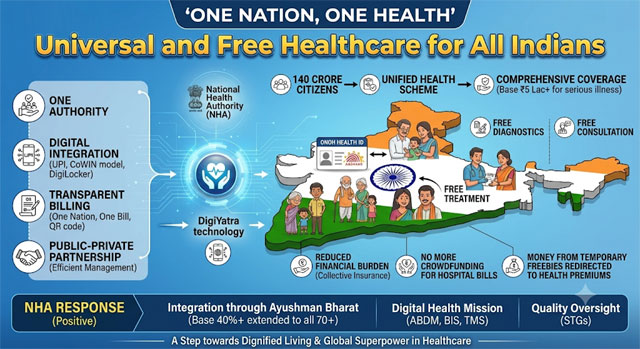
AI-generated image
Currently, central and state governments together run more than 150 different health schemes. Since each scheme has its own separate rules, eligibility criteria, and enrollment processes, this has caused confusion among citizens.
The main objective of the ONOH concept is to bring all these scattered schemes under one roof. It includes the following key reforms:
- One Nation, One Authority: Establishing a centralized system to manage the country's health policies and fix accountability.
- One Health Scheme: A single scheme applicable to every Indian, replacing the 150+ schemes currently in operation.
- Universal and Free Coverage: Providing free health insurance to every citizen regardless of income, age, caste, or gender.
Proposed Key Reforms and Mechanism
To successfully implement this plan, the proposal suggests several transformative measures:
- Use of digital infrastructure: India has already successfully managed large digital systems such as UPI, Aadhaar, and CoWIN. On the same model, the 'DigiYatra' technology used at airports could be used for patient identification in hospitals. Patients' medical history and records could be securely stored through 'DigiLocker' and a 'Briefcase App'.
- Transparent billing system: The proposal suggests implementing a "One Nation, One Bill" system nationwide. Assigning an Aadhaar-style unique code and a fixed rate to every surgery and medical device would put a check on unnecessary billing malpractices by private hospitals.
- Public-Private Partnership (PPP): Leasing out existing government hospitals and primary health centres to efficient private entities could raise their standard of management, making top-quality treatment available to the poor as well.
Reducing the Financial Burden and Redirecting Freebies
A common argument is that providing free healthcare to the entire nation would be a huge financial burden on the government. However, according to the proposal, purchasing insurance collectively for 140 crore people would substantially lower premium rates.
In addition, the cost of temporary election-time freebies given by governments — such as TVs, bicycles, or cash transfers — could be cut, and that money redirected toward paying citizens' health insurance premiums. This is based on the principle that "temporary freebies last only a few days, but free healthcare lasts a lifetime."
Official Response from the National Health Authority (NHA)
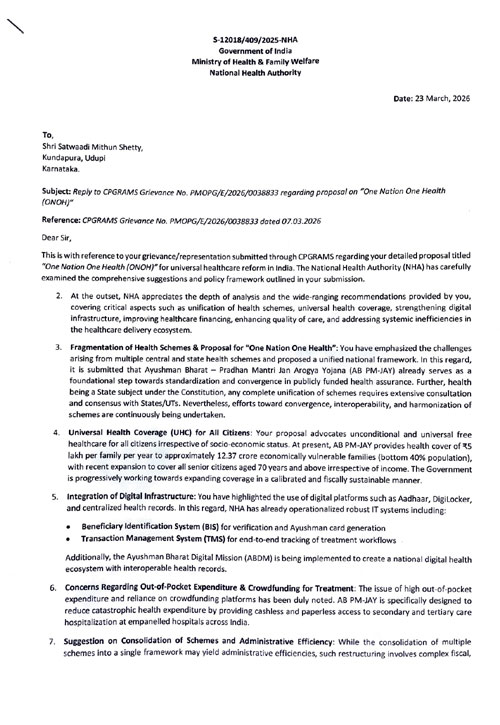
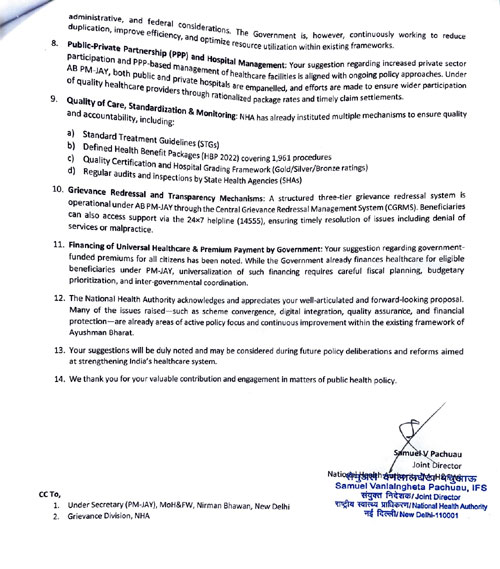
The National Health Authority, functioning under India's Ministry of Health and Family Welfare, reviewed Satwaadi Mithun Shetty's proposal and gave a highly positive response. In a letter sent by NHA Joint Director Mr. Samuel V. Pachuau, the depth of analysis in the proposal was praised.
In its response, the NHA outlined the measures currently in effect:
- Integration through Ayushman Bharat: The existing Ayushman Bharat scheme already covers 40% of the country's population at the base level (approximately 12.37 crore families), and has recently been extended to all senior citizens aged 70 and above without any income limit. This is described as a first step towards ONOH.
- Constitutional challenges: Since 'health' is a state subject under the Indian Constitution, bringing all state schemes fully under one umbrella requires the consensus of all states.
- Digital Mission implementation: As mentioned in the proposal, the 'Ayushman Bharat Digital Mission' is already in place to strengthen the digital health system. Under it, the Beneficiary Identification System (BIS) and Transaction Management System (TMS) are being successfully used.
- Quality oversight: Standard Treatment Guidelines (STGs) and a hospital rating system have been implemented to maintain quality standards in private hospitals.
In the world's largest democracy, the fact that citizens have to beg for money on social media for their own or their children's treatment reflects a national failure. Shockingly, more than ?4,500 crore has been raised for hospital expenses through various crowdfunding platforms over the past five years. Under the "One Nation, One Health" plan, since every family would be provided a minimum base insurance cover of ?5 lakh, with this limit automatically increasing in cases of serious illness, such hardships would find a permanent end.
Implementing "One Nation, One Health" requires only political will. Even though India's taxpayers continuously contribute to the national treasury, they are left helpless in medical emergencies. If this scheme is implemented, the financial security of middle-class and poor families would be strengthened.
The National Health Authority has assured that it will consider the key elements of this proposal — digital integration and universalization of insurance — during future policy formulation. For India to become a global superpower in healthcare and to ensure every citizen's right to live with dignity, the implementation of revolutionary policies like "One Nation, One Health" is essential.
The 'One Nation One Health' scheme must be implemented. Health insurance, being of utmost importance, must be made free for everyone. No one should have to beg for help from anyone.